Page 50 of 65

Featured writing

Revolutionary Road (Edward J Taylor)


1.

Not far from the American Embassy in Havana, mere steps from the body of water that proves narrower than ideology, stands a monument to the USS Maine, which exploded under mysterious circumstances in the city harbor over 100 years ago.  Upon the monument an American eagle once perched, until on a January day in 1961 its head was carried away by citizens equally carried away by revolutionary fervor.

It is easy to lose one’s head over Havana.  Travelers return from the city raving about the classic automobiles passing beneath old colonial period buildings.  Like most visitors, it was the cars that held the most appeal to me.  I’d first heard of them twenty years ago, over beers in Hanoi with an American whose boat had engine trouble, and was forced to dock in Havana for a few days for repairs.  So it was only fitting that one of these old automobiles was the centerpiece of one of my first views of the country, spied from a plane high above the open fields, as if I were reenacting the final scene of American Graffiti.

Here the American graffiti is the island’s relationship with its neighbor to the north, writ large upon every aspect of Cuban society.  The half-century long trade embargo had seemingly stopped the clock in 1960. More accurately, every so often somebody keeps turning the hands back.

There are few places on earth so stuck in time, a concept that has admittedly become a travel agent’s cliché.  They’ll tell you to go immediately, before the old is lost forever.  But how much more exciting to visit a place in the midst of change, as the traveler comes back less with the static memory of wandering a picture postcard, and more with the feeling of having connected with the flow of history.

I couldn’t have timed my visit better.  A week before I arrived, the first commercial flight in over half a century arrived from the US.  It landed just days after the death of Fidel Castro, who in taking control of Cuba in 1959 had caused those once regular flights to cease in the first place.

I’d booked my own ticket ten months before, not anticipating any of these events. The visa situation at that time called for a round-about approach, so I opted for a couple of days on the beaches of Cancun on either end of the journey, which admittedly wasn’t such a hardship.

José Martí Airport has a certain Third World vibe, and I smile at the irony of its 19th Century namesake having initiated the propulsion of Cuba toward the First.   I catch a faint whiff of cigar smoke the moment I exit the plane.  Bodies move noisily and chaotically through the hot, still air.   A father carries a shirtless child, limp and listless in his arms.  He is waved over to a table, which I presume is staffed by the quarantine squad.  I think of ZIKA and suddenly worry about the poor kid. Behind me a few pieces of luggage from our flight begin their turn on the carousel.  For some unexplained reason, no other bags will appear for the next 90 minutes.

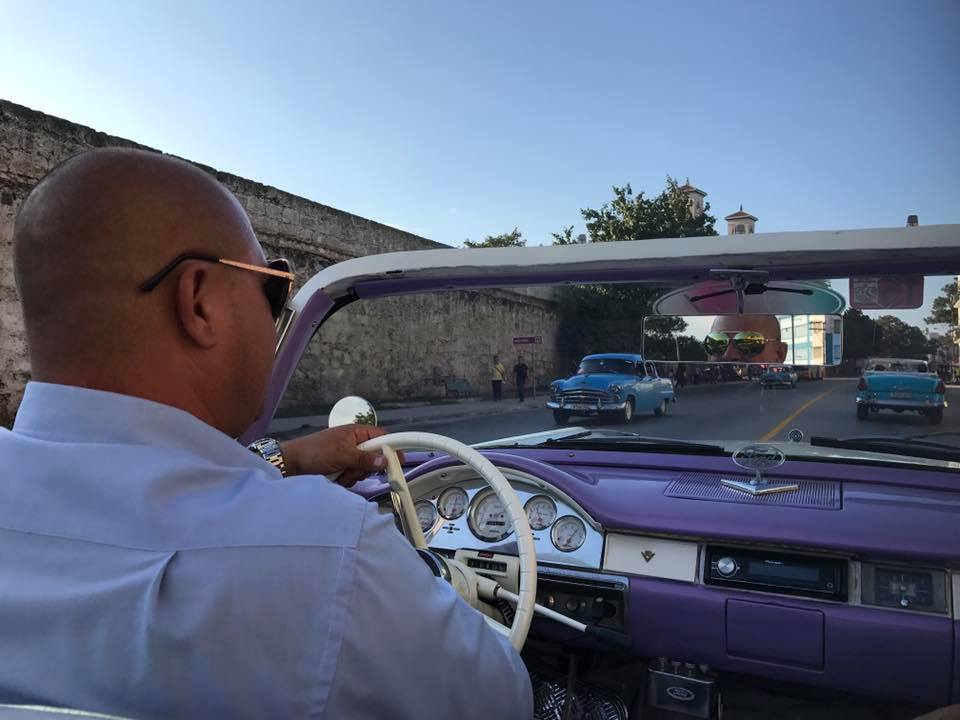
We arrive finally at our hotel, the plaza in front looking like a car lot circa 1958, filled with monsters of Detroit-made steel. Many of these beasts are now used as taxis, mainly for foreign tourists willing to pay the high fares.

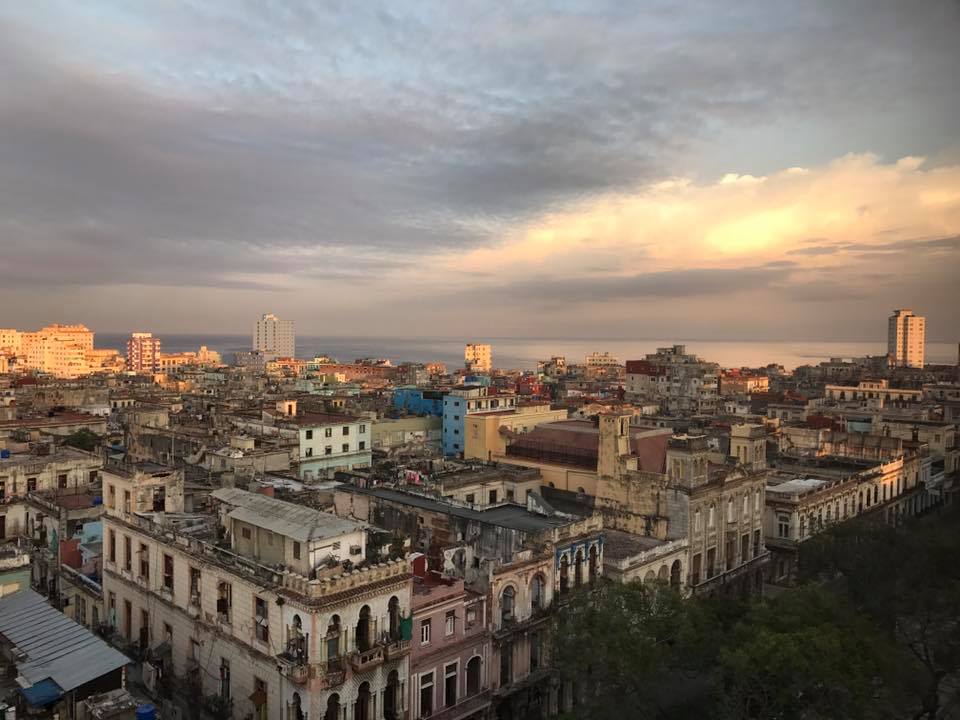
I’m not given much time to admire them as we are quickly shuffled over to the old town.  Habana Vieja is pedestrian friendly, and in the fading light, clusters of silhouettes move along the stone streets before 16th Century facades.  Most of the action seems to be up a single shallow alley where a half dozen restaurants are crammed, their sidewalk tables filled with boisterous foreigners high on rum and the easy Latin vibe.

We take our dinner in the far corner of the alley, inside Paladar Dona Eutimia, which appears to be an old home tricked out to serve meals.   So begins our introduction to Cuban service: slow, patient, unhurried.  This allows time for conversation, as well as drink, for that is the only element of the Cuban meal that arrives quickly. When it arrives, the food is heavy and rich, and goes well with red wine, Chileans having cornered that market.  From the very first, I fall in love with Cuban cuisine, a love consummated on this particular night with ropa vieja, shredded beef in a chili, tomato, onion and cumin sauce.  I am lucky to be traveling with other foodies, and the four of us are generous with our orders, rotating our plates every so often as if we are speed dating.  Well sated, we limit our selves to just two desserts.

After dinner we step into the neighboring Taller Experimental de Grafica gallery to admire the prints, having little context for Cuban art beyond that obsequious photo of Che.  Tired as we are from the travel, tonight is not the night to learn, so we step out before long, and pass the al fresco diners taking the night to the next level.   One table is unmistakably Russian. I am tempted to say hello, but press on toward the car.

It is a missed opportunity of sorts, for Russia, then the Soviet Union, was the one foreign country besides the US to have any regular interaction with Cuba over the years, though those relationships were polar opposite in nature.  So I am curious as to how the average Russian views Cuba, its vassal state of sorts, once a red flag to fly in the face of its long-term adversary.
2.

Second hand contact with a people through books or film can most certainly be informative, but one accepts these insights with some risk, filtered as they are through whatever baggage the writer brings to the project.  Far preferable to get out amongst the people and observe directly.  On this first full day we are to do just that, but with a twist.  We step out of the hotel and straight into a horse-drawn carriage.  My girlfriend and I hadn’t known about this, and agree that this isn’t our thing at all, but still we take the ride.  And so it was we began our spin around the city center, seated in the privileged position of the well-heeled colonist, looking down on our subjects.

The city itself takes revenge, the cars spewing choking exhaust.  Eyes and throat rebel as the unfiltered petrol enters our systems and does some colonizing of its own.  But in time, the beauty of Havana works as a remedy.   The first wave of travel books written after the revolution all talk of the city’s crumbling beauty, but by 2016 an obvious attempt has been made to clean things up.  In most cases around the world, this restoration is done by wealthy foreigners who have bought properties.  But in Cuba, this has yet to begin on a large scale, as investors cautiously negotiate Cuban law, and it wasn’t until very recently that Cubans themselves could own their own home.  As it is, all properties for sale have already been renovated, and despite passing a great number of these obviously empty buildings, the streets below are bustling filled with locals just going about their day, still somewhat oblivious to a pair horse-drawn carriages pulling past, their occupants wearing sunglasses and trying not to breathe.

We wheel through El Barrio Chino, which has only a handful of Chinese anymore, with nary a dragon to be seen, nor the color red.  To me, the architecture that most impresses is the French Baroque, which adds nice flourishes to the Spanish colonial which it dwarfs.  The gem of them all is the Capital Building, modeled on the dome of its twin in DC.  And of course, old Detroit classics line every street, and on every other street stands one broken down, hood open.  The dull hum emitting from those that do run hint at a horsepower far greater than that which bears us.  Still, the cadence of the hooves is hypnotic, and as they carry us to the next destination, they take on the sound of boots on the march.

I had been looking forward to visiting the Museo de la Revolution, since I am intrigued by the absurd superlatives of propaganda and the glorious monuments they spawn.  With Cuba’s proximity to its greatest enemy, I was expecting the heights I’d seen in a similar museum in Hanoi, with its photographs of dead children and jars containing fetuses twisted by Agent Orange.  But this one is somewhat subdued, with near empty rooms displaying a few photos and jungle-tattered clothing and equipment. It is as if the success of the revolution spoke for itself.  The structure that houses it had once been Batista’s Presidential Palace, and from its design you can see the former dictator had a Versailles fetish, if Versailles had been designed by Tiffany’s. Today, the famous ballroom is playing host to a party of generals who have gathered along with Minister of Defense, who politely declines my friend’s request to be included in a photo. Who knows to what purpose such a photo might be used?

Our horses draw their rest at Habana Vieja, and we are let down to wander its stone covered streets.  This is of course Havana’s real treasure, and its carefully planned restoration project has earned it a UNESCO rating, not to mention hundreds of tourists.  Despite this latter fact, there is no begging, nor any pushy touts.  The biggest danger I’m told is getting bullied into taking a photo with the cigar-chomping women who look as if they just stepped off a Chaquita banana label.  Thus we go unmolested through this veritable architectural museum, popping into the odd museum and café, perusing the photos of Hemingway inside the Hotel Ambos Mundos, where Papa is said to have written For Whom the Bell Tolls.  The street before the Plaza d’ Armes is laid with wood, used at one time to soften the sound of horses’ hooves.  Along this stretch dozens of book stalls, each one busy and a testament to Cuba’s high literacy rate.  Upon the covers of many of these can be seen one of the Bearded Trio – Castro, Che, Hemingway.  As I lean in to have a look at one stall, its owner begins a chat and by its conclusion I’ve bought an old peso coin that bears the face of Che, who I’ve been told I resemble somewhat (sans beard).  The coin is worthless I know, but the dollar that I’ve given in exchange I see not as a scam but as a tip for an interesting encounter.

Our walk ends not far away, at the Plaza de San Francisco de Asis. The former church that gives the square its name is known for its remarkable acoustics and is now the setting for frequent concerts.  I am lucky to find a choral group at practice inside, and I stand mesmerized as the voice of one soloist traces the curves of the arched ceilings and the grooves of the pillars holding them up.

We have lunch adjacent, in the Café del Oriente.  The wooden bar, checkerboard tile floors, and deeply varnished tables simultaneously harken both 1950s New York and 1920s Paris.  A pianist visits both these periods with music that acts as a sort of flavor enhancer for yet another stunning meal.

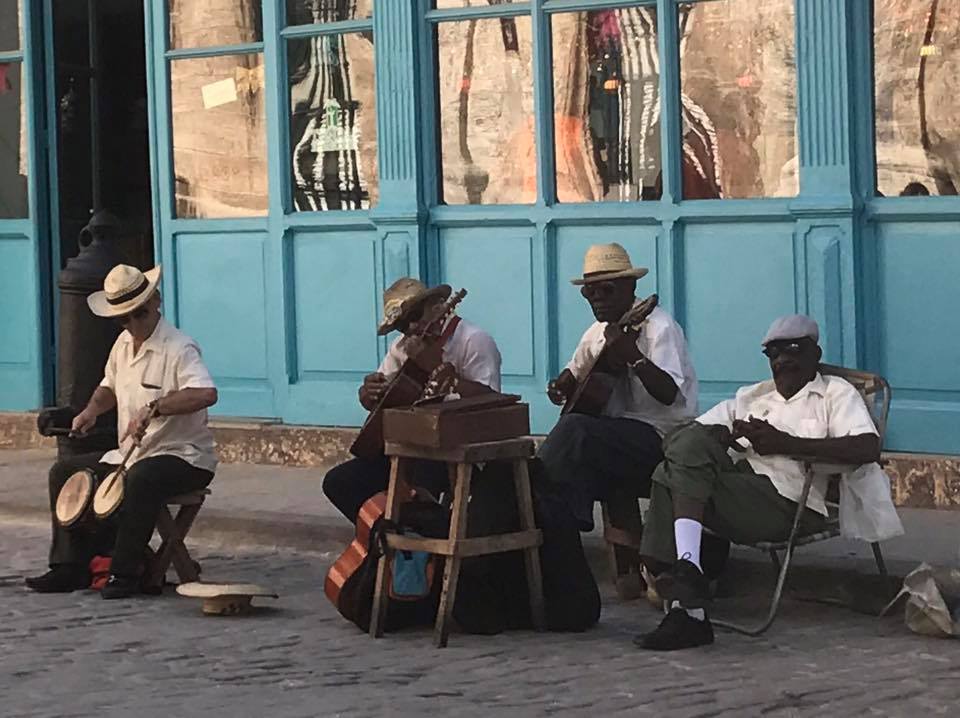
The wine has made me drowsy, and the thought of wandering through a market has no appeal.  While the other half our quartet shops, my girlfriend and I go in search of coffee, which we find in a converted warehouse down on a pier somewhere. To my delight I also find local craft beer.  Some of the other tables are drinking theirs from long yard glasses, and as they tip them skyward, it looks as if they are part of the horn section of the band creating heat on the stage.  The vocalist gyrates somehow in a dress three sizes too small, and somehow the horn section behind her isn’t distracted as they start and stop their parts on a dime.  This is my first encounter with Cuban music proper, and as has been oft-told, what has been caught on recordings is only part of the story.  (And during my time in Cuba, I never saw any musician that wasn’t of the highest talent.) It is hard to tear ourselves away, but it is time to dance.

On approach the street looked like a quiet residential street, and Casa del Son is discreetly located midblock. This former house has a half dozen rooms converted to studios, each lined with mirrors and hung with bright and colorful artwork.  We pass through the gyrating bodies of the entry room, and are led through its open-air labyrinthian corridors to a room in back.

For the next 90 minutes we are led through our paces by a small wiry man with a head shaved but for a lone patch at the pate, from which extends a stump of pony tail.  His tank top, quickness of speech, and hurky-jerky movement seems copped from the hipster streets of New York (though no doubt the reverse is more apt).   But man can he move!  Salsa isn’t such a difficult dance to learn, being little more than a quickened boxstep.  More than the footwork, the spirit of the dance is in the hips.  The movement is an invitation, a promise.  It is a dance to be danced with one you love, even if that love lasts a single night.  As it is, my own love is being twirled in the arms of another, and I am paired with a young woman whose eyes, and thoughts, are far away. Still, there is never a bad time to dance, and I spring rather than walk back toward the front door at the end of the lesson, body drenched in sweat which flows toward the earth to which I now feel far more connected.

We welcome the evening with drinks out on the terrace of the Hotel Nacional.  The drink in my hand is lost on me, this libation of the liberation, this Cuba Libre.  The well-known, fancy moniker doesn’t change the fact that it is simply a rum and coke, the drink of high schoolers, a sip of which conjures up the ghost of hangovers past. We sit here awhile, watching the sun lower itself over toward the Yucatan.  On the near empty stretch of the Malecon below, a horse carriage moves in the same direction, followed by an old Buick, then a red Chinese-built tour bus.  Bigger, faster airborne vehicles have just begun their passage across these waters before me, and with their coming, such quiet scenes are certain to cease.  I ponder the inevitable, as I empty the remainder of my drink onto the grass.
3.

The Caribbean is renowned for its easy, laid back nature, but Cubans take it to another extreme, raised as they are on long queues and systematic uncertainty.  If patience is a virtue, then Cubans must all be saints.  The only time I ever see anyone move beyond an amble is the morning it rains.  But even then they move only negligibly faster.

This is the day we were meant to commence our drive by heading along the Malecon, then on through Miramar with its big houses, former estates converted to embassies.  But our guide G tells us that we need to take an alternate route, as the Malecon would be flooded by now with storm-born waves. Instead we navigate the grander boulevards of the city, but even many of these are flooded due to the poor drainage system, the old cars stranded like dinosaurs in a tar pit.  Within, the passengers sit quietly in wait.

Free of the city, we move quickly but cautiously along the broad, well-cared for Autopista, heading west.  Even behind the wheel, no one seems in much of a hurry.  The rain and clouds begin to lift, revealing a flat land, unkept and shrubby.  It is surprising to see an almost desert-like quality to a Caribbean island. The hills begin to rise, but there is little else on the landscape.  There appear to be fewer old cars in countryside, but then again, there are fewer cars period.  Here and there, somebody is standing alongside the road with his hand in the air, clenching cash.  Road-trippers in Cuba act as impromptu taxis, and can pick up money for petrol by offering rides.  A lucrative act of charity, as many cars are packed six to eight in a vehicle.

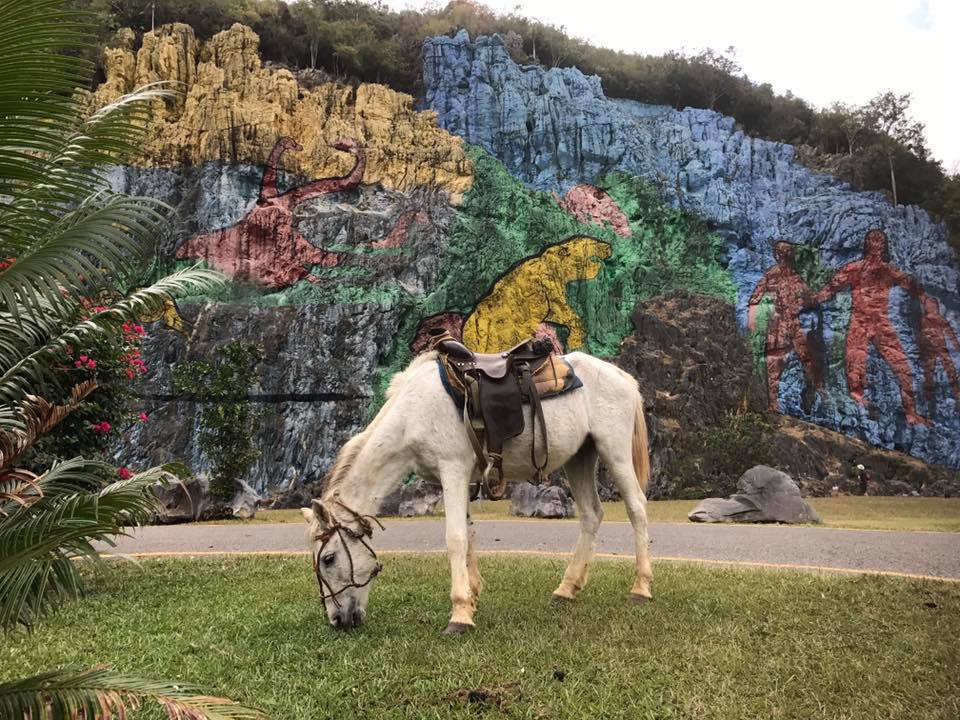
The landscape of Valles de Vinales truly impresses, its perimeter lined with tall and fragile limestone hills, pocked with caves.  We are shown one cliff face painted with colorful fossils, dinosaurs and prehistoric men.  Cats doze in the grass beneath, and we are offered rum in a small thatch hut nearby. (Every destination on our tour seems to include a rum drink.) There is more rum at our lunch stop, in a nameless restaurant alongside the highway.  The owner appears to be quite a character, entertaining a group of people with some uproarious tale.  We are not invited, which is just as well, allowing us to enjoy a quiet lunch alone with the scenery.  Eventually one of the guys comes out of the kitchen with a guitar, and leads into some of the better-known Cuban classics.  He seems to like my voice as I spontaneously join him on Guantanamera, so he hands me a pair of maracas. This soloist then promptly becomes part of a duet, and I enjoy helping him finish his set.   It is a reminder that in Cuba, music will always trump politics.

My favorite cultures are those that are the most musical, that find value in time dedicated to music.  In the sweep of the rat-race, it is difficult to find time to pick up a guitar.  And Vinales represents this, a place where traffic moves at the pace of a horse’s tail.  Pony carts ferry people past rows of bungalows, each with wide porches and brightly colored rocking chairs.  This is the greatest resource of the valley, the scenery, and the rocking elliptical flow of the day.

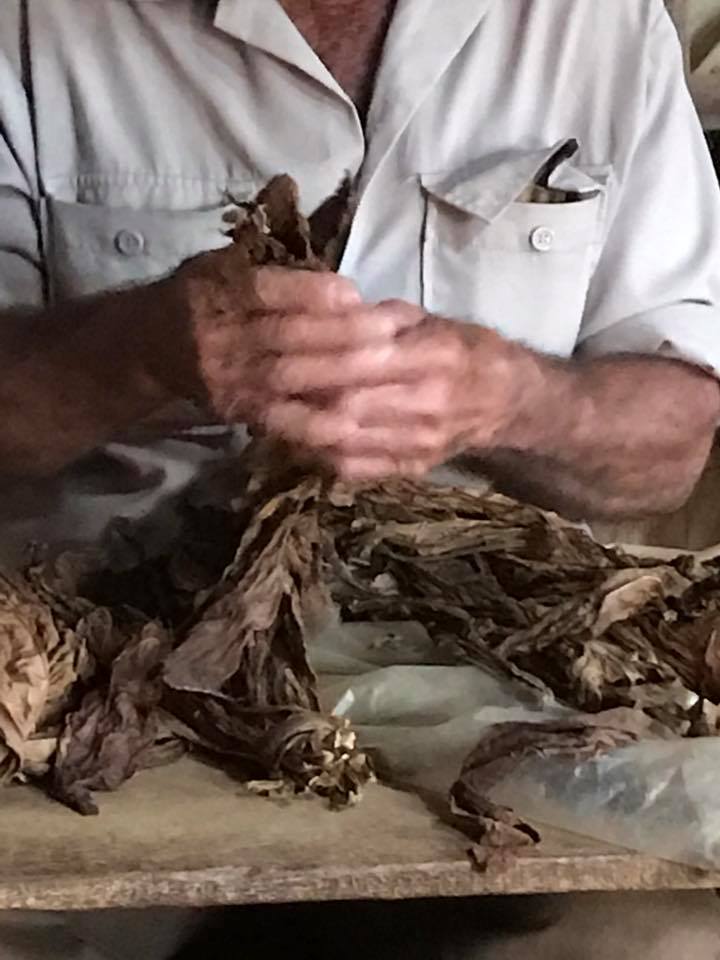
The only thing missing then, I suppose would be a cigar.  Our guide G takes us to a small farm on the edge of town, where we watch a man roll his leaves with his tobacco tanned hands.  He must have rolled hundred of thousands in his life, and there is a precision there that is beyond thought, relying more on habit and muscle memory. His boss has a similar relaxed nature, though more methodical in his jokey charm.  He has us all laughing before long, and we are sad to decline his offer to stay a night here at his farm.  Sadly we need betray the spirit of the Valley, for we have appointments back in Havana.

The first of these is dinner at La Esperanza, renowned as a gourmet delight.  The owner meets us at the door, charming and gracious, but apologetic.  It seems that there is a film team from New York filming a documentary, and their lights, cables, and equipment are strewn everywhere.  We say that we don’t mind the chaos, and take a table adjacent to the patio. (The patio itself would be ideal, but it has started raining again.)  The occupants of the only other occupied table are going through the motions of a meal, as the cameras circulate around them, and the boom mike hangs threateningly above.  Besides the TV presenter, the diners include a member of Buena Vista Social Club, Cuba’s premier ballerina , and the man heading the restoration of Habana Vieja.  When the shooting stops, all begin to mill about, and the night takes on the feel of a party.  We too are swept along, and I spend a fair amount of time with the producer, hearing tales of what it had been like to shoot during Castro’s mourning period.  Having previously received governmental permission, they were able to get near unlimited access.  It is a good night, albeit a surreal one.  But there is another destination to come.

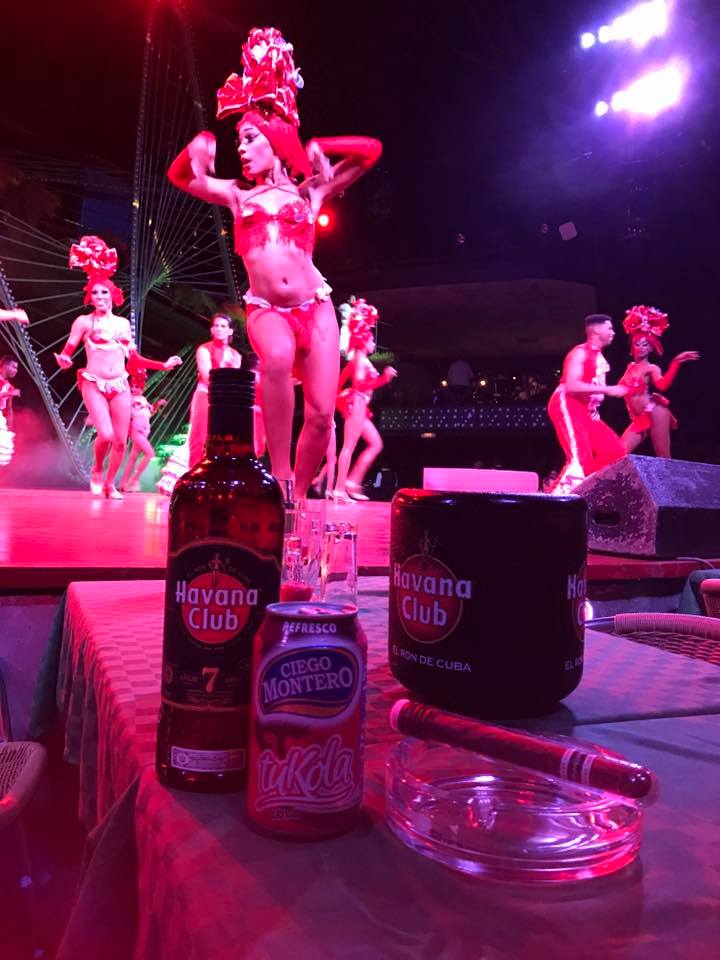
The Tropicana fulfills all my dreams of visiting a time when travel was glamorous, when it was unheard of to go anywhere without a dinner jacket in your valise.  Granted I am tie-less in my linen sport coat, but the spirit still applied.  The club is in what appears to be a distant suburb, up a tree-lined drive well hidden from the road.   The hostess hands me a fat Cohiba and leads us to our table down front of the stage.  The tables behind us are filled with foreign tour groups, all tinted blue when seen through the haze of cigar smoke.  A trio of waitresses come up and plonk down a metal ice bucket, a bottle of rum, and four colas. I ignore the rum and instead drink the soda.  It is the local brand of course, due to the embargo.  (The only Coca Cola I see in Cuba is in the neutral land of the airport bar.) I like this about Cuba that the usual brands and logos are nowhere to be seen, a little corner of the world where corporations don’t yet dominate. How long till Coke signs permeate the walls? How long till the rum is American?

The show starts promptly at 10 pm.  A bevy of sequin-draped beauties wrapped in ostrich plumes fill the stage, the aisles, the dance spaces high above.  There is a phantasmic quality to the night, in the sweep and flash of colored light, tricking the eye into thinking it is observing a bizarre species of animal.  They way they completely surround us is quite unnerving.  They are joined eventually by young men in their white suits who whip and whirl and pump their hips.  Ricky Ricardo never did anything like this.  Over the night the costumes shift into the more and more bizarre, the hats and frills getting bigger, then falling away completely to be replaced by gold-lame bikinis that help keep a portion of the audience awake.  The men are bare chested and muscled, which wakes up the rest.  The music stays high energy, foot-tapping, though growing a tad monotonous.  It will go on through the night but will do so without us.  I grab my girlfriend’s hand and twirl and dance her from our seats and up the aisle, like we are part of the show.  We laugh as we escape into the quiet open air, swept clean by the winds blowing through the hedges, as if fanned by a flock of ostriches.
4.

Lost in Havana.  It sounds like the title of a spy novel, but it is true.  We had simply gone to the winding spiral of an underground passage to the hotel annex for breakfast, and somehow, hadn’t been able to find our way back.  At some point we give up and escape out a broad glass door, then try to get our bearings.  Decades of decay are being removed from along an entire block, soon to be renovated into a massive hotel that promises luxury, and hopefully, better signage.  On the street below, a good number of foreigners, Americans mostly, are all walking in the same direction, and in following them, we arrive back at the front of the hotel.

I am surprised by all those Americans but really shouldn’t be considering the recent opening of legitimate flights from the States.  They all seem to be staying at my hotel, and that morning, they clog the lobby as if all the tour groups are leaving at the same time, to board a fleet of buses that blockades the boulevard in front. The hotel is a popular spot, and at happy hour, the lobby is filled with people drinking wine or overpriced rum drinks, the men being men with their cigars.  It is fun on an American scale, scripted fun, with little of the relaxed looseness and spontaneity of the Cubans.  Still, it is an interesting glimpse of how things must have been before the Revolution, all these moneyed notreamericanos gone south to let down their hair.  If all stays the same, this will only increase.

We begin our day on the outskirts of town at the home of a man who truly did know how to party.  Hemingway’s Finca la Vigla sits somewhat unobtrusively atop a tree-covered hill that overlooks the sea. I could see why the writer loved this place, and how in losing it he had lost more than just a home.  He was apparently quite untethered after forfeiting this refuge, and just a year later found a refuge far more permanent.

The house appears to look as it had the day he left.  Visitors aren’t permitted to enter, but we are able to see the interior well due to the copious windows in every room.  I am most taken with the books, which fill every wall of every room.  As I squint and lean to take in the titles, I feel a tap on my shoulder and see it is the producer that I’d met the night before.  He’d gotten filming permission all over the island, but hadn’t been able to receive it here.  He told me that he wished I’d turned up just 10 minutes earlier, wielding my writing credentials and a tall tale that I was working on a piece for a major US newspaper.  (I was flattered, but who did this guy think I was, Hemingway himself?)

Two women sit by the pool and chit-chat.  These guards aren’t particularly concerned with people fiddling with Hemingway’s famed boat Pilar, which has found permanent dry-dock atop the tennis court.  This is a nation seemingly taken with boats, as across town, the Gramma, which brought Castro home to wage revolution, stands under glass, beneath the gaze of 24-hour armed security. Both boats seem in far better condition than the handful I’d seen in Havana harbor, wrecks purposely hobbled in order to discourage trips of a longer nature.  In Hemingway’s case, his final flight took him beyond America, beyond fame, to immortality.

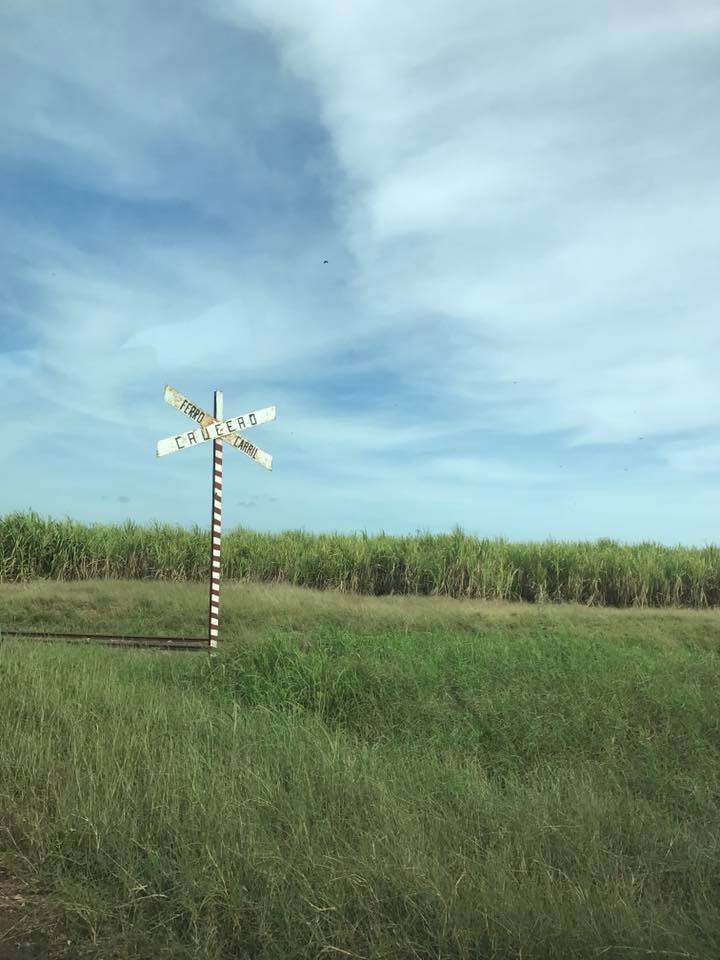
Heading east, our own road is again relatively untraveled, and dotted on occasion with those trying to flag a ride.  At one point a wall rises up, running parallel to the highway for thirty-three kilometers.  It was built for no other purpose than to dispose of the stones that had been plowed up when farmers were laying out beds for sugarcane a century ago.  Today not a thing has been planted, which surprises, as Cuba has the ideal climate to grow nearly anything.  The problem appears to be in the organization of these state owned farms, which hadn’t even been utilized during the near-starvation years of the Special Period after the fall of the Soviet Union, Cuba’s biggest benefactor.

We divert off the highway not far past the turnoff to the village of Australia, which besides being an amusing moniker had been Castro’s base during the Bay of Pigs.  Along this narrow road we begin to see crops, rows upon rows of corn, the rough stubble of tobacco.   Growing amongst them are signs bearing political slogans, and the faces of Castro and Che begin to pop up like mileage markers.  They are proud of the revolution in the country, and few places more than Cianfuegos, our next stop.  The town is prettily arranged along the curve of a long bay, and far across the waters stands the abandoned hulk of an unfinished nuclear power station once planned by the Soviets.

Our first task is to fuel up with lunch at Paladar Ache, yet another tidy house wrapped around a lovely garden.  Masks hang along one of the walls, each representing a Orichá, a Santeria deity disguised as a Catholic saint.  The two religions have over the centuries been fused and intertwined, and in the few cases that I encounter Santeria I am reminded of the folksy nature of Catholicism of rural New Mexico.

Fusion becomes the theme of the day, not only in the meal served up, but in the look of the buildings about town, a mish-mash of various European cultures and styles, all tempered by a mild Caribbean climate.  The most extreme example is the Palacio de Valle, which upon approach looks typically French, yet whose roof has been capped with a Mughal palace.

My favorite building is the Tomas Terry theatre, and I’m not alone in my devotion as it had once attracted the likes of Enrico Caruso and Sarah Bernhardt.  I sit in one of its plush red seats, watching a dance troupe practice for the weekend show.  From here we stroll the French renaissance plaza ringed with even more beauties, and up to the Paseo del Prado, punctuated midway by a statue of Benny More.  The statue is modest, yet few legends of Cuban music were as big as Benny. Down a pair of side streets is a small street market, with a few dozen stalls catering to the localized crowd of Saturday strollers. It had a charm shared with other markets I’d seen in other socialist states, a timeless look at capitalism reduced to a neighborhood scale.
5.

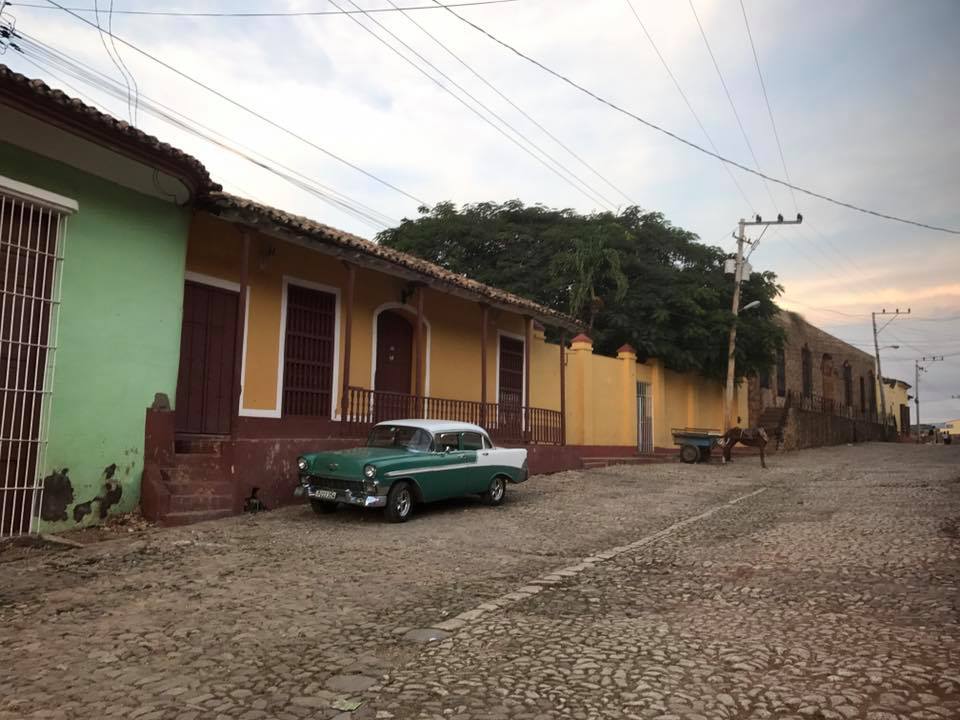
The historic towns of Cianfuegos and Trinidad have been forever paired by UNESCO as heritage sites, but they each have their own distinct character.  The former is typically Caribbean in that it is (slowly) facing the future, yet not at the expense of its rich colonial past.  Trinidad on the other hand appears happy right where it is, which is 19th Century Spain.   Renowned tourist sites can be divided into micro and macro types.  Kyoto, where I live, is the former, being essentially an ugly city filled with some marvelous sites.  Trinidad is the latter, for the town itself is a gem.  Nested on a long rolling series of hills between the mountains and the sea, it is a spiderweb of little lanes, cobbled with what I’ve heard best described as turtle-shells, and sloping downward toward drainages running down the center.   These irregular surfaces make for difficult walking, slowing everyone to a leisurely amble.  Those who can’t even be bothered to walk sit before low two-story buildings painted an array of hues, and punctuated with brightly colored doors.  When the pony-drawn carriage before you passes by a parked 1952 Chevy, you suddenly find yourself part of a travel brochure.

Like in all the best towns, there is little to do but absorb the vibe.  We listlessly explore a couple of palazzo museums, poke our heads into churches.  Have the obligatory canchanchara at its namesake Taverna.  I also take the time to do a solo walk at dawn one morning, into the barrios well away from the tourist heart of town, where young dudes work on their motorcycles, and groups of young girls stroll to school in their uniforms.  Along the way I come across a Yoruba temple, in the courtyard of which a man is washing and plucking a chicken, either a result of, or preparation for, a ceremony of some kind.

The slow pace of life in the daytime serves to pace the locals for their revelries at night.  Music is simply everywhere, in every café, spilling onto the streets.  Not far from the steps beside the Iglesia Parroquial where tourists sit and welcome the night, we dine at Paladar 1514, an antique shop of sorts crammed with the wares of five centuries.  This all adds to the restaurant’s ramshackle look, of crumbled brick and absent roof.  I believe that the structure actually is half-collapsed, but we dine alfresco safely between two columns.  Our waiter is a very young man who’s been working there for just a few weeks, and he deftly avoids our queries about history in charming and amusing ways.   We are the only diners at first, but slowly others come to sit at tables overladen with ancient ceramic and glass (removed of course before the meal arrives). Another waitress comes on duty, moving through the narrow spaces as if dancing tango; all the movement below the waist.  At some point musicians crowd into one corner of the courtyard, and before long I am pulled before them to dance with a young black woman that I’d seen flirting earlier with the mulatto bartender.  Trinidad has a certain racial ambiguity, its people even a greater array of colors than its buildings, yet seemingly devoid of any of the usual tension.  When I make this comment to my guide she tells me that Trinidad’s port had been one of the points of entry for African slaves.  In fact, more African slaves arrived in Cuba than the United States.  This is mainly because the Americans saw the value in have healthy slaves to work and breed.  The Spanish simply worked theirs to death, to be replaced by new African slaves.  Things have improved of course, but G tells me that the lighter-skinned tend to do better with education and employment, but the overt racism of the North is quite rare.

The final morning we drive out to the Sierra del Escambray, tracing the coastline lined with small, underdeveloped hotels before turning inland to climb and wind over the tendrils of hills pointing seaward.  Roads like these never fail to amuse.  It is as if there was no time or thought about grading.  Far easier to just pave the hillsides, creating a roller coaster effect.  Always thrilling, always exhilarating.

We stop at the park information center which has detailed information about the various hikes in the area.  Towering just above is a large hotel block that had once been a TB sanitarium.  We leave this soon enough, in the back of a massive Soviet-built troop transport, bouncing along on the hard bench-like seats as the truck powers along the windy mountain roads.  Now and then small settlements appear, small clusters of squat homes amidst all the verdant green.  Symbols and slogans of the revolution are everywhere, little wonder since that these hills were home to the revolutionaries for much of its struggle.

We climb from the truck in a small village at the start of the trail., and quickly come across a decent-sized coffee plantation, shaded by massive trees.  This canopy shades us as well, as we make our way gingerly along slopes made slippery from the recent rains.  We come eventually to a tall waterfall, and a swimming hole that on this day serves as playground to a handful of foreigners.

The second part of the hike isn’t much harder than the first, though it does require us to climb gradually from the valley. The views open up some and include the river we parallel, which in itself draws out more bird and wildlife. We leave the jungle at a small farm, not far from a series of bungalows where we’ll lunch.  We sit out on the veranda, eating a plate of chicken and the obligatory beans and rice.  It is a pleasant, bucolic afternoon, though now growing hot.  When it is time to depart, our truck is nowhere to be found, so we sit awhile more in the shade, watching the chickens who, no matter how fast they can run, cannot outrun their destiny as tomorrow’s lunch.

Back finally at our van, for the long ride to the airport.  Our guide G decides to pass the time in discussing Cuba and what it is like to live there.  For days we have politely avoided the topic of politics; it seems as if she finds it important to show how politics is intricately entangled with daily life.

She tells us of the hardships of the Special Period, the country in free-fall after the collapse of the USSR, its main economic trading partner.  The government did a remarkable job in strategically weathering out the crisis.  Not to say that the people didn’t suffer.  Food production dramatically declined, due to the absence of fossil fuels.  But the Cubans are a clever people, due to a high level of education and resilient due to the embargo.  Bicycles began to appear on the streets, and many moved out into the countryside to grow their own food.  The diets became incredibly imaginative and innovative, with people substituting plantain peels for beef, and utilizing vegetables long overlooked.  One bizarre side effect was the huge reduction of deaths from as diabetes and heart disease.

Cuba weathered this, as they weathered everything else.  But with exposure to tourists growing exponentially, Cubans are beginning to resent the stagnation of their island.  Most live on a monthly salary of $25 dollars a month, and I know that some of our meals cost more.   Yet despite this, she, along with all the other Cubans I met, truly love their country and have no intention to leave.  And therein lies the paradox.  To wait as patiently as the Cubans do, implies the belief that something better will come along.  And after fifty plus years, at no time does the future look brighter than it does now.  Obama seemed determined that part of his legacy be to open up the country, and I smile at the thought that the “Hope” slogan of his initial presidential campaign also holds meaning for the people of this nation.  Granted his successor seems equally determined to slam shut the doors again.  Yet a bigger factor is the fact that Cuba is taking its first baby steps into a future without Fidel. It is hard to picture a Cuba without Castro, despite the fact that the Cuban exiles in Miami and the CIA have been doing that for decades.  But the issue all along was with Fidel, and never with the Cuban people.

So that hope stills exists.  Americans and their tourist dollars are now flowing in, and that will certainly change things.  It won’t be long before the big corporate players follow, and familiar logos will begin to appear on Havana’s crumbling facades.  Perhaps one of those logos might even be of a certain hotel chain owned by Obama’s successor himself.

Personally I think that Cuba’s biggest potential lies in being a major destination for medical tourism.  This island is famous for the high quality of its healthcare system, and it exports more trained medical personnel to the developing world than all the G8 countries combined. Americans are already finding inexpensive treatment in countries like Thailand, India, and Singapore, and it won’t be long before they find relief closer to home.

At any rate, the tourist industry is a young one. I notice that there is a definitive separation between the Cubans and the tourists who are beginning to move amongst them in greater and greater numbers.  It’s unlike other cities I’ve been, where there’s much more engagement, more interaction.  Here, the Cubans continue to go about their business, or their lack of business, as the touts are as yet unpushy, choosing to let these specimens of overseas wealth simply drift by   That ability to choose implies a freedom that they’ve had all along.  Let’s hope they can weather the myriad of choices to be made as their island grows more and more open.

The inevitable return of the big hotels and international conglomerates may return Cuba to a role similar to that it had in 1959; that is, a tourist vassal state, with all the familiar abuses. A more optimistic view is that Cubans, being proud, patient, and educated people, will take a slower more sensible approach to things.  But the people are most certainly hungry.  Not for food this time, but a chance to share their strengths with the rest of the world.
 

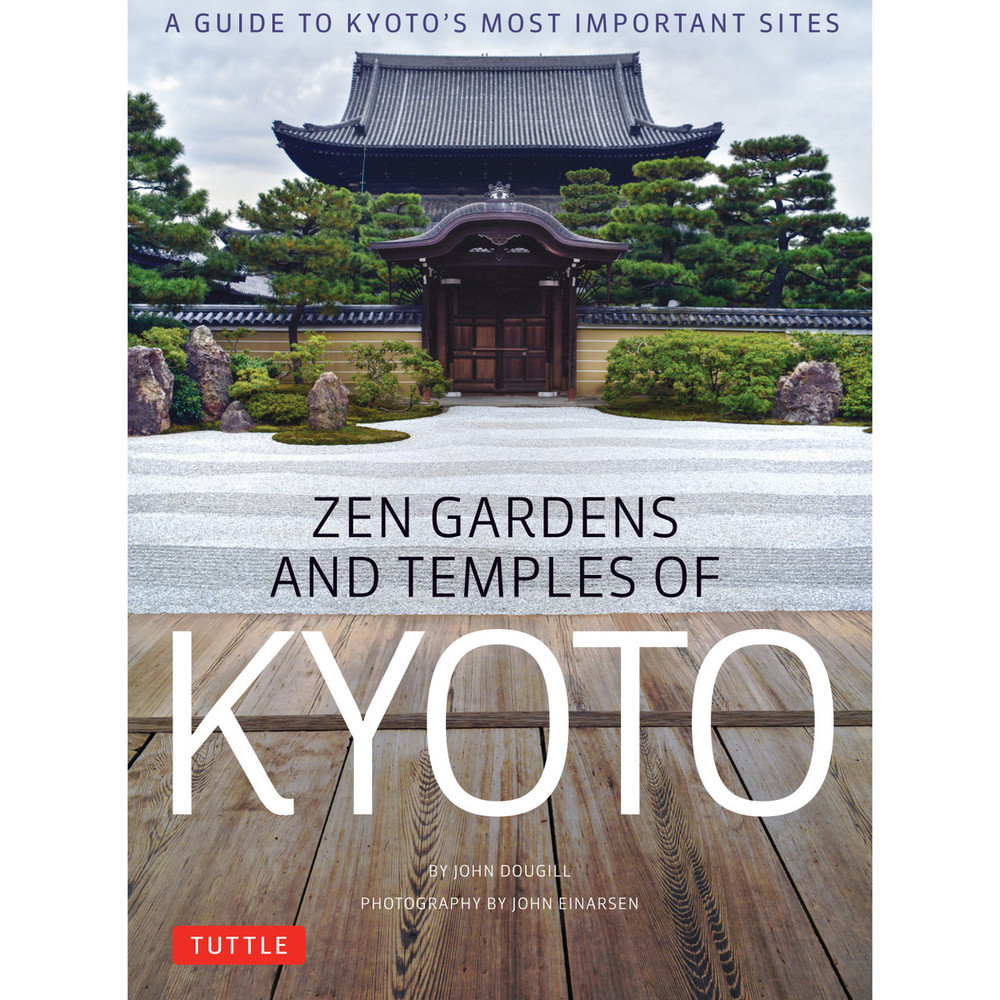
Book launch: Zen Gardens and Temples of Kyoto

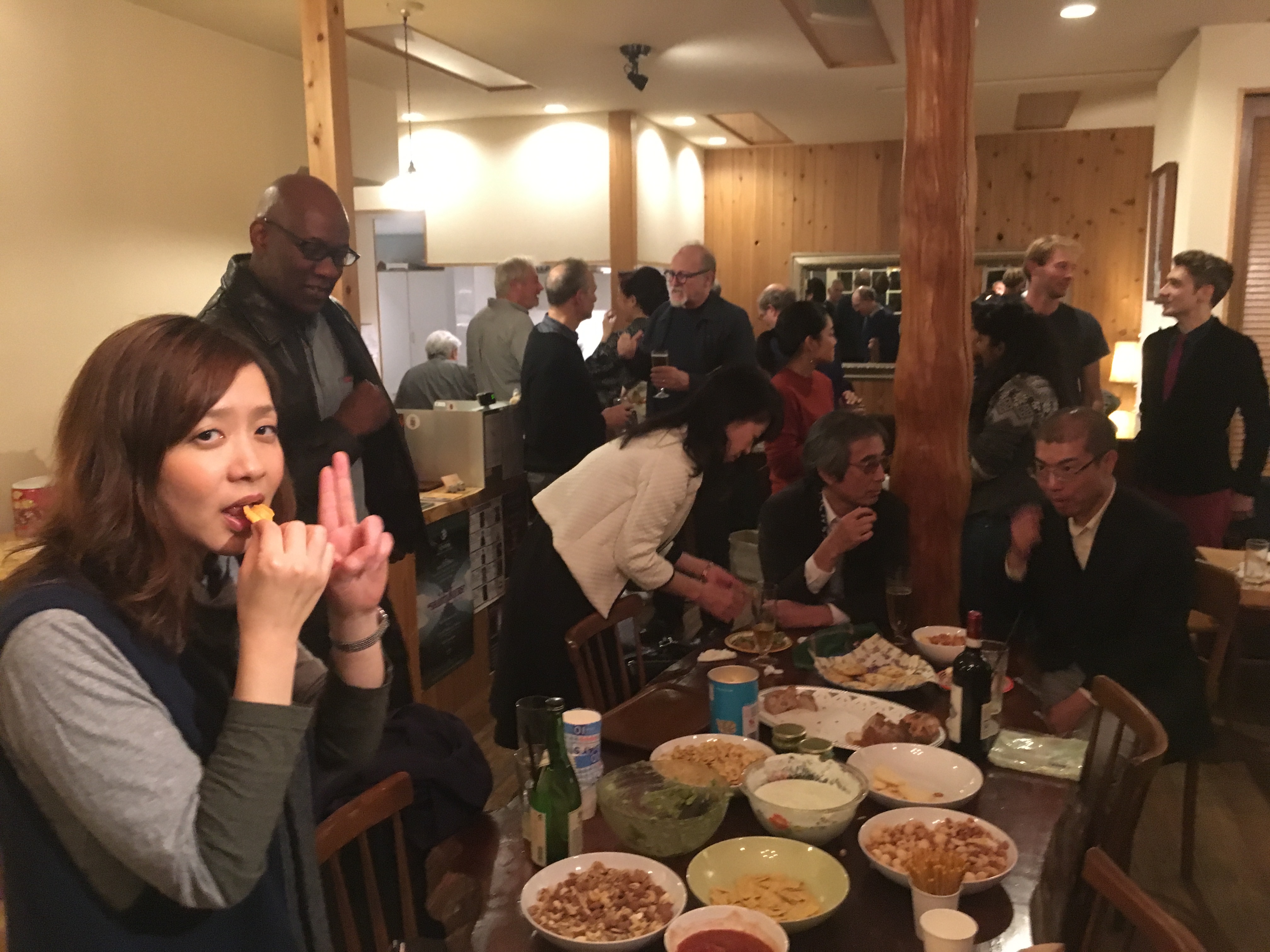
A fine time was had by all as people from different backgrounds met and interacted

Book Launch Nov 18, 2017
Report by
Andrew Sokulski Zozaya, WiK intern

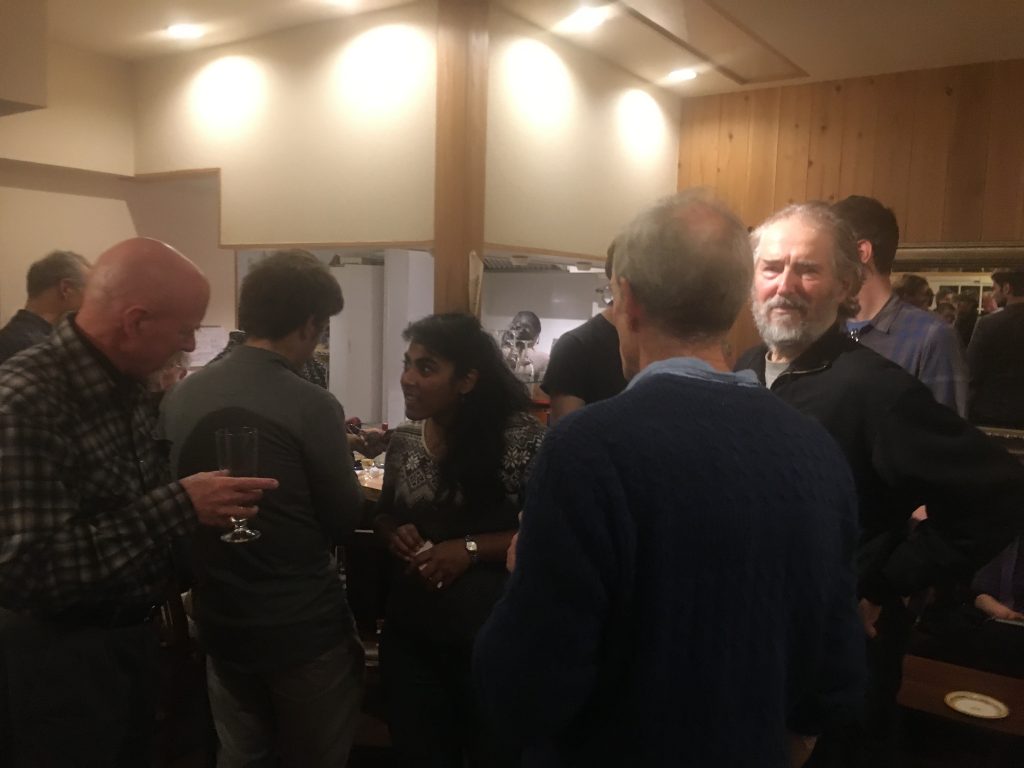
Saturday night a splendid celebration was held in high spirits for the book launch of John Dougill and John Einarsen’s  Zen Gardens and Temples of Kyoto. There were writers, artists, scholars, priests, tour guides and Kyoto Journal interns in the audience. A wonderful musical performance was held, alongside delicious side dishes and an exhibition of inspirational photos taken by John Einarsen.

Photographer John Einarsen, whose photos were exhibited at the cafe

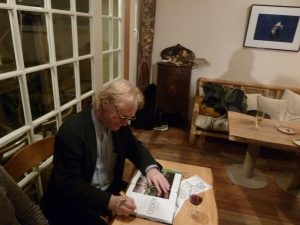
Author John Dougill signing one of the books

While at the event I was able to talk some of the people there including Paul Carty from Ryukoku University and Hirisha Mehta, a graphic designer for the Kyoto JournalTalking to Paul Carty was intriguing for his connection to my college, the New School in NY. In speaking about the differences with Japan, he remarked how he believes literature to be one of the hardest degrees to obtain within the United States. Hearing this I thought back to John Dougill’s speech and his remark about how strenuous the Zen path was. Come to think of it, you could say both writing of one’s emotions in detail and finding peace and faith where there is no tangible attachment are two paths toward clarity.

Turning to the book, Hirisha Mehta seemed enthralled with the pictures and content of Zen Gardens and Temples of Kyoto. Being from a design background, she sees the details and how they add up to create an overall atmosphere. For instance, she talked of the daily maintenance of the rock gardens within Zen temples such as Ryoanji, which takes a lot of painstaking time and involves complex circular formations with precise width that contribute to the general calm of the environment.

I also talked with Stephen Gill, founder of the Hailstone Poetry Circle, and as we were looking at John Einarsen’s photos he spoke of how a photo of snow on a temple’s roof could be a wonderful subject for haiku, for something unseen below the roof could be suggested in the poem.  Being that Zen and poetry are not far separated, it is pleasant to muse on the different ways in which pictures can be interpreted and stimulate writing. In this sense the well crafted words of John Dougill provide context and balance for the stimulating photos of John Einarsen, and of the specific intricacies of what was called ‘Kyoto Zen’ through doing so.

All in all, everyone clearly enjoyed the music, the food, the interaction and the exhibition pictures. It’s sure to lead to word of mouth recommendations to friends and others. Instead of Zen being treated just as a pop culture icon, those who come to it through this book will learn of it culturally and historically through the filter of John Dougill’s fine words and John Einarsen’s discerning eye.


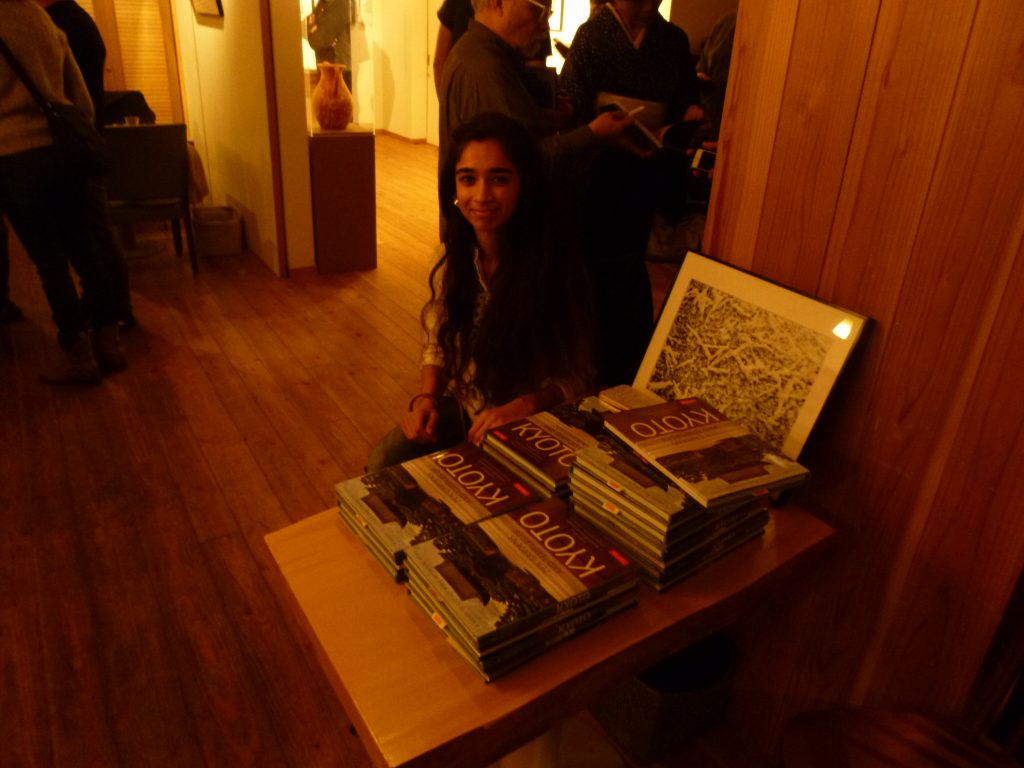
Book sales were brisk and by the end of the evening the whole table of books had been sold off

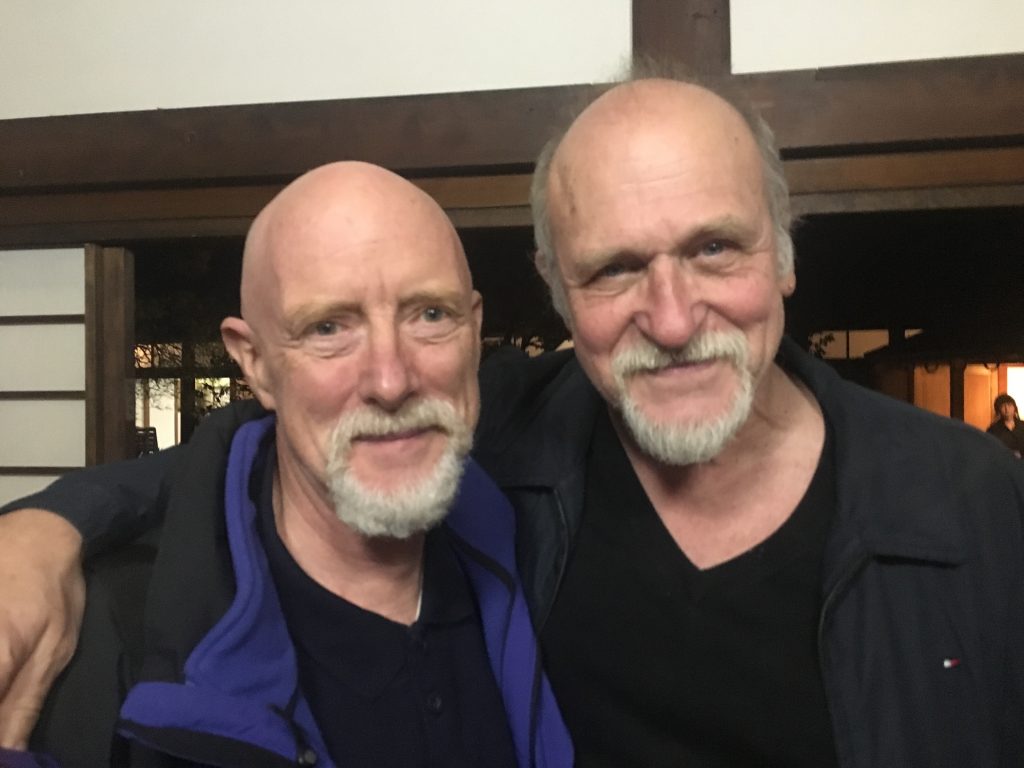
Two guests with matching ‘taches and t-shirts, shakuhachi maestro Preston Houser and cheesecake master Charles Roche

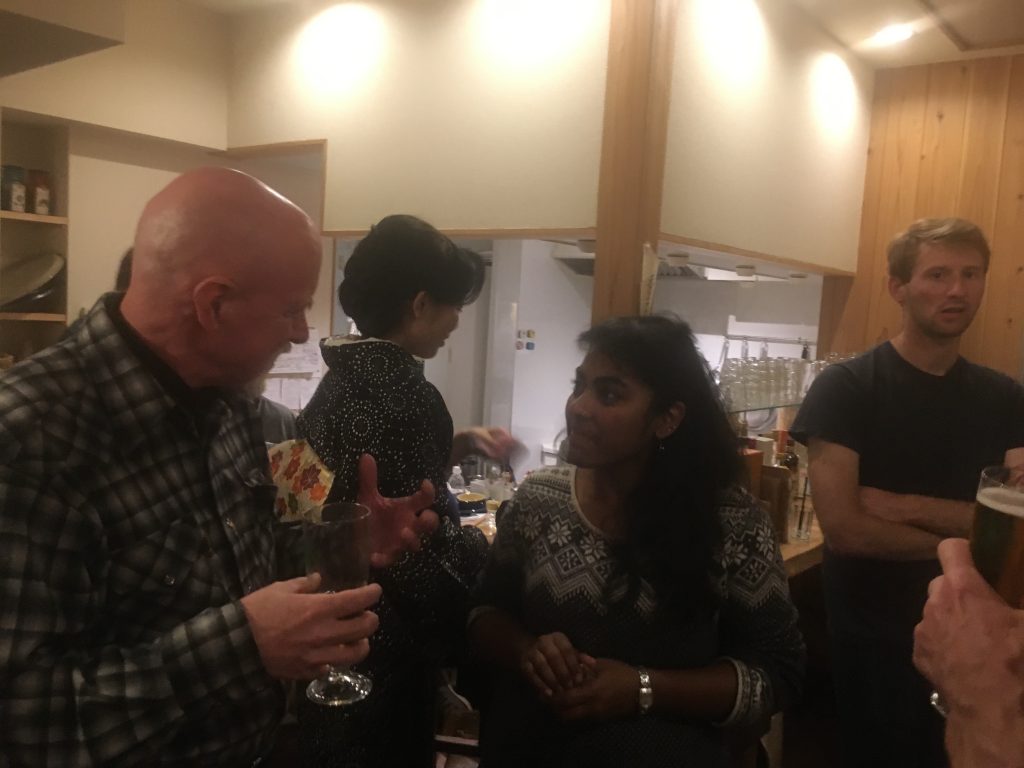
Even at Zen parties the bar is the most crowded area…

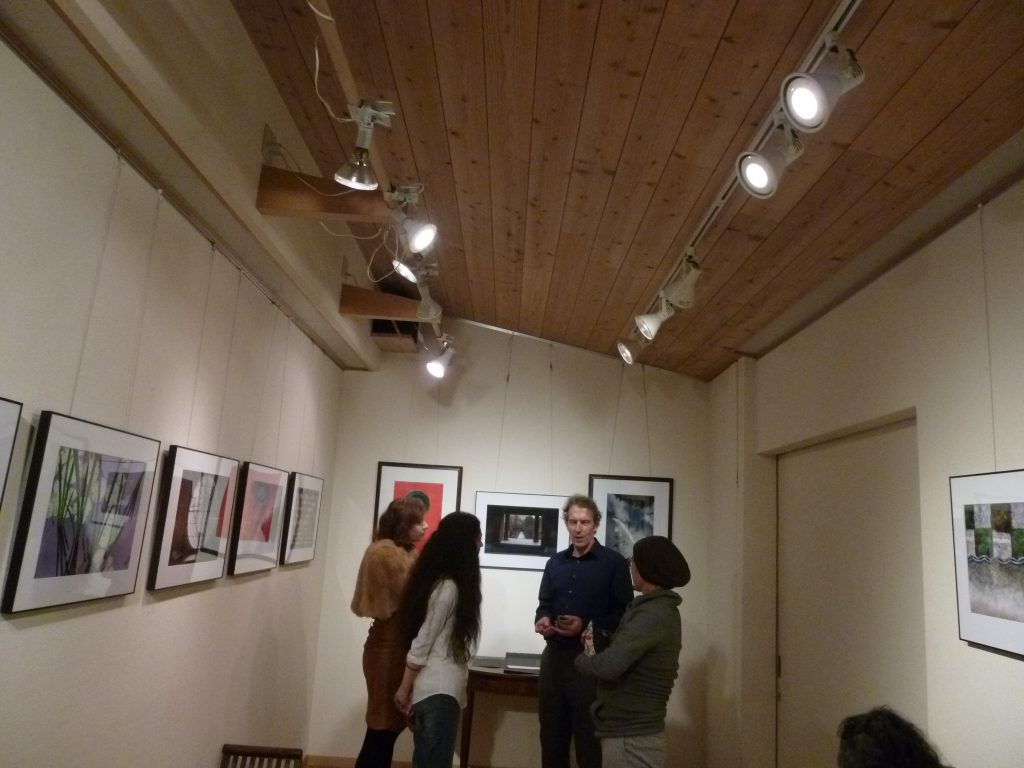
John Einarsen’s photos provided stimulus for discussion in the small gallery area

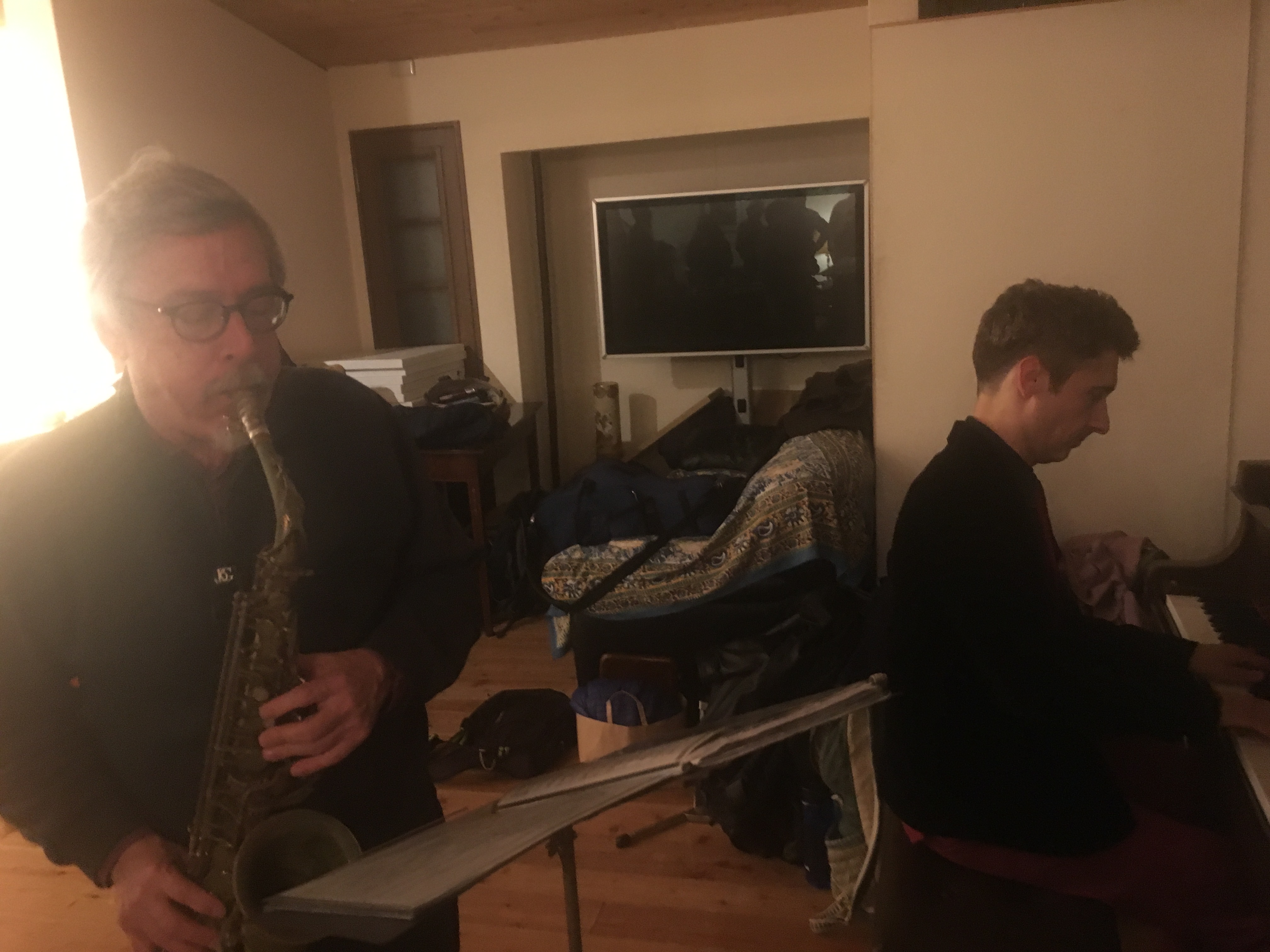
Music was provided by two topnotch musicians, whose first piece was a superb impromptu piece of Zen-like improvisation. A deep bow of respect to Gary Tegler (on sax) and Quin Arbeitman (on piano).

Such were the good vibes that the local cool cats wanted to join the fun too

Writers in focus

Isabella Bird on Kyoto 1878

The remarkable Isabella Bird came to Kyoto nearly 140 years ago…    Her impressions are all the more noteworthy given how few foreigners had ever visited the city. According to research by Eric Johnston in his article for the WiK Anthology 2017, up until 1872 only about a dozen foreigners had ever set foot in the old capital, as it was off-limits and considered a sacred city.  Bird recorded her account in the engrossing Unbeaten Tracks in Japan (1881). The first edition was in two volumes. However, later editions were in one volume, cutting out half of the material including the section on Kyoto, which is why few people are aware of it. You can find the rare first edition at this link, with the account of Kyoto starting from p. 224. [Thanks to Joe Cronin for providing the information.]

************** 

Nijosan Yashiki, Kyoto, October 30 [1878]

This is truly delightful. As the Hebrew poets loved to sing of mountain-girdled Jerusalem, so Japanese poetry extols Kyoto, which is encompassed, not with forest-smothered ranges like those of Northern Japan, but with hills more or less rugged, wood here, broken into grey peaks there, crimson with maples, or dark with pines, great outbreaks of yellowish rock giving warmth and varied, and the noble summit of Hiyeizan crowning the mountain wall which bounds the city on the north. On fine days, when the sun rises in pink and gold, and set in violet and ruddy orange, these mountains pass through colours which have no names, the higher ranges beyond the Gulf of Osaka look faintly through a veil of delicious blue, and I grudge the radiant hours passing, because rain and mist persistently return to dim the picture.  There is a pleasure in being able to agree cordially with everyone, and everyone loves Kiyoto.

(…)

I realised in half an hour that Kiyoto is unlike the other cities of Japan. It is the home of art, given up to beauty, dress, and amusement; its women are pretty, their coiffures and girlies are bewitching, surprises of bright colour lurk about their attire; the children are pictures, there is music everywhere; beautiful tea-houses and pleasure-grounds abound, and besides all this, the city is completely girdled by a number of the greatest temples in Japan, with palaces and palace gardens of singular loveliness on the slopes of its purple hills.

[There follow descriptions of the Christian mission schools in the city, as well as a visit to the house of Mr and Mrs Neesima, the former of whom was to become founder of Doshisha.]

Writers in focus

Hyogo vignette (Simon Rowe)

Notes from Himeji, Hyogo: I am a Passenger
by Simon Rowe

What do commuters think about on their long rides to and from the mills each day? I bet they don’t think about how lucky they are that the wheel was invented.

I was a commuter once—a nameless man in a salt-stained suit and headphones. A Business English instructor, a corporate gun-for-hire with a bandolier of ballpoints, a ronin who could commit hara-kiri with the edge of a Let’s Talk2 cd. But didn’t. Because it was never about the destination—the depressing chemical plants, semiconductor factories and sinister steel mills waiting for me at the end of the line—it was about the journey.

The Kakogawa line train is the quintessential ‘paddy lands express.’ Four years of rattle and roll through the greenest rice fields this side of the Japan Alps, from the Seto seaboard to the lush hinterlands of Hyogo, a place where frog eats fly and snake eats frog and snake gets beaten to a pulp by village boy. The journey (like the boy) neutralised the destination.

The Kakogawa-sen follows a great, slow-moving torrent called the Kako River. If you’ve ever seen Ford Coppola’s “Apocalypse Now” or read Conrad’s “Heart of Darkness”, for four years that guy in the story (Willard in the movie, Marlow in the book), that was me. I wish I could say I found someone as interesting as Kurtz, but alas, there was no badass at the end of the line.

The two-car conductorless train still departs Kakogawa station at 20-minute intervals, bound for upcountry with students, workers, Guinness Book grandmas and sometimes a foreigner or two. Young women still sleep on the shoulders of strangers and college girls still doze and nod their heads like glam-rock groupies as the train bounces down the rails. Some days the entire car looks like it has been gassed; passengers everywhere, draped on each other, slouching, snoring. I stepped over a fat boy asleep on his back on the aisle floor once.

My destination was Yashiro-cho, a place where trains pass hourly and the station attendant is a large, fat ginger cat which eyes passengers suspiciously as they pass through the turnstile.

In summer, midge flies, moths and nymphs cloud the platform. Fuzzy caterpillars crawl over the bench seats and spiders abseil from the rafters. In winter they disappear and the soft, silent misery of falling snowflakes fills the hour-long wait for the night train back to modern-day Japan.

I don’t miss the long commutes. But I do miss the man who was always waiting for me at the end of the line. A taxi driver named Yamamoto. His shiny black Nissan Cedric always got me to the mill on time. Love him or loathe him, I still can’t decide; he was both the endearing face of small town Japan and the Mister McGoo of privatised transportation.

He drove at a speed I could have bettered running on my knees. He clocked 39 km/hr once on a paddy by-pass. He would veer and drift all over the road, squinting over the wheel as he squeezed out his best radio-learned English. He once answered the dispatcher in English: “Oooh yes? How are you today? I am very fine, veeeeeery fine thank, and you? Hahaha-ha!” Every conversation with him ended the same way: “Many thankyous Mister Simon, for the free English lesson.”


Simon Rowe writes short fiction and screenplays from a small room in an old house behind Himeji Castle. This vignette is one of 45 linked ‘letters home to Grandma’ – a project he is working on called Seaweed Salad Days.

Writers in focus

The Hamlet Paradigm (Kimura)

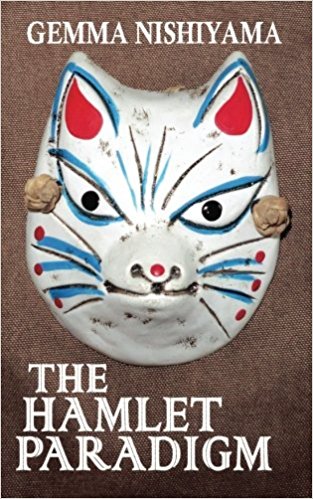
Marianne Kimura is a Shakespearean scholar teaching at a university in Kyoto, and her papers on Shakespeare have proved popular on the website academic.com. She also writes imaginative fiction based on Shakespearean themes, integrating ghostly or SF elements as can be seen in the excerpt below from her second novel, The Hamlet Paradigm, published under the pseudonym of Gemma Nishiyama. (For more about Marianne, click here, and for more about her book see here.)


Chapter 11

“First of all”, said Haruki, “I have to explain what happened next in Dr. Fukuzawa’a apartment. He explained what he had found out, and then he gave me a flash memory stick with all the incriminating files he had and asked me to keep it safe. He wanted to have another person involved, to back him up, in case anything happened to him. He also wanted to ask me what I thought we should do.”

“What was your advice?”

“I said—-and he agreed—–that we should just keep working as if nothing had happened and then wait for a chance to bring the information to light and get the project stopped somehow.”

What project?” I asked, hearing my voice getting loud, “I can’t seem to get you to tell me! It’s very frustrating! What project?!”

Yuuki rolled over and mumbled something in his sleep.

“You’re waking him up!” said Haruki. “I’ll tell you, but try to control yourself a little. How can I rely on someone as emotional as you?”

I was about to get annoyed and defend myself, but he smiled mischievously at me in the flickering light. I could never quite keep up with him. I had to laugh.

Haruki waited until Yuuki was sleeping soundly again and then began to tell me, in a serious tone, everything.

“The project is code named Project Elsinore”, he said.

“Project Elsinore?” I asked, “what a funny name. Why? “

“Briefly, the night sky, crowded with bright stars, above the castle of Elsinore, in Shakespeare’s play Hamlet was the inspiration for the name. There’s a lot more I need to tell you about the Shakespeare reference later, but for now, just remember that—as far as our research was concerned—-it’s basically a weird story based on the phrase ‘two stars that have left their spheres’, like Hamlet’s eyes and Juliet’s eyes.

“Hamlet’s and Juliet’s eyes? Why?”

“Well, you see, we were told that the goal of Project Elsinore was to find the sun’s binary companion star. That’s what the “two stars” refers to. That is, the star that the sun—our sun—-may be going around.”

“You mean, orbiting? Our sun is orbiting another star? Really? Can this be true?”

“Yes, there’s a theory, still only a theory that, in fact, our sun, which is, after all a star, goes around another star. It may be Polaris, Sirius, or it may be a dark companion star or a black hole. No one is sure, and we were extremely excited to be given such a lot of funding and a great deal of freedom to find out whether or not our sun, together with our whole solar system, is in fact orbiting another larger star. The second goal of our research was, of course, to identify this other star, our sun’s own sun, as it were. It would be a major finding if it could be proven.”

“But Dr. Fukuzawa learned something he shouldn’t have about it? So what is ‘it’, this secret?”

Haruki sat up. He seemed focused and taut again, though he also looked drawn and sad now.

“It was quite a shock when he showed me the documents in the files. It seems that Vector has a secret plan to launch hundreds of huge solar-energy-gathering satellites to orbit just beyond the earth’s atmosphere. They will block the sun’s light over a large portion of the Pacific Ocean, since, of course, this light will be used to generate electricity. Vector plans to enter the market for electricity and sell the electricity to the highest bidder, large corporations like themselves, their clients and suppliers.”

“But satellites have to keep orbiting, right? Didn’t you say so once?”

“Yes, but with new technology, the satellite remains almost stationary, moving very slowly in tight circles only over the Pacific Ocean. It’s obvious that no government of any country would tolerate Vector blocking the sun on the territory of the land that makes up their country, but the Pacific Ocean is commonly held, so Vector would use that fact as a wedge to act and in a sense, take over the Pacific Ocean, or at least steal almost all of its solar energy.”

“But how does this horrid plan of theirs relate to the two stars idea?”

“We were told that we were making instruments, like gyroscopes and other items, to measure the earth’s speed relative to the sidereal background—-the stars you can see in the night sky—-but Dr. Fukuzawa explained to me what he had discovered. The ‘two stars’ idea, or identifying the star that our sun is revolving around wasn’t the real goal of Project Elsinore at all. That was just a lie we were told so that we wouldn’t quit or go public with the truth. What we were actually doing was figuring out navigation data that would be programmed into the satellites and then also used to guide them from earth. I was shocked when he told me how we had been tricked into helping Vector with their evil plans. The Pacific Ocean will basically die once a large portion of it is starved of sunlight.”

“My God!” I said, thinking of fish, whales, seaweed, plankton, starfish. Yamaguchi, the western prefecture where Kiyama is located is surrounded by the sea and every town along the coast has a small fishing port. Everything alive in the sea would die once the energy from the sun could no longer reach the plankton and carry out photosynthesis.

It would devastate the food chain!

“The whole Pacific ecosystem would be disrupted and subsistence fishermen all along the coasts of the whole ocean, of course, not only in Japan, would go out of business and millions would starve. The poor would bear the brunt of it.”

“Can’t the government stop Vector?” I simply couldn’t believe that Vector was going to be allowed to go through with this devious scheme!

“I asked Dr. Fukuzawa the same thing, but he explained that unfortunately, Vector is so immense that it secretly pays off many politicians and political parties, not just here in Japan, but in many other countries too. I had always had a kind of bad feeling about working for Vector. It’s an enormous corporation with large offices and facilities and factories in almost every country you can think of. Although they were once only an American company, now they are all over the world and elected representatives in practically every country are in their pockets. Vector has kept the plan a secret, but their idea seems to be that if it becomes known, they will use their funds to pay off any powerful political entities that try to stand in their way before the satellites are launched.”

“Good heavens!”

This was ghastly news indeed!

“So my plan is to bring this out into the open before the huge satellites go up. Once the satellites are established up in the sky, it’s too late.”

“What do you mean by ‘too late’?” I asked.

“No matter how many international protests are registered, it won’t matter. There’s no way to bring the satellites down unless they malfunction on their own and drop or get shot down by missiles, which is risky and dangerous, so Vector is calculating that people will accept its effective takeover of the Pacific Ocean once the satellites go up, kind of a fait accompli. Then Vector will mount an expensive PR campaign to drown out any remaining opposition.”

“The beautiful Pacific Ocean! Nami’s favorite ocean!”

Everyone’s ocean.

Not Vector’s to steal!

I felt my body go weak and limp; just hearing this bad news was making me depressed. How could people like those who ran Vector be allowed to have so much destructive power?

“You have to understand something fundamental about all of this”, said Haruki, sounding more calm and scholarly, but looking haggard and weary in the shadows of the lantern light, “Mari, you see, the basic and underlying problem is that oil is getting more and more expensive. It isn’t just the price in money or currency, which is influenced by many things, but the physical effort, the expense and energy that companies have to put in to get it out. To extract the oil, the oil companies have to dig deep through the ocean floor, or mine oil sands, or else they have to blow up oil-soaked rock. The same is true for uranium, for nuclear power and it can be said for coal too—with all of them the easier deposits are drained first. It’s sayaku. Things become harder and harder.”

Sayaku. Terrible.

“I think I understand the basic concept.”

“All of the work involved in oil drilling is tough, expensive, and time-consuming and getting more so, of course, every day, so Vector wants to corner the energy markets with its massive Pacific Ocean satellites before the oil gets even more expensive and remote and difficult to obtain. When the global petroleum energy situation starts to really bite, Vector’s factories that make everything from aerospace technology to pharmaceuticals to weapons to communications, their large investment bank, and their other divisions might not be profitable anymore, and they’ll face an end to their power and influence. Frankly speaking, they must be worried, or they wouldn’t be trying this rather extreme, risky and rather devilish idea. Developing these truly revolutionary and remarkable satellites has cost them billions of dollars.”

In the darkness, Haruki poured out more wine for us. I drank mine nervously in one gulp. This was too fast, and some rose up uncontrollably into my nose and my eyes started watering.

“I see” I coughed, “Their satellites will also keep them going, in other words”, I said, wiping my eyes. What we were up against was becoming clearer to me now.

“Of course. And all the TV stations, the big advertisers, the huge corporations, the plastics makers. The electric cars, for those who will be able to afford them.“

“And Dr. Fukuzawa found out about all this?”

“He hated to think about a large dead Pacific Ocean. He told me that he was sent the files detailing the satellite plan anonymously, so there must be at least one other person in Vector who also hates this plan and wants it to come to light. But perhaps he or she is also being watched by now, or maybe even dead, too. I don’t know. Anyway, somehow, someone at Vector must have found out about the fact that Dr. Fukuzawa knew too much.”

“What exactly happened that night, then?”

“As I was leaving Dr. Fukuzawa’s shukusha, I saw a man in a car pulling into the parking lot. It was dark, but I saw his face clearly under the light in the parking lot. I couldn’t remember where I had seen him, but he looked vaguely familiar.”

“When you got home, what did you do?”

“I heated up a frozen pizza for dinner that night, then took a look at the files showing the designs for the satellites, their proposed launch locations, all the specifications. I was eating my pizza while studying the files, and the details of the plan just amazed me, but all the while, somehow, in the back of my mind, I was still wondering who the man was in the car. It was bothering me that I couldn’t remember. Later, as I was about to take a shower, I got a call from Dr. Aoyama, the Department Chair. He told me, in a shocked voice, that Dr. Fukuzawa had been found dead on the ground outside his shukusha. It seemed he had fallen or jumped from the balcony. I was shocked. Dr. Fukuzawa hadn’t been depressed or sad. I just knew it couldn’t be suicide. I hung up. I didn’t know what to do. I took a shower after all, unable to think about anything except Professor Fukuzawa. I went to bed, but I was too worried to sleep.”

“You should have called me!”

“I was already worrying about what was going to happen. Probably, I didn’t want you and Yuuki to become involved. I couldn’t sleep, of course. And it was then, anyway, while I was lying tossing and turning in my bed, that I remembered who the man in the car was!”

“Who was he?”

“It was someone who had visited our research center. He could have been someone from Vector. I don’t know his name. I had only seen him in the hallway once or twice very briefly. He had never introduced himself or spoken to any of us, it seemed. In fact, when I recalled him, it was as someone turning his head away and seeming to blend in with the scenery, almost as if he had wanted not to be noticed.”

“My god! How sinister!”

All of my exhaustion was gone, and I could feel my heart pounding with fear.

“I finally fell sleep, although I was worrying about the next day. What would we hear about Dr. Fukuzawa? I was also wondering if the story would break and everything would become public. But at 6 am, someone called me on my cell phone. I woke up right away, I was sleeping very fitfully, as you can imagine. On the other end of the line, there was a woman, but I had never heard her voice before. She said ‘Professor Muramatsu, Don’t go to work today, and don’t stay in Kubatsu either. Get out as fast as you can. Someone knows you were visiting Dr. Fukuzawa last night. They know you have the files, and you are in danger. ‘ I said ‘who is this?’ and there was a pause before she said, ‘My name is Sumiré’ . Then she hung up. I didn’t even have time to say a word.”

“I don’t suppose you know anyone actually named Sumiré, right?”

“No, of course not.”

“Was her voice familiar? Had you heard it before?”

“No, never.”

“Is Sumiré her real name or a code name then? All of these bizarre events are like something out of a spy novel, not real life. I can’t even believe it myself. Sumiré must be her code name. But why would she choose ‘violets’ for a code name?”

“It could be her real name, obviously; I mean, it is a name, a woman’s name.”

“Of course, and we just have no way of knowing either way. But anyway, what did you do next?”

“Since I realized now that Dr. Fukuzawa had probably been murdered, and I had seen the man in the car, I recognized that Vector would be worried about what I knew too. Sumiré’s warning haunted me. I had to assume that the man in the car had seen me on my bicycle.”

“So what did you do? They could have been outside your apartment too! Those dangerous thugs! How did you get away?”

“Well, don’t laugh, but remember how you brought up a bag with one or two of your old cotton summer dresses for me to rip up and use as cleaning rags? I can now safely admit to you that I actually had never gotten around to cleaning anything with them, or even to ripping them up. It was lucky as it turned out. You and I are not so different in size, I realized. I put one on, and cut the other one up to make a large flowered scarf that I put on my head. I packed a small nylon bag with some of my own clothes and put on a pair of loafers and a sweater and walked out casually. There may have been someone watching in the parking lot or not, I still don’t know. Maybe people just thought I looked crazy, someone dressing for a cosplay. Maybe people thought I was really a woman, even with my razor stubble. I don’t know, but somehow, it worked. Probably, it was just weird enough to work.”

I had to laugh. Haruki could be very practical when he had to be.

Haruki smiled and continued, “I just kept my head down so no one could see my face and I went to the nearest bus stop and the next bus took me to a train station on the Joban Line. That’s where I changed back into my real clothes in the men’s bathroom and melted into the crowds. I spent the morning riding different trains, changing lines, going first west towards Takasaki, then south down to Kanagawa, then over west towards Nagano. I got as far away as I could. I kept my cell phone off the whole time, since, actually, you can be tracked with your cell phone, though they need sophisticated equipment. But Dr. Fukuzawa told me that Vector has good friends in the NSA, one of the major spying organizations in the world, so the technology wouldn’t be a problem for them, I guess. By the time I got to Hakone, I was fairly sure that I had evaded them. I called you later that afternoon, when I was sure your classes would be finished for the day. I was near Shizuoka but I thought it wouldn’t matter if they picked up my location since I was just passing through.”

“Thank you. That was considerate of you. It would have been awkward to leave in the middle of class.”

“Yes, I was fairly sure that it would take them time to think of accessing your address and name on the university computer, and since you weren’t at home anyway, I decided rather than have you panic and rush out of the classroom, it would be better to wait.”

“Well, they did show up, as I told you.”

“Yes, they were quicker than I had expected. As I told you, there are some powerful people on their side. They can probably deploy an army to seek us out. Certainly they can use the police force as they wish. We are totally outnumbered, of course. To tell you the truth, our situation looks so hopeless that I’m thinking, a little, of just giving up. It might be safer. They’ll let you and Yuuji go, I’m sure, even if they keep me locked away somewhere until after the satellites go up.”

“But what a world it will be if they succeed with their plan!”

“Exactly. So my thinking is that if I can contact some journalists at some reputable newspapers to bring this out in the open, then there will be enough opposition, probably, to force them to abandon their heinous and cruel scheme. Decimating the largest ocean on the planet for money or for any reason must be where human beings draw the line.”

Haruki lay back down and stretched and I checked the time. It seemed like we had been talking for a long time, but it was only eleven o’clock. All the emotions and fears associated with his story had utterly sapped me. I managed to crawl into my sleeping bag, and I was tired enough not to care about the fact that we didn’t have soft futons to sleep on. Haruki had done his best to keep us warm and safe. I closed my eyes and felt my body becoming more relaxed. I was almost asleep, but, then unexpectedly, suddenly two bright, glowing and beautiful stars came into my mind and I opened my eyes wide in the dark, half expecting the stars to be before me in the little room.

The two stars were still a mystery!

Hamlet’s eyes!

Juliet’s eyes!

The stars that had left their spheres!

And now I was desperate to know more about these stars!

In a whisper I asked Haruki, “What about the two stars that have left their spheres?”

But there was no answer. My husband was already asleep. My lingering questions would have to wait.


The Life and Death of Chine (Robbins)

THE LIFE AND DEATH OF CHINE

Selection, Translations and Commentary by Jeff Robbins

Assisted by Sakata Shoko


Words of Basho, Kyorai, and Chine in bold to stand out

In this article we meet Kyorai, the second son of a doctor of Chinese medicine in Kyoto, born in 1651, and his fascinating yet retiring nine-year younger sister Chine (pronounced “Chee-neh”). When the father died, Kyorai’s older brother continued the medical practice. In the autumn of 1686, Kyorai took Chine on a pilgrimage from their home in Kyoto to the Ise Shrine, central shrine of the Sun Goddess.  The distance round-trip was about 200 miles, and apparently they walked the whole way, staying the nights in ryokan, or Japanese inns. Kyorai’s Ise Journal is an absolutely unnoticed gem, not only of literature but also of anthropology. As far as I can tell, it has never been translated, and even in Japanese is difficult to find. Most of the journal does appear in the biography Mukai Kyorai by Oichi Hatsuo and Wakaki Taiichi (Tokyo, Shinkyosha, 1986, pp. 34 ~ 41).                                                    

The journal consists of prose by Kyorai and haiku by both Kyorai and Chine. For this article, I have selected prose passages in which 35 year old Kyorai observes his 26 year old sister as she learns the world outside her parents’ house. Sensitive to her feelings, supporting her with positive energy, and paying attention to the poetry she writes (far better than his own), Kyorai transcends the patriarchal assumptions of his society to reveal the exuberant and playful heart of this young woman in 17th century Japan.

In Japan at this time young women were trained to stay quiet, smile, and nod to what the man says.  Historian Tokuza Akiko in the The Rise of the Feminist Movement in Japan (Tokyo: Keio University Press, 1999, p. 41) says “Criticism of women’s intelligence, autonomy, and moral worth was essential to the total subordination of women that society demanded.” A pretty grim prognosis, but Kyorai appears to have been an exception (as was Basho). Tokuza continues: “Parents thus protected their daughters’ chastity and morality by isolating them both from men and from rational and critical thought”. Chine’s parents however, allowed her to go on this journey,  and she seems quite capable of rational and critical thought. Anthropologists should take note.

In a prologue to Kyorai’s journal, Basho writes:

The first time I read this journal, my feelings awoke.
The second time, entranced by it, they were forgotten.
The third time, I realized how perfectly it is written.
This person Kyorai has fully traveled the path.

The Ise Journal begins:

The sun hot yet wind cool on our heads,
I take my younger sister on a pilgrimage to Ise.

Until Ise
such good companions,
morning geese

The genius of Chine’s verse is in the double meaning: “Kyorai and I are good companions” along with “wild geese are our good companions.” These birds spend the summer in Siberia then in autumn fly south to winter on the marshes of Japan; south is also the way from Kyoto to Ise. The feeling Chine has watching a flock of geese fly in the direction they are walking, and her feeling for her brother, become one. Chine’s spirit along with her brother’s take flight in the haiku.

Affection between adult brother and sister occasionally appears in old-time literature – Ophelia and Laertes in Hamlet, Sebastian and Viola in Twelfth Night – but the circumstances in these plays are extraordinary beyond belief. The brother-sister bond portrayed in the Ise Journal is unique in literature because it is so ordinary.

Kyorai and Chine stay at an inn, and Kyorai writes:

The innkeeper’s wife is such an uba. She turns her face toward us and shouts  “Fresh from the mortar! Before they cool down!” Chine cannot stop laughing.

Uba, “old woman” suggests a former wet-nurse, a rather earthy sort of woman (think Juliet’s Nurse). I love the sound of uba (rhymes with “tuba”) here. The innkeeper’s wife was making mochi rice cakes: kneading the mass of cooked rice in a mortar where her husband pounded it with a mallet, then molding into a cake with a surface soft and smooth as a baby’s bottom. At this time women used face powder containing white lead to fill in the wrinkles and obtain a mochi-hada, skin as smooth as mochi.

On behalf of the innkeeper Chine writes:

If you will not
remove that face powder,
when oh when
can we see the wrinkles                                                                                                        
in your uba mochi

Kyorai says it is the innkeeper’s job to advertise his wife’s rice cakes, but Chine does that job for him in her tanka. Chine uses the classical poetic form for her hilarious look into women’s concern for their aging skin. Change uba mochi to “old woman’s skin,” and you will see what 26 year old Chine is saying to this uba in her fifties or sixties. Shoko comments that Chine’s verse is onna-rashiku, “womanly, feminine.” I, like Chine, cannot stop laughing.

For the following night, Kyorai writes:

This being Chine’s first time away from the realm of our parents, in sympathy with her upset, I say what I can to divert her.

Kyorai actually pays attention to his sister’s mind and heart. Where else in male literature is there such a record of male consideration for a woman who is not his mother or romantic interest? Basho seems to have had much affection for his seven-year-younger sister Oyoshi – since he often mentions her by name in his letters – so he could easily appreciate Kyorai’s feeling for Chine. If you too have a younger sister, you may also feel as they did.

Another night, another inn:

In a house across the way, young and old women  gather to hull rice while singing until late night, with the door open, we hear them.

 At each lodging
the rice-hulling songs
are different

On her first journey, Chine learns of human diversity— that people only one day apart do the same work, to different songs. Her verse is anthropology in its purest form. A standard anthropologist would record the location and lyrics to each song, but Chine summarizes her conclusions in one concise observation.

Beside a river near Ise where Basho wrote of women washing the tuber taro in the flowing water, Chine wrote                                    

Put in water
hands better be wiped,
the autumn wind

Chine is so fundamental, so sensory, so conscious of her body: where skin is wet, how the wind penetrates! In our time we provide warm water to many people, yet the hundreds of millions of women in the temperate zone who work in unheated water may be able to appreciate Chine’s hands’ awareness of the need to wipe well with a dry cloth, so they can endure the work for decades of the four seasons.

Chine’s haiku about her hands has an ally in an early spring haiku by another Basho woman follower, Chigetsu:

Hands stopped
by the bush warbler
kitchen sink

The bush warbler sings in February when the weather is still very cold, and the well water a woman used to wash dishes is especially chilly. The lovely call of the bird takes her consciousness away from her hands, and without consciousness, they stop moving.

Hands also appear in a haiku another woman follower, Uko, writting about her small daughter Sai:

I shall breathe
on your frostbit hands —
big ball of snow

She breathes warmth on her daughter’s red and inflamed hands. Mom and Sai-chan rolled the ball of snow together.   These three woman poets follow their teacher in his frequent focus on body parts and the sensations and activities of these parts. (See Article F-2 HANDS in Basho4Now.)

Kyorai and Chine arrive in the part of Ise where the Grand Shrine is.

We change our clothes and fix our hair then with deep respect go to visit the Inner Shrine. Our eyes could not be parted from the scene…

It is not appropriate to wear dirty travel clothes or loose hanging hair when visiting the home of the Sun Goddess.

In the evening we buy souvenirs for everyone and so it became night.

Just like their descendants traveling today, Kyorai and Chine buy souvenirs for the folks at home. Here ends our time within Kyorai’s journal.

Chine’s journey with her brother was her final fling before marriage. She had one daughter in 1687, but in the summer of 1688 when Basho was in Kyoto, he learned that Chine was gravely ill, possibly from complications from her second pregnancy. Her brother used all his medical skill, but still she passed away.

Chine’s jisei no ku or “farewell to life” poem was:

Easily glows
and easily goes out
a firefly

Kyorai responded to his sister with:

On my palm                                                                                                                      
sadly goes out
the firefly

Simple words to express Chine’s humility and Kyorai’s grief.

While in Gifu I hear that Chine has passed away so I send these words to the home of Kyorai.

Now the house robe
of the one who is gone —
airing in the heat

Clothing gets musty in the warm moist summer, so one sunny day everything is hung outside to “air in the heat.” Basho cannot be with Kyorai’s family in their grief, but he sends them an image which transcends the distance between Gifu and Kyoto. One of Chine’s kosode, a simple kimono for household wear, is being kept as a memento and is hanging outside with the rest of the family’s clothing. The traces of Chine’s being linger in the fabric she wore, gently dispersing in the warm breeze.

The trio of her death-verse, her brother’s response, and Basho’s ode to her existence form a testament to the warm feelings among these three people. Chine’s laughter resounds through the centuries.  May her light continue to shine in our thoughts.


Jeff will be running a workshop on Oct 28 from 2.00-5.00 at Ryukoku University, Omiya campus, sponsored by WiK and Kansai SWET. For details, please see the top righthand column. Jeff’s previous articles for this website on Basho include Kyoto vs. Home, New Year BashoBasho’s Letters to Uko, Basho in Saga and Basho in Zeze.
For an interview with him about his work, see here.


Jeff writes: “Basho’s several hundred poems about women children, friendship, love, and compassion, are almost unknown in Japan and in the West, yet I believe the most pro-female, child-centered, and life-affirming works in world literature.

Here a few Basho4Now articles [see below] which relate to themes in The Life and Death of Chine:
On a Journey – 10 Basho haiku, 10 renku, 6 haibun, and 3 letters about the nature of traveling
Women at Work – 12 Basho haiku and 13 renku about the labor of Asian women
Anthropology in Basho — 6 Basho haiku, 15 renku, 5 letters about human nature and behavior

I ask for your help in finding a person or group to take over my 3000 pages of Basho translations and commentary, to edit and clarify, to receive all royalties, to spread Basho’s works on humanity worldwide and preserve for future generations.”

https://www.yumpu.com/user/basho4now

basho4now@gmail.com


Writers in focus

Teddy and Daruma (Weiss)

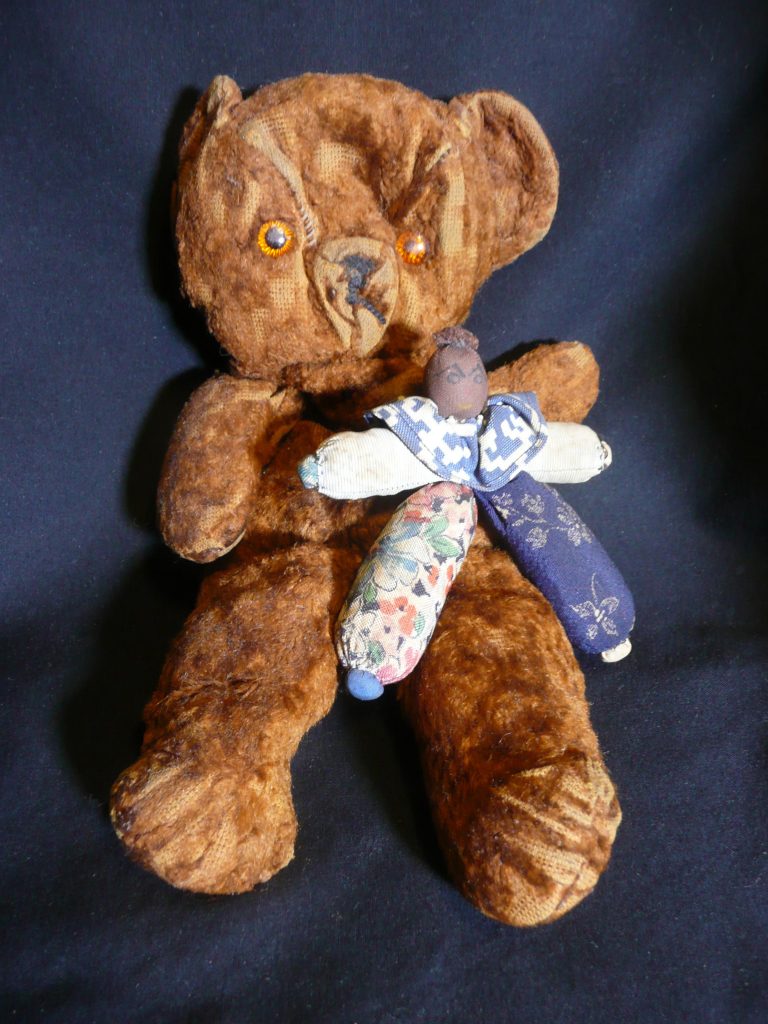
“Teddy and Daruma” by Allen S. Weiss

Like the shaman from his cave, Teddy (yes, Teddy, my teddy bear!) finally emerged, resurrected after a hibernation of forty years, with what particular wisdom I cannot say. I have no idea if Teddy is an adept of Zen, but I am sure that the roly-poly Daruma who now shares, alongside a bizarre pin-cushion doll, his tiny abode – a knitted ski cap full of embroidered galloons – knows by heart the famed kyōgen Jizō’s Dance, about a wandering monk who asks for shelter for the night, but is refused because of the strict interdictions against lodging travelers. After repeated pleading, the owner agrees to at least take in the monk’s large precious straw hat, and soon afterwards the monk appears, as if by magic, under the hat, arguing that as long as he stays beneath the hat, it is the hat that is sheltering him, and not the house, so no law is broken. The owner, amused, agrees to the arrangement, and in repayment for the kindness the monk does a dance that is the finale of the piece. In the manner of true Zen humor, Teddy’s compatriot Daruma relishes the fact of living not under a hat transformed into a shelter, but inside a hat. Superficially, it might seem easy to interpret a world where there are so few elements: a hat, three occupants, eight galloons. To describe it, one might think of a cheap magic trick, or the stage of a destitute childrens’ theater straight out of Dickens, or an addendum to Through the Looking-Glass, rather than of an entire world. But it is grandiose: heaven and earth transposed, a coincidentia oppositorum, a corpus hermeticum for our times. Teddy’s very eyes are an allegory of this primal conflict, one that sees straightforward and clearly with the acuity of an eagle, the other askew and askance; approbation and disapprobation in the crossing of the eyes, a perpetual double-bind that touches all that his gaze falls upon. Can one possibly attempt the interpretation of a world where everything is already its double, its opposite? The calculus is incomprehensible, and with just the thought of it I am already lost in the labyrinth of infinite semiosis!

I have no idea as to what is happening within the terribly confined quarters that house Teddy, Daruma and the disquieting pin-cushion doll whose identity and origin are a total mystery, just as I have little idea about what is going on inside Teddy’s mind. In fact, I even wonder about the reality of Daruma, he who at one point spent nine years staring at a wall in a cave, and, having briefly fallen asleep during the seventh year, immediately cut off his eyelids so as to prevent such an indiscretion from happening again. Is his presence yet one more incarnation of Bodhidharma, during yet another moment of his endless travels, having alighted here because he somehow sees interaction with Teddy as a path to the salvation of humanity? Or is he an emanation of Teddy’s mind, whether stemming from unconscious guilt at having slept so long, or from religious fervor at finding a compatriot who so complements, by sheer antinomy, his long-lived lethargy? Or perhaps Teddy has chosen, for simply pragmatic reasons, an adherent whose zealously wakened state will guarantee vigilance in case Teddy once again falls asleep for an extended period? Or is Daruma just a drinking buddy? As for the sinister pin-cushion doll, I won’t even begin to speculate, fearing what I may find.

Ultimately, it is impossible for me to tell whether Teddy’s domain – the world in a hat – is cosmos or chaos. But then, who can really distinguish ostensible accumulation from hidden organization, who can know object from allegory, reality from symbol? I even wonder what Teddy is to me, and me to Teddy.

************
[Excerpted from The Autobiography of Teddy, forthcoming.]

For more by Allen S. Weiss, please see the WiK piece about his 2016 book, The Grain of the Clay, or his Manifesto for the Future of Landscape where you can find an overview of his biodata and multifarious creations.  (His Author Page with amazon can be viewed here.)


Featured writing

Interview with Yoppy (Tawarayama)

Karen Lee Tawaryama has been interviewing Kyoto people on her blog, Kyoto Faces. In her latest piece she writes of the non-verbal long-running performance called GEAR, which in 2015 was voted on TripAdvisor one of the city’s best attractions!  In the interview below, she questions Yoppy, one of the dance performers about the show and his involvement.  [For more about Karen’s blog, please see here.]

************

I’d like to hear about your story. When did you start breakdancing?

A: I began breakdancing when I was eighteen years old. Until then, I taught hip hop, but I saw someone breakdancing at Kyoto Station and thought it was really cool. At that time, I was with Katsu, another breakdancer in GEAR. I started acting in GEAR about three years ago.

Can you tell your perspective about the GEAR story? What do you feel when you’re acting in the show, and what would you like to convey to the audience?

A: In the show, I’m the yellow robot, who acts as a bit of a fool. In that role, I always try to smile to show my positive attitude and that I’m having fun.

How about the meaning behind the character Doll?

A: Because of the doll’s appearance, each robot discovers his own originality. Over time, the tension builds and everyone starts to have fun together. At the beginning, all of the robots are the same and their routine is rigid, but because of the doll, this all changes. The robots take on their own personalities and talents, and they begin to “feel”. In my opinion, it’s this kind of story.

What’s your favorite part of the play, and also the part your consider the most difficult?

A: I love it when everyone is running around the desk on the revolving stage. There’s a big surge of excitement and there’s a big flurry of activity. That’s really fun for me. As for the difficult part, hmm… There’s a part where, even though I had been moving around, I suddenly have to freeze in place. I always get nervous about that.

What’s your “Kyoto #1”?

A: I live in the neighborhood of Toji Temple, but I often go to the mountain beside Fushimi Inari Taisha, Mount Inari, for training. I climb all the way up the mountain. There’s a place at the very top where the view is really beautiful and you can buy a small juice for 200 yen. I love the satisfying feeling of opening and drinking that juice at the summit.

YOPPY, thank you very much for your time and a wonderful performance!!

FOR MORE INFORMATION:
GEAR performances take place on Mondays, Wednesdays, and Fridays at 2pm and 7pm, and Saturdays, Sundays, and Holidays at 12pm and 5pm. Tickets without reservations are on sale one hour before the show at the show venue. If it is your birthday month, you are also eligible to receive a small gift!

For more detailed information about the show, or to reserve tickets, please refer to the GEAR website: (English): http://www.gear.ac/en/

IMG_0261

Advertisements

Leave a Reply

Writers in focus

Poems & Photos (James Woodham)

A collection of poetic images by James Woodham.  (For an earlier posting of James’s rendering of Lake Biwa in poetry and photography, please see here.)

******

papers on the desk
blown by the wind that blows leaves
on the hillside now

******

Plato’s ideas –
discussion suddenly stopped
by windborn blossoms

******

the baby mantis,
stretching one leg all the way
to the next petal

******
Osawa-no-ike

clouds on the pond
a murmur of voices

ducks float slowly
over trees the wind quivers

a fish rises
ripples the mountains

trees spill birdsong
white egret landing

******

Veloce

Crossing my legs in the cafe,
my pocket tilted, coins fell,
jingling the wooden floor.

Salaryman beside me unflinching,
locked with his business finger
into cell phone dream time.

******

Memory?
Yes,

but
also fact –

for I am
still

standing
there

before
the rocks

in the
garden

hills
beyond.

***********


Featured writing

Hearn on Higashi Honganji

In Chapter 6 of Kokoro (1896), Lafcadio Hearn writes of some of Kyoto’s sights, an unusual topic for a man who normally looked to folklore and tradition for insight into the culture of his adopted land.  However, his belief that religion reveals the heart of the people comes across in the final part of the description below, where he writes of Hongan-ji (representing Jodo Shinshu) as a true expression of the common folk.  Anyone who has seen the amazing ropes there made of women’s hair will know just how much the faith meant to the people of the 1890s. (Elsewhere in his writing, Hearn waxes lyrical about the grace and elegance of the Japanese female, and how vital a role their hair played in their attractiveness.)

But the gift of the people to Kyoto is still grander. It is represented by the glorious Higashi Hongwanji, – or eastern Hongwan temple (Shinshu). Western readers may form some idea of its character from the simple statement that it cost eight millions of dollars and required seventeen years to build. In mere dimension it is largely exceeded by other Japanese buildings of cheaper construction; but anybody familiar with the Buddhist temple architecture of Japan can readily perceive the difficulty of building a temple one hundred and, twenty-seven feet high, one hundred and ninety-two feet deep, and more than two hundred feet long.

Because of its peculiar form, and especially because of the vast sweeping lines of its roof, the Hongwanji looks even far larger than it is, – looks mountainous. But in any country it would be deemed a wonderful structure. There are beams forty-two feet long and four feet thick; and there are pillars nine feet in circumference. One may guess the character of the interior decoration from the statement that the mere painting of the lotus-flowers on the screens behind the main altar cost ten thousand dollars. Nearly all this wonderful work was done with the money contributed in coppers by hard-working peasants. And yet there are people who think that Buddhism is dying!

More than one hundred thousand peasants came to see the grand inauguration. They seated themselves by myriads on matting laid down by the acre in the great court. I saw them waiting thus at three in the afternoon. The court was a living sea. Yet all that host was to wait till seven o’clock for the beginning of the ceremony, without refreshment, in the hot sun. I saw at one corner of the court a band of about twenty young girls,– all in white, and wearing peculiar white caps,– and I asked who they were. A bystander replied: “As all these people must wait here many hours, it is to be feared that some may become ill. Therefore professional nurses have been stationed here to take care of any who may be sick. There are likewise stretchers in waiting, and carriers. And there are many physicians.” I admired the patience and the faith. But those peasants might well love the magnificent temple, – their own creation in very truth, both directly and indirectly. For no small part of the actual labor of building was done for love only; and the mighty beams for the roof had been hauled to Kyoto from far-away mountain-slopes, with cables made of the hair of Buddhist wives and daughters. One such cable, preserved in the temple, is more than three hundred and sixty feet long, and nearly three inches in diameter.

« Older posts Newer posts »

© 2026 Writers In Kyoto

Based on a theme by Anders NorenUp ↑