Page 53 of 65

Writers in focus

Antiquarian Book Fair

Kyoto has three annual book fairs of interest to expatriates, for amongst the Japanese selections are a number of English books going relatively cheap, including art books and ukiyo-e prints.

The spring fair is coming up next week at the Miyako Messe in Okazaki, the summer fair is at Shimogamo in August, the autumn fair at Chion-ji at Hyakumanben.  Please note that the dates given here are from 2016, but you can check the official website here for the latest details.  (For a report of the summer fair, see this Deep Kyoto posting.)

Spring Antiquarian Book Fair (May 1st – 5th)
The first floor of Miyako Messe in Okazaki, near Heian Jingu.
10~16:45 (16:00 on the final day)

Summer Antiquarian Book Fair (August 11 – 16)
Shimogamo Jinja
10:00 – 17:30 (until 16:00 on the last day)

Autumn Antiquarian Book Fair (October 31 – November 4)
Chion-ji Temple, at Hyakumanben next to Kyoto University
10 am to 5 pm

The Antiquarian Booksellers Association of Japan (ABAJ) was established in November 1964 by ten major antiquarian booksellers of Tokyo, Osaka and Kyoto. This was a time when Japan was experiencing an unprecedented economic growth and Japanese collectors, scholars, and curators were avidly selling and purchasing rare material domestically and internationally. The ABAJ was founded with the aim of developing the Japanese antiquarian book trade to meet an increasingly global age. The first “International Antiquarian Book Fair in Kyoto” was held in March 2012.  In 2015 the ABAJ celebrated its 50th anniversary at the Hotel Grand Palace in Kudanshita, Tokyo.  25 of the leading Japanese antiquarian booksellers from Tokyo, Osaka, Kyoto, Hokkaido and Kyushu participated with a further 15 international booksellers from Europe and the United States.

Of Poetry and Pottery (Robert Yellin)

Robert Yellin yesterday launched the third year of WiK with a wonderful talk at The Gael, which was inspired and inspiring in the passion for pottery which infused his every word.

Now recognised as a world expert on the subject, Robert is in demand as a speaker at museums and galleries abroad as well as being asked to write articles for Japanese and foreign publications. In addition, the beautiful and homely gallery he has set up in north Kyoto has become a mecca for pottery lovers of all nationalities.

Remarkably, he had taken no interest in pottery until his twenties after coming to Japan. This had only happened on a whim following a suggestion by his father that he try a homestay there. It was ironic, since his father had been a P51 pilot in WW2 (recently featuring in the news following Scarlett Johannson’s plea for more assistance for war veterans to heal themselves with Transcendental Meditation.)

While teaching English in Shizuoka, Robert found his world turned upside down one day when he was knocked sideways by the beauty of a Japanese pot.  As he put it, it opened his eyes ‘to the beauty and the divine in routine everyday things in life’.

He embarked on learning more about the subject, reading voraciously and visiting exhibitions and pottery sites.  Eventually the self-taught enthusiast approached the Japan Times and was offered a column, which proved a springboard for him to carve out a niche as someone who could communicate the joy of beauty to be found in Japanese ceramics. It led to requests for catalogues, in response to which he opened an internet gallery.

A token of Robert’s ability to involve others in his passion for the subject was his generosity in bringing to the talk a Kamakura-era saké cup, together with a bottle of nihonshu. The 800 year old cup was passed around for everyone to drink from, with the intention of putting a communal seal on proceedings and adding another item to the cup’s long record of human interaction. Pottery is for use as a living object, was the message, not an object to be hid away in an exhibition space and consigned to an obsolete past.

For Robert, pottery is a form of visual poetry, with roots in the present that gives rise to suggestions of the future.  His talk was interspersed with readings from poets who shared his passion, and there were illustrations of some stunning pots, ranging from the Jomon period to the avantgarde productions of today. As a collector he spoke of the difficulty of letting things go, and sadly after responding eloquently to a series of questions from his audience, Robert too had to let go of a subject which clearly means so much to him. ‘I implore you to support your local crafts,’ he urged his audience, underlining how sad it is to see traditional ways dying out in the present generation. With Robert as spokesman, one feels Japanese pottery will surely win a wider audience.

************************************

For Robert’s gallery, see the Yakimono Gallery.
Click here for Robert’s book, Ode to Japanese Pottery.
For Robert’s father, Jerry Yellin, see The Resilient Warrior about the role of TM in helping his PTSD, or The Letter about his wartime experience. For his connection with Scarlett Johansson, see this article.

************************************

Writers in focus

Hearn on silhouettes

On this day, over a hundred years ago, Lafcadio Hearn wrote a journal entry in Kyoto that found its way into the collection of essays in his book Kokoro (1896).  Here, long before Kawabata wrote his well-known thesis In Praise of Shadows, Hearn describes evocatively the attraction of silhouettes on shoji (paper screens) and the delicacy of the aesthetics built into the architecture of Japanese houses.

“Kyoto, April 16. The wooden shutters before my little room in the hotel are pushed away; and the morning sun immediately paints upon my shoji, across squares of gold light, the perfect sharp shadow of a little peach-tree. No mortal artist – not even a Japanese – could surpass that silhouette! Limned in dark blue against the yellow glow, the marvelous image even shows stronger or fainter tones according to the varying distance of the unseen branches outside. It sets me thinking about the possible influence on Japanese art of the use of paper for house-lighting purposes. By night a Japanese house with only its shoji closed looks like a great paper-sided lantern, – a magic-lantern making moving shadows within, instead of without itself. By day the shadows on the shoji are from outside only; but they may be very wonderful at the first rising of the sun, if his beams are leveled, as in this instance, across a space of quaint garden. There is certainly nothing absurd in that old Greek story which finds the origin of art in the first untaught attempt to trace upon some wall the outline of a lover’s shadow. Very possibly all sense of art, as well as all sense of the supernatural, had its simple beginnings in the study of shadows. But shadows on shoji are so remarkable as to suggest explanation of certain Japanese faculties of drawing by no means primitive, but developed beyond all parallel, and otherwise difficult to account for. Of course, the quality of Japanese paper, which takes shadows better than any frosted glass, must be considered, and also the character of the shadows themselves. Western vegetation, for example, could scarcely furnish silhouettes so gracious as those of Japanese garden-trees, all trained by centuries of caressing care to look as lovely as Nature allows. I wish the paper of my shoji could have been, like a photographic plate, sensitive to that first delicious impression cast by a level sun. I am already regretting distortions: the beautiful silhouette has begun to lengthen.”

Writers in focus

WiK Competition 2017 Winner

The Joys of Silence and Bewilderment
by Jane Kramer, California

Yesterday I went with our Japanese obaachan, aged 87, for a massage. I didn’t know for sure if we were really going because my Japanese is primitive. But at 8:15 she emerged from her machiya [traditional wooden house] carrying a bag with polka dot material. I thought that it was the pajamas that she told me to bring for the massage. We walked past a love hotel and a shamisen maker.

Because we cannot communicate verbally, I realized how often we fill sound-space idly. When someone passed walking a dog I told her that I had one at home, yet all I could say was ‘cat’ (neko) and mispronounced it at that. So I pointed to the dog and said ‘niku‘ (meat). Obaachan looked at me quizzically. The moment passed. I realized that it didn’t matter if I tell her that I have a dog in California.
I live in a constant bewilderment in Kyoto. Having the time to enjoy bewilderment is a great luxury.
We arrived and were ushered into a big room. Obaachan put the bag with the polka dot fabric on her cot. Curled on her side she smiled and I saw her eyes without glasses for the first time.
My massage over, I picked up the bag, which I presumed were the pajamas that obaachan had brought for me. Obaachan and my masseur share a laugh. The masseur translated. “They are your son’s underwear which had blown off from your roof. She is returning them to you.”
Walking home, I take obaachan’s hand. I wonder what she is thinking. I think, rare are the times when silence and space are given the honor they deserve.
And holding hands with a woman at the edge of time, I am grateful.

Featured writing

WiK Competition 2017 Runner-up (Leow)

Yamaguchi-san
by Florentyna Leow, Malaysian student in Kyoto

That’s a nice haori you’re wearing. Are you on an errand now? Taking photos? Come in. I’ll make you some matcha. I’m all alone anyway.

Well, come on in. Sit here.

I’m 104 years old, you know. 104. The doctor paid me a visit, right before you passed by. Gave me a clean bill of health. I’m old but my mind’s still working. Not gone senile yet. No one believes it, but I’m 104. Everyone says I look like I’m 80. Next month I turn 105.

Here’s a sweet. You have to eat the sweet before the matcha. But for sencha you eat it after. Sweet before matcha and after sencha.

Hai, dozo.

Mou… Didn’t you learn how to do this in school? Bow first. Pick up the bowl – not like that. One hand. Like this, and the other hand comes below. You turn it twice – no, not like that. You lift it up. Yes. Now drink. You need practice.

I used to teach tea. Omotesenke.

You’re not Japanese? You look Japanese. Your parents? No?

I had a sister. She’s gone now, though.

The haori really suits you. I’m not just saying it. In September you should wear it over a kimono.

Write your name here. What’s this? Katakana? You have a strange name. Ah, you can pass for a Japanese. You came over here, you should just live as a Japanese. Let’s call you Akiko. Ii yo ne? Akiko.

It’s fate that we met.

You go straight home, you hear me?

Make sure you don’t slip. It’s easy to slip and fall.

It’s not safe out there. Back then Kyoto wasn’t so bad, but these days, there’s all kinds of folks out there. It’s getting dark. You take care. And come by again for a cup of tea.

******************

Glossary

matcha is whipped green tea, and sencha is ordinary green tea.

Hai dozo = Here you are / please begin

Omotosenke is one of the three main schools of tea in Kyoto.

haori = long jacket usually worn over kimono

Katakana = one of the three styles of writing in Japan, usually used for foreign words

Ii yo ne – That’s good, isn’t it?

Featured writing

WiK Competition 2017 Runner-up (Poulton)

Palm-of-the-Hand Story: The Blue General
by Mark Cody Poulton, Victoria, Canada

After my mother-in-law died, my wife and daughter were sorting through her things. When they opened her wallet, a funky smell filled the room. My wife pulled out something papery inside—the skin of a snake. It was good luck, I learned, to keep a bit of snakeskin in your wallet. Just as a snake can slough off its skin and it’ll grow back, so you can peel away your banknotes and they will magically reappear in your pocketbook. My wife unfolded the snakeskin. It was large, about the size of a sheet of foolscap. “I bet this skin is from that aodaishō that lived in the Nishiki house,” my wife said. The aodaishō, or “blue general,” is a rat snake, large but harmless. The Japanese call them guardian spirits.

Until she moved in with us, her mother had run a fruit stall in Nishiki Market. She and Mitsuko lived in back of the store, as did just about everybody in Nishiki. The long, narrow houses were connected one to the other, all down the street. Mitsuko said that as a girl she could climb from one laundry rack to the other without stepping out the front door to drop in on a neighbor. ​

Her mother told her that one night, when she was young, she came down with a high fever. As she lay on her futon, she listened to the pitter-patter of a rat in the rafters. Then, zurizurizuri! the slithering sound of the aodaishō in pursuit, and no more pitter-patter of rat feet. That night, her fever broke. Her mother swore the snake had cured her. ​

Hearing this story, my daughter laughed. “You don’t think grandma was really a snake, do you?”​

Writers in focus

Basho’s blossom kimono

Blessings Unto Kasane:

Basho’s Haibun and Tanka of Hope to a Newborn Girl

Translation and commentary by Jeff Robbins

Assisted by Sakata Shoko

               (Basho’s own words in bold to stand out)

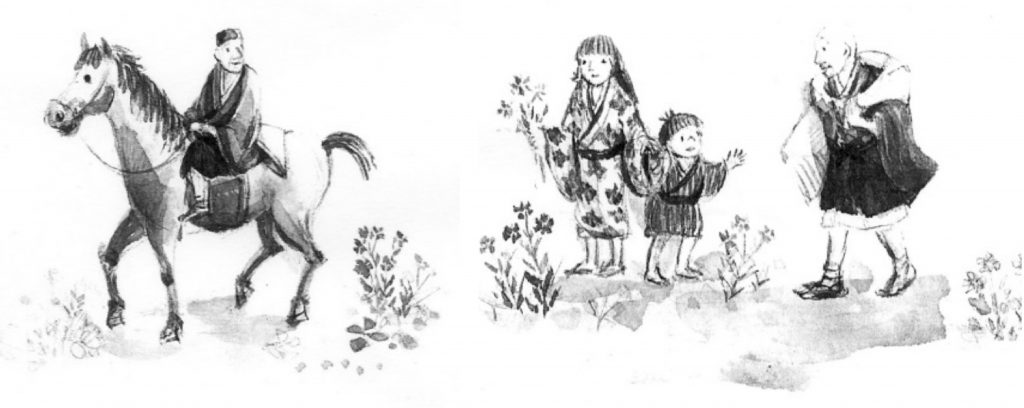
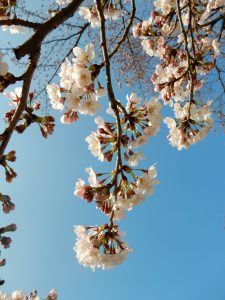
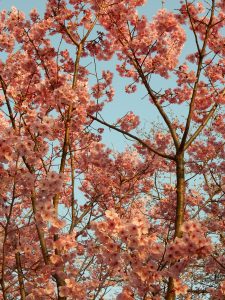
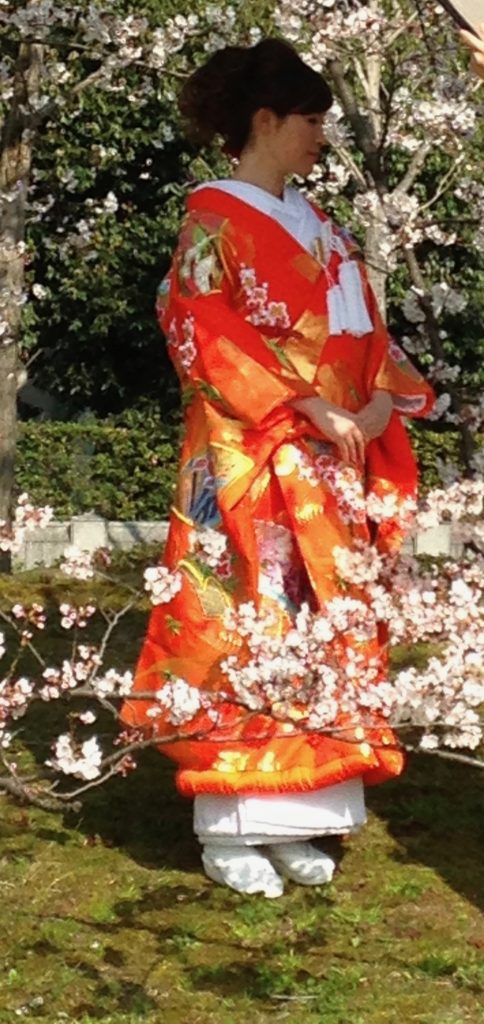
Illustration by Ogura Reiko (Photos by J. Dougill)

In Summer of 1689 Basho and Sora, on their journey to the Deep North, got lost among the fields of Kurobane in Nasu. A kindly farmer loaned them his horse for them to follow as far as it would go, then let it return on its own. The farmer’s two children came running after. Basho spoke to the little girl and was charmed. In his journal account, he writes

Two little ones follow in the footsteps of the horse, one a tiny princess who says her name is Kasane,
an unfamiliar name yet a gentle one.

We see this is a Time of Peace — thanks to the dictatorship of the Tokugawa Shogunate which has eliminated the feuds and wars which plagued the country until the early part of the 17th century– so now in 1689, small children are not afraid of strangers. We also see that Dad was doing childcare while farming.  Kasane is fortunate to have a father like this.

She said her name was Kasane: ka as in ‘cot,’ sa in ‘father’, ne in “nest.” Kasane(ru) is ordinarily not a name, but rather an active verb, “to pile up in layers, one on top of another. Furthermore, in the dimension of time, kasaneru is “to reoccur, again and again, in succession”.

 Nine months later, in the spring of 1690, Basho was in Zeze (Otsu City, just across the mountains east of Kyoto; beside Lake Biwa, the area around the eastern end of the Omi Ohashi bridge, ten minutes by train from Kyoto Station.) Basho formed a profound spiritual relationship with Zeze; this spring of 1690, he wrote about Zeze and the surrounding mountains and adjacent Lake Biwa

The mountains in silence nurture the spirit;
the water with movement calms the emotions

 In a 1692 letter Basho in Edo writes to his follower Kyokusui who lived in Zeze,

Again and again within thy boundaries my heart points,
with humility I know not how, Zeze is like my hometown.                 

 In the spring of 1690, someone in the neighborhood asked a Basho follower to arrange for the Master to choose a name for their newborn daughter. Basho remembers the Kasane in the Deep North, and passes her name on to another. The following haibun ending in a tanka are Basho’s prayer for his goddaughter’s happiness and longevity.   

During my pilgrimage to the Deep North,
in one of the villages there was a little girl
who looked no more than five years old.
She was so small and indescribably charming
that I asked her name and she said Kasane.
What an interesting name!
In Kyoto rarely is it heard
so I wonder how has it passed down
and what is that “layers, again and again”?

 The prose is mostly phonetic hiragana and only a few Chinese characters, and has a natural speech-like rhythm, — and we suppose Basho wrote it that way so it would be easy for little Kasane to read. The farmer and wife wanted a special name for their daughter, not just a name fashionable in the capital city. What were they thinking of when they linked her heritage and destiny to this lovely multi-faceted word?

“If I had a child this name she would receive
I said in jest to my traveling companion
and now, unexpectedly, through an acquaintance
I have been called on to be Name-giving Parent.

Without being biological parent, Basho gets the magical opportunity to give life through a name, and through a poem.                 

       Blessings unto Kasane      

Spring passes by
again and again in layers

of blossom-kimono
may you see wrinkles
come with old age

The double and triple meanings, in both space and in time, overlap in a web of blessing and hope for Kasane and all female children. A silk kimono will, with proper care, last for generations. “Layers of blossom-kimono” has three areas of meaning:

1) the two layers of kimono fabric over an inner robe;

2) the succession of blossom-kimono one woman passes through from bright to sedate as she ages;

3) the kimono passing onto her daughter and grand- daughter, the next layers of herself. Also “wrinkles” are both in the kimono and her skin.

A formal kimono is a two-layer silk robe meticulously folded and tucked around the body in flat, even layers. The colors and pattern are chosen in harmony with the woman’s age. A blossom-kimono for a girl entering womanhood might be a soft pink with bold cherry blossom design on the lower portion. A thick brocade sash of a darker contrasting color encircles her waist. The red inner robe, suitable for a party, shows at the neckline, and where the left side of the skirt covers the right, margins of the kimono lining appear and disappear as she walks.

Speaking to the newborn spirit: ‘Kasane, now your time begins, stretching to infinity before unfocused eyes. Soon you’ll be laughing and playing in the sunshine – that is, if no wars come, and natural disasters, fatal illness, and financial ruin stay away too. One spring in youth, you shall be given your first “blossom-kimono,” an exquisite robe to be worn just once a year to view cherry blossoms, then folded up and stored away until next time to celebrate under cherry blossoms. The springs shall come and go with clouds of pink blossoms filling the treetops to fall in a shower of petals as you blossom into a young lady elegant in your impeccably layered kimono. Each year as you sit with legs folded under you on the straw mat under the cherry trees, creases shall form in the fabric. Carefully, as your mother shows you, restore its silky smoothness for another year.

I pray the day comes for you to pass this youthful kimono onto your daughter, while you wear one more moderate in color and pattern – and this too passes onto her, and you to the dark sedate kimono of an older woman. So, Kasane, may our nation remain at Peace and the happiness in your family pile up layer upon layer until wrinkles in the fabric no longer smooth out and you see wrinkles of old age across your face. Do not despair, my child, for you live again as spring passes by and your granddaughters laugh and chatter in their blossom kimono.’

The tanka SPRING PASSES BY offers Hope to small females —Hope for a childhood without misfortune, hope that she will grow into womanhood and see grandchildren. Basho speaks of what concerns women: the succession of life, the happiness of children — the conditions of Peace, both in society and in family, in which little girls can dress up and party with relatives and friends, and life goes on generation after generation. In less than a single tweet, Basho encapsulates the life of one woman from newborn to wrinkles.

“Civilization will begin the day the well-being of a newborn baby prevails over any consideration.”
– Wilhelm Reich

I know of one poem that compares to Basho’s verse in utter simplicity with profound human depth: it was written by a four-year-old Russian boy in 1928. In the 1960s when nuclear war between America and Russia seemed imminent, the little boy’s poem was set to music and became the refrain to a song. The lyrics never caught on in translation, but the refrain became an internationally known prayer for Peace:

May there always be sunshine
May there always be blue sky
May there always be mama
May there always be me

Both the poems of 46-year-old Basho and 4-year-old Russian boy make a wish from destiny – not the wish for a million dollars or a movie star lover—but rather the wish for something infinitely more precious: that our current Peace will continue. Millions of small children in the world today have reason to doubt these four wishes. The boy speaks only of the environment, mama, and himself, while Basho looks ahead to future layers.

Spring passes by
again and again in layers
of blossom-kimono
may you see wrinkles
come with old age

*******************

To access one hundred articles about women, children, friendship, love, and compassion in Basho, please go to my data base Basho4now@yumpu.com. Here are a few of my recent Yumpu posts which relate to Blessings unto Kasane:

Babies in Basho — 6 Basho haiku, a tanka, 11 renku, and 6 Letters all about babies.

Breastfeeding in Basho — 2 Basho haiku and 8 renku about breastfeeding

Child Welfare – 2 haiku, 8 renku, and 4 sections from his letters

I plead for your help in finding a person or group to take over my 3000 pages of Basho material, to cooperate with me to edit and improve the presentations, to receive all royalties from sales, to spread Basho’s humane wisdom throughout the world and preserve for future generations.

Jeff Robbins basho4now@gmail.com

Featured writing

Poems and Photos by James Woodham

The Beach in Winter

Yaki soba/tako yaki sign spins
outside the closed shop.

Pine tree leans,
dropped needles rusted.

Sparrows
flung from a tree.

Ducks disappear
between waves.

The fishing boat
moves deeper.

*******************

Beachcombing

A leaf,
red stalk
and veins

and on it
still – gold
glinting

now –
the shower
remains.

****************

Reds, yellows
on the wet
asphalt.

Sun
sifts
the air.

The trees
cathedral
Sunday.

*************

At the wind’s
coming

another
tumbles air

a moment
and

is
earth.

*************

To be
present
at the

fall
of a leaf –
to be

the instant
of touched
earth.

**************

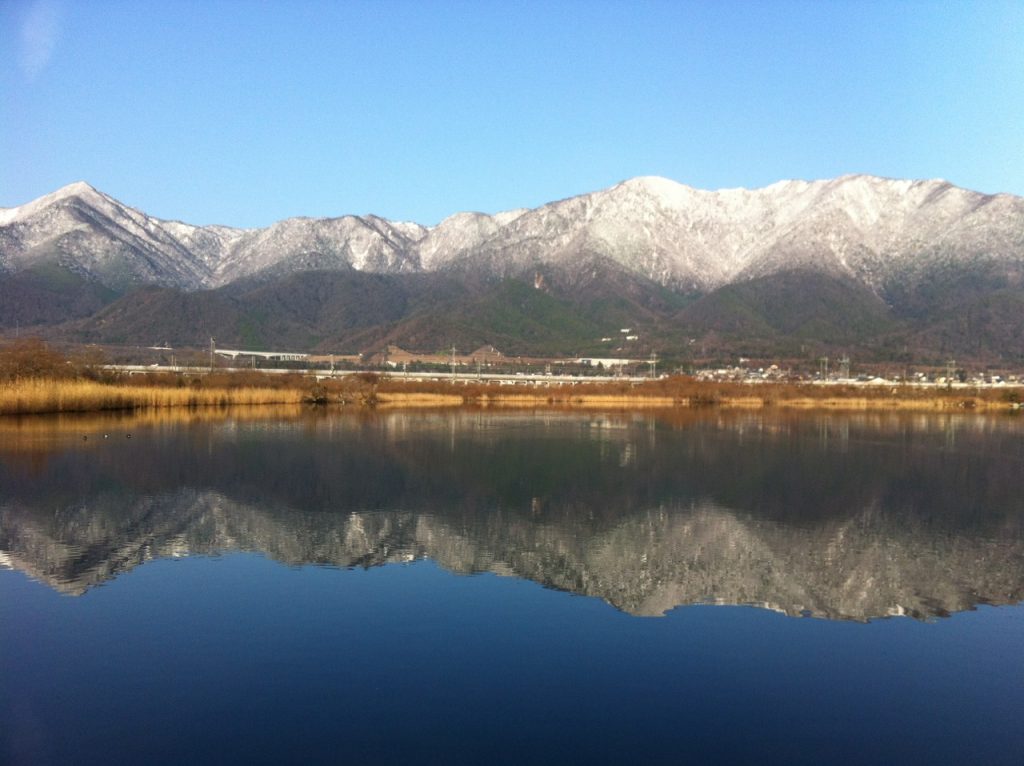
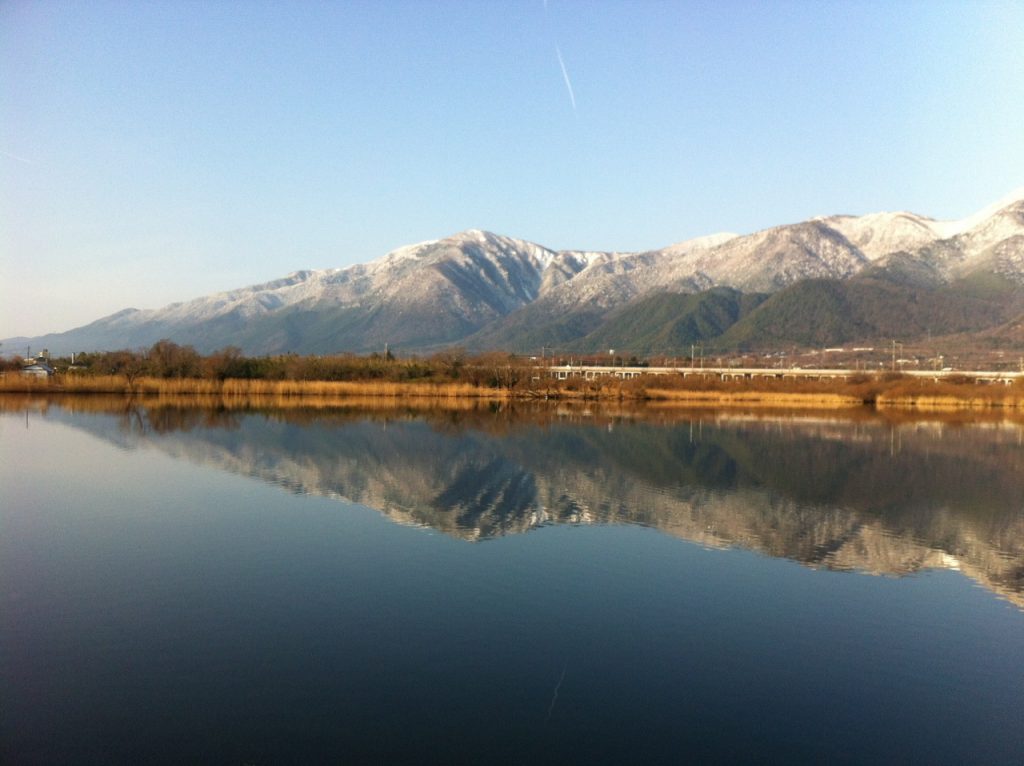
Biwako

lake, mountains
and this

breathless
sweep

of sky.

What
warrants

such
munificence

of emptiness?

******************

this bone-chilling wind
and the numbing distances
of the heartless stars

*****************

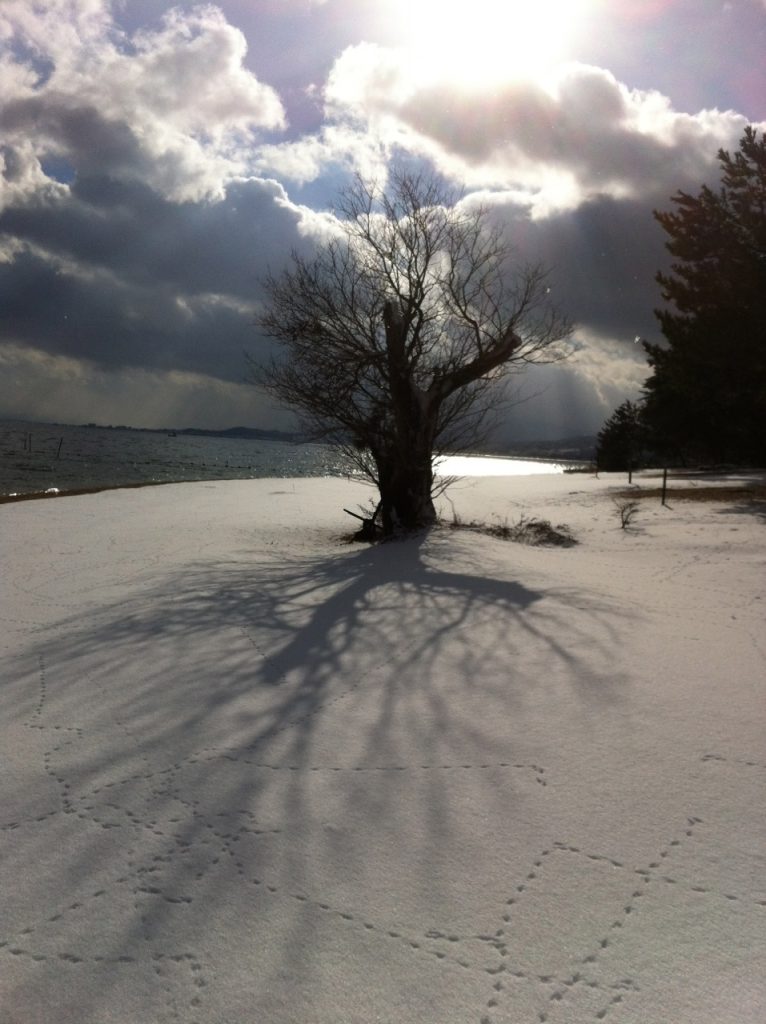
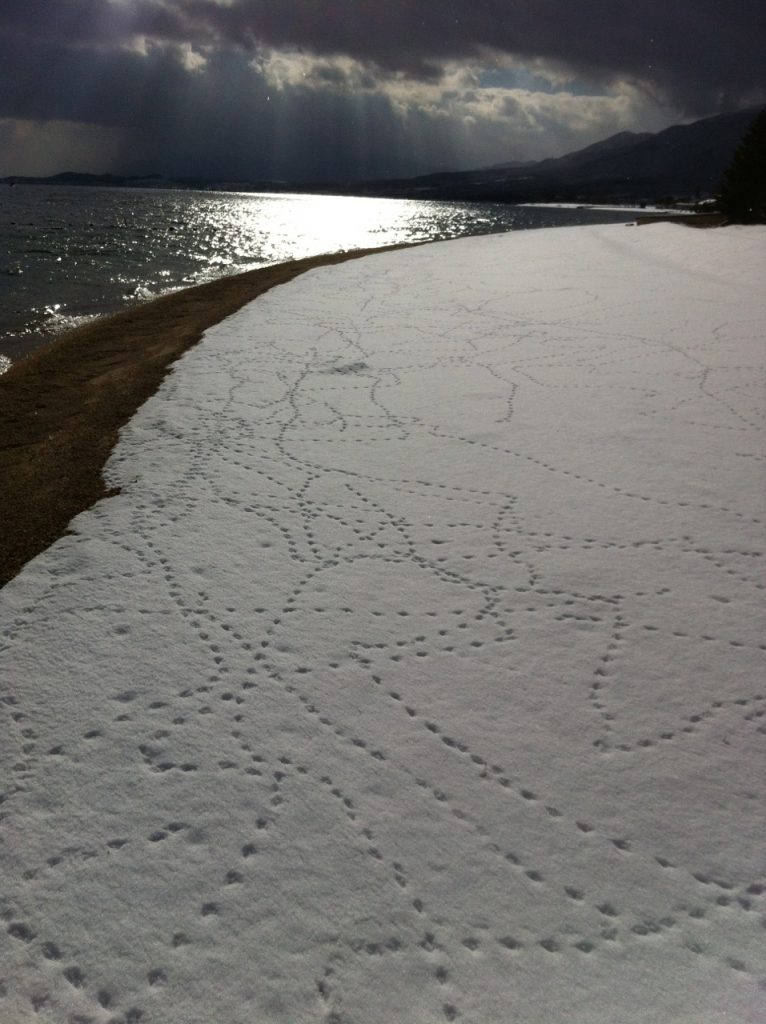
tracks of the wagtail
random dashes in the snow
going where they go

*****************

still there

(at the desk
after running
the shore)

sky wind lake air


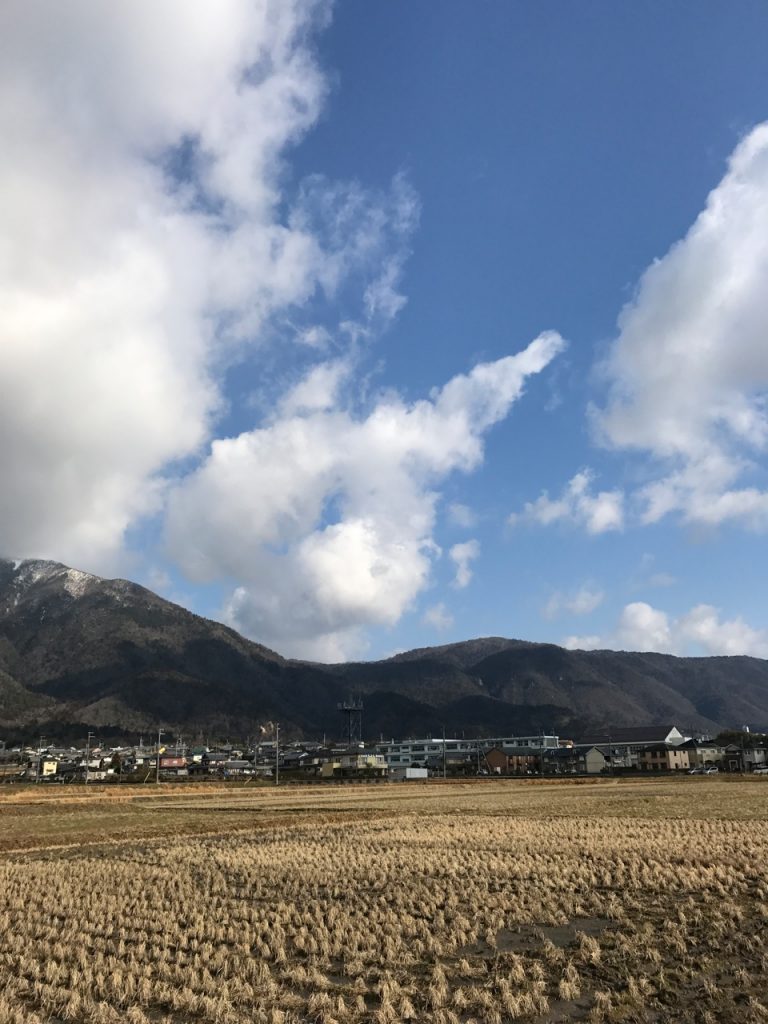
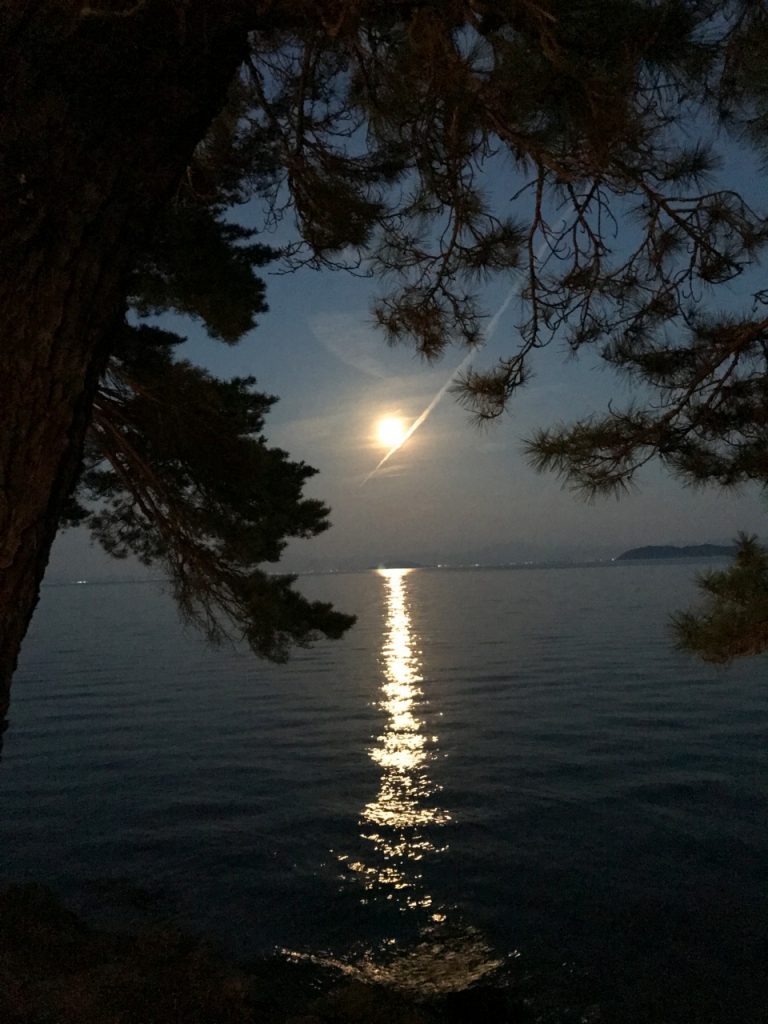
(Photos all taken not far from Omimaiko station near Lake Biwa)


Writers in focus

Edith Shiffert, RIP

Edith with fellow Ohara resident, Venetia (photo Micah Gampel)
Photo by Micah Gampel

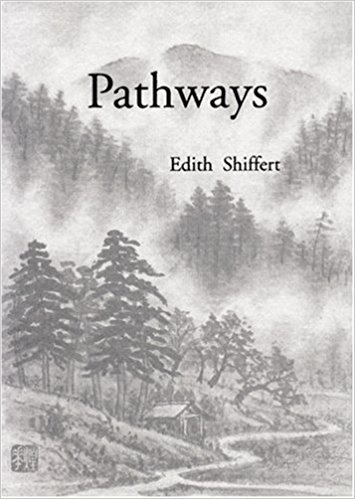
(John Dougill writes…)  News comes of the passing away of Edith Shiffert (1916-2017), long time resident poet and a revered figure for those of us who belong to Writers in Kyoto.  Other English-language authors lived in Kyoto before her, but for the postwar generation and those who followed in their footsteps, Edith was a groundbreaking figure who represented the very best of Kyoto’s literary connections.  This was not only because of the widespread reputation she had, both here and in the US, but for her close identification with Kyoto’s historical and spiritual heritage. Along with such poets as Cid Corman, Gary Snyder and Hal Stewart, she established Kyoto as a rich source of inspirational writing exemplified by the Kyoto Journal in which she often featured.

Personally I first came across Edith in connection with her book on Buson, written in collaboration with a graduate student of mine,  Yuki Sawa. The book was influential in raising Buson’s esteem in the outside world. Thereafter I was fortunate to encounter Edith on several occasions, notably through her guest attendances at the interfaith discussion group run by Morris Augustine. I was also able to visit her both at the Residents Home in Ohara and her final Residents Home here in Kyoto.

Perhaps the book that best sums up her attachment to the city is the Tuttle publication, Kyoto-Dwelling: A Year of Brief Poems (1987). Extracted pages are available online through Google Books and can be read at this link here. It’s worth savoring her poetry while dedicating a few quiet moments in her memory.  There is an autobiographical introduction, and as the subtitle indicates it contains a yearly cycle in 12 different sections, with a seasonal illustration for each month.

Edith first came to Kyoto in the heady days of 1963, and she writes fondly of the various dwellings which gave rise to poetry closely related to the spirit of place: a room on Yoshida Hill overlooking the city; a rented room in a Zen subtemple at Myoshin-ji; a lodging in the north between Takaragaike and Midorigaike lakes, before relocation close to Kamigamo Shrine and later Shimogamo Shrine.  From 1981 she lived at the foot of Mt Hiei in the north east, not far from Buson’s grave at Kompoku-ji.  Here she enjoyed a happy second marriage with Minoru Sawano, which formed the basis for a book in Japanese.

Edith studied Taoism and Buddhism in the 1930s, part of a pioneering generation who turned their attention to the Far East. Her love for Kyoto is evident throughout her writings, and she saw it as ‘a Taoist realm, a place of imagined satori…  The sound of rain. The sound of wind. The silence of falling snow. Ridges disappearing into mist. A sudden bursting out of masses of blossoms. Birds in the early morning. Eroding rocks that blow away as sand. Flowing water.’

This love for the earth
is all I need to survive.
My pack sack holds much.

Writers in Kyoto would like to salute the passing of one of our great predecessors.  RIP Edith Shiffert.

*********************

For a detailed biography and listing of her works, see this University of California site.

For an article and tribute by Jane Wieman, please see here.

For a Japan Times review of In the Ninth Decade by Edith, please see here.

For a listing of her books in print, see here.

Writers in focus

Cats and Dogs in Basho

         CATS AND DOGS IN BASHO

Selection, Translation and Commentary by Jeff Robbins

Words of Basho in this font, bold    

Last January David Duff posted his loving discussion of cats on this site which included no poetry about our feline friends. Here, to complement David’s article, are five Basho haiku and six renku links about cats, plus two haiku and three renku about their canine cohorts. Let us consider Basho an ethologist, observing animal behaviour and consciousness.

The nursery song Yuki (yuki ya kon kon arare ya kon kon…) is a traditional folk tune, so certainly was known when Basho was a little boy around the year 1650.

     Snow

Snowing on and on, hailing on and on

Falling and falling, higher and higher

Mountains and fields wear cotton hats

Every withered tree a white umbrella.


Snowing on and on, hailing on and on

Falling and falling, still not stopping.

Dog joyfully runs about the garden

Cat curls up inside the kotatsu.

A kotatsu is a heater (in our time electrical, in Basho’s charcoal) with a frame holding up a blanket and table top, People sit with their legs inside the warm space and the blanket around their hips – but the cat’s whole body can get in. The song observes that dogs like to get all excited and run about, while cats prefer to be warm and comfortable.

These two renku pairs continue the observation of cats in kotatsu. In the first pair, Basho wrote both stanzas in succession:

With cotton bursting out

walks a pure white cat–

Unknown to us,

within warm kotatsu

lying contented

In summer the balls of soft cotton fiber burst out from their buds, each as soft, white, and furry as a darling little white cat walking amidst the cotton plants.   Come winter, this cat, like an old person, seeks warmth, inactivity, and no involvement with the absurdly changing world. Instead she lies there getting high on the embracing heat.

Uncomforted, the cat

outside, how she cries

Charcoal fire

gone out, ‘twas cold

in the kotatsu

This cat expects to spend the winter inside the kotatsu where it is nice and warm, but now is outside freezing her paws off. Iji explains: the fire in the kotatsu went out, and inside becamse as cold as outside, so here the cat is, crying. Next, the middle segment by Yaba, an ode to the feeling of stroking soft fur on a warm living body, is a bridge between two Basho stanzas.

Gradually

helped to sit up, she

combs her hair

Cat fondly caressed

by the one I adore

To stop blossoms

from falling, if only

there was a way

Recovering from a long illness, with my assistance, she sits up for the first time. Unable to comb her long black locks properly while lying down, now she enjoys running the comb down through the hair again and again, absorbing power into her body. (Throughout Japanese literature and especially in Basho, a woman carries power in her hair – as when the Sun Goddess Amaterasu prepared herself to battle her brother, the Storm God, she let down her hair; as Samson carried power in his hair till Delilah cut it off). Now done with her hair, her next task in a sitting position is to hold her pet in her lap and caress this small furry living thing. Watching her do this, so soon after she was close to death, makes me love her all the more.   If only there was a way to keep the young and tender from growing old and bitter.

Cats in love

       quiet down, bedroom‘s

       hazy moon

The cycle has ended for now, and the screeching and the yowls cease as the hazy moon shines secretly into the room where futons have been laid out on the tatami for people to sleep or make love on.

‘Heat’ is caused by estrogen, so it occurs only in the female. She then invites Mister Cat to turn on his testesterone. Estrogen drives female cats into ‘heat’ several times a year, but early spring is most common. Spring is the season for love and sex in many species, including humans. The pathos of cats at the mercy of their hormones shows us how pitiful we are in love.

Heat periods occur about every two weeks and last about 4 to 7 days. Multiple males will be attracted to a female in heat. The males will fight over her, and the victor wins the right to mate. At first, the female will reject the male, but eventually she will allow him to mate. When cats mate the male bites the scruff of the female neck so she cannot escape (which is why cats like to be rubbed there, behind the neck). The female utters a loud yowl as the male pulls out of her because a male cat’s penis has a band of about 120–150 backwards-pointing penile spines, about 1 mm long; upon withdrawal of the penis, the spines rake the walls of the female’s vagina, which may be a trigger for ovulation. (I’ve heard that sound outside my window.)

After mating the female gives herself a thorough wash… with her tongue which has hooks on it like a brush that untangles fur; also her saliva contains a detergent which cleans fur. If a male attempts to breed with her at this point, the female will attack him. Once the female is done grooming, the cycle will repeat.

                            (Wikipedia)

With my cat

                the stray cat does it,

                crying pitifully    

Wikipedia and Basho tell it like it is.


The lady cat                                                                            

        over crumbling cookstove                                        

        she commutes

The sex-crazed she-cat ‘commutes’ (kayoi) through the kitchen, climbing the stove then jumping out the window, so many times a day on her trips outside WHERE THE BOYS ARE, that the baked clay structure is starting to crumble.

            Love worn thin                                        

    on barley for dinner?

            the lady cat

The verse is a question. Again we see a cat on her way to get laid. Is the family that feeds this cat too poor to give her any rice or fish, only barley, a grain the Japanese consider low-class, tasteless, and low in nutrition, and since she is too horny to eat much anyway, in her malnourished state the nights of frenzy and exhaustion leave her looking like hell, right?

She resents the snarling

cries of cats fighting

High on top,

low on bottom, how

love is done

This is the Toms fighting for “access” to a female. Cats and humans do it the same way: as a struggle for dominance and being on top. Not only in sex but in every aspect of life, those on top stay there – having fun and sex and leisure — while those on bottom remain on bottom for life.

Fujiwara Teika, in the 13th century, wrote what may be the funniest of all classical tanka:

How I envy

his voice unsparing,

the stray cat

with all of his heart,

makes love to his wife

Because Japanese are reluctant to show their inner feelings, Teika envies the cat’s freedom of expression.

On the other hand, Basho wrote what may be the funniest of all haiku:

   Like a saint

   dog stepped on by

   cat in heat

Mataudo means ‘complete person’ — but is used sarcastically in kyogen comedies to actually mean a fool. The lady cat is so drunk on sex-hormones that she walks right on top of a dog. But the dog is asleep, and only half wakes up to gaze around a bit, wondering ‘what was that?’ then goes back to sleep. Basho compares the dog to a ‘complete person,’ a saint or a fool, who can face any situation with equanimity.

   Clouds passing over –

   a dog peeing on the run

   village winter shower

On an early winter evening, clouds gather in the sky, moving fast while they drop sudden cold showers. To portray this phenomenon Basho chooses a striking image: a dog pissing while running. The rain falls on a village where many dogs run about, and sometimes pee. Clouds, dog, village, and urination, all are one with the season, rain, and movement.

He stays for two nights

before his enemy’s gate —

Sweeping away

dreams, on the field stands

a statue of Jizo

Longing for a wife?

call of mountain dog

A warrior seeks to kill his enemy who plans the opposite. He waits with his weapons at the enemy’s gate, never knowing when and how that one will appear. His feeling is “threatened.” He must remain half awake all night long, ready to defend himself. By force of will, he sweeps the dreams from his drowsy mind. In the nearby field stands a statue of the bodhisattva Jizo, the Buddhist “Guardian of the Roads.” Anthropologist Michael Ashkenazai explains: “Jizo comforts those in distress, succors captives, assists all those in need … Statues of Jizo were therefore erected along lonely mountain passes and difficult roads.” So the warrior calls on Jizo for strength to stay awake and stay alive.

That lonely cry in the distance, is it real or in a dream? Wild dogs do not form pair-bonds, so there is no concept of “wife” in their world. Is the ‘dog’ a real dog or a metaphor for man or men? Or for Basho who had no wife. Jizo “comforts those in distress… and assists those in need.” The male seeks a wife to do the same for him. Within this trio is the life of a warrior: his struggles against male enemies and against nature (the need to sleep), his use of religion to justify these struggles, then (from Basho) his longing for female love. Basho may not have thought of these meanings, but we can.

On stage from humble

cottage the forlorn cry —

Dumb jerk’s

loud squeal of surprise

at the scene

A dog being stabbed

that voice is so sad

 Each of the three stanzas highlights a voice responding to the transitory nature of existence: first, the dejected cry of someone in a stage play whose happiness has vanished. Next, the moron in the audience who reacts noisily. Finally, Basho gets REAL with the actual cry of a life being snuffed out.

Such coolness

naked and waiting for

moon to rise

Straw mats held in front

 they run and jump about

“Is he sleeping?”

strange that the dog’s tail

keeps its shape

Here are little children in summer with no inhibitions at all about taking off their clothes when the heat is so oppressive even in the evening. They wait for the moon to rise, but this may carry the hidden meaning of “waiting for puberty.” Basho says naked is okay, but how about a bit of restraint? The kids hold thin straw mats about a meter square in front of their privates as they dash about screaming. Still we see their “moons.” These children in the paradise of innocence feel the first hints of shame to emerge when their bodies show sexual traits – yet still they are children and can enjoy “running and jumping about.”

One naked child notices a nearby dog asleep — but holding tail up with attention.   Shiba and Akita dogs, the original breeds on these islands, are known for perpetually holding their tails up in a perfect curl, the white fur under the tail curling around to show on top, as round and white as the moon. (Ahh, the link between the three stanzas). The child who frolics in naked joy has consciousness and can observe with wonder the natural world.

The poet 300 years ago makes this observation, through the eyes of a small child, about Japanese dogs, and also about the nature of sleep, consciousness, and muscle control. We can see these round tightly curled tails any evening in a Japanese neighbourhood. Somehow the brain signals which produce this tail shape are programmed into Japanese dog genes. I have a shiba dog, and she always hold her tail in a perfectly round curl. When completely relaxed her tail falls, but she can also sleep with it fully round. In other dogs in the neighborhood, the circle of tail may not be so neat and round, but still with some control in that direction. Often when I see my dog Suzu’s full moon tail, I think of this stanza or the entire trio. Thanks to Basho and his followers, it becomes more fun to be with my dog – and thanks to Suzu, the renku trio becomes ever more enjoyable.

**************************

To access several hundred Basho poems about women children, friendship, love, and compassion, please go to Basho4now@yumpu.com. Mostly recently I have uploaded the following which may be of interest:

Basho Discovers Lightness — 10 Basho haiku, 3 renku, 6 letters, and 10 passages of speech about Basho’s Ideal for poetry.

Basho on a Journey –– 11 Basho haiku, 10 renku, 8 prose passages, and 3 Basho letters on the nature of traveling.

Shonagon and Basho — 8 passages from Sei Shonagon’s Pillow Book, 4 related Basho haiku, 2 linked verses, and a bit of Basho speaking about Shonagon.

I plead for your help in finding a person or group to take over my 3000 pages of Basho material, to cooperate with me to edit and improve the presentations, to receive all royalties from sales, to spread Basho’s wisdom throughout the world and preserve for future generations.

Jeff Robbins  basho4now@gmail.com

 

« Older posts Newer posts »

© 2026 Writers In Kyoto

Based on a theme by Anders NorenUp ↑