Page 55 of 65

Featured writing

New Year Basho (Robbins)

New Year Basho

Eight Basho haiku, four linked verses,

two Basho letters, and one haibun

                   Selection, translation, and commentary by Jeff Robbins

     Words of Basho appear in bold face


For the New Year of 2017 and Writers in Kyoto, I have assembled a collection of Basho works on the human experience of this season. Basho writes of Hope emerging after a long darkness, of the Sun Goddess Amaterasu rising from the horizon, and of the things people do at New Years: getting up early to see the first sunrise, visiting shrines, offering good wishes, eating special foods, playing customary games, and enjoying the first signs of spring – all within the still very cold weather.

New Year in traditional Japan was by the lunar calendar in which the 1st day of the First Moon occurs on average in early February by the Western calendar (in 2017, however, the lunar New Year is Jan. 28th).  Nowadays, of course, the Japanese celebrate the New Year on January 1st, but this is too early in the year for many traditional New Year experiences. For instance, the call of the uguisu or bush warbler is suitable for a New Year poem because the bird does actually first sing out in the freezing weather of February, but not on the first of January. A poem which mentions a Japanese New Year custom is a New Year poem, even without the words “New Year,” and contains the February hope for a new year and a new spring. Zoni — a vegetable stew containing mochi, rice cakes made from glutinous rice, traditionally eaten in the New Year season –belongs to this season. Poems about mochi may be another season, however if the mochi is combined with another February experience, the New Year reference is clear.

Bush warbler

poops on the rice cake                     

verandah’s edge

Mochi rice cakes are eaten throughout the New Year which in Japan lasts up to three weeks. As the days pass, with no refrigerators or plastic wrap, the leftovers get moldy – however dried in the sunshine, the mold can be wiped off and the mochi eaten – but not if it had bird poop on it. Usually we hear the lovely song of the bush warbler, but Basho notices something else about the bird. Scholar Kon Eizo says this verse is a “crystallization” of Lightness; it gives a definite form to Basho’s ideal: nothing poetic or philosophic, romantic or tragic, simply life as is, with a touch of humor, to be interesting. Small children will like any verse with pee or poop in it, so this should be a favorite.

Basho began the year 1683 — on February 5th, with this haiku

New Year’s Day –

 thinking of a lonely

  autumn nightfall


I believe he is “thinking of” the autumn nightfall two and a quarter years earlier when he wrote

              Withered branch

               where a crow has settled

                autumn nightfall


The branch lifeless, the crow black and forbidding, the nightfall cold and dreary, accumulate to form sabi, or wabi-sabi, which the Japan Encyclopedia defines as “a medieval aesthetic combing elements of old age, loneliness, resignation, and tranquility.” This poem accompanied some profound realization of human loneliness – we might call it an existential crisis – which led to Basho to give up his ordinary life in society to be a wandering poet; for the next 18 months, he studied/practiced Zen Buddhism, and wrote numerous heavy, desolate poems reminiscent of Chinese Zen recluse poetry. Scholars claim the heaviness of WITHERED BRANCH is characteristic of Basho. In reality, however, sabi only characterizes the two years from late autumn 1680 through winter of 1681 and into 1682. From 1683, Basho begins to lighten up, and the majority of his works, especially his linked verses, shine with Lightness: here in 1689:

         New Year’s Day

         sun on every field

          is beloved

At New Year’s rice fields are barren expanses of mud and frost with row after row of cut-off stubble; the Sun (Goddess) weak and cold yet shining with the promise of better things to come – so we love Her.

In a Shinto ritual, ice from winter is preserved in an ice house to last until midsummer, and that spirit of perseverance offered to the kamisama. As the Japanese frequently advise each other, gambatte, “persevere, hang in there, maintain your strength.” Basho begins this renku stanza pair in the hot season with a dedication to that last bit of ice which has persevered for six months:

                      So it will not melt

                       this ice we dedicate

New Year’s dawn

the morning sun a faint

glimmering


Issho switches from mid-summer to freezing cold New Year’s daybreak; just before we see the first bit of Sun-circle, there is a glimmer on the horizon. The joy of reading renku occurs when we expand our minds to see the affinity between Sun rising into the sky and the thermodynamics of ice melting. The stanza-pair is a poetic representation of the yin-yang symbol. Yin is dark and cold; Yang light and hot. The bit of ice in the midsummer heat is the spot of Yin in the field of Yang; the sun rising in midwinter is the bit of bright heat in the cold dark field. The two fields with opposing spots together form the cycle of the year, of reality, of consciousness.

The phrase hana no haru, “flowery spring,” belongs to the New Year. To accommodate those of us who cannot imagine flowers at New Year, I translate “glory of spring”:

                    There is a man

                     covered by a straw mat

                     glory of spring

A beggar sleeps under a straw mat in the freezing cold New Year’s weather. This man who most people ignore or wish to ignore, has an identity, a human dignity, within the glory of spring. If not for fortune, I could be him.


Socks taken off to dry

air shimmers from wall

At New Year

we take along our

little buggers

Though meaning we hide

they stand and listen


                       Tabi nuede hosu / kabe no kagerou

Nentou ni / chiisaki yatsura / tomo sasete

                       Kakusu tayori o / tachi-nagara kiku


Whose socks are these? And why did they get wet? Basho explains. On New Year’s Day we get dressed up to visit shrines and friends and people important in our lives – so we adults have a lot to talk about. We brought the kids along with us, but really they did not want to go. (Ciisaki yatsura: yatsura is the plural form of yatsu, a slang word meaning, for an adult, “guy” or “jerk” or even “asshole,” although chiisaki, ‘tiny,” makes them small and cute. We told them to keep their cloths clean, but somehow their socks got sweaty. I hang the socks on the garden wall in the New Year’s sunshine; moisture and odor from them rises to form shimmers in the air.

Bokusetsu takes Basho’s thought off into a different direction; the socks and wall disappear. As we walk about and talk to relatives, friends, and people important to us, a lot of what we say is not appropriate for children to know, so we hide our meaning in a maze of adult words with references to people and things they know not; the Complete Renku Anthology says “we speak rapidly and respond with ‘uh huh’” – but how much do these highly attentive language sponges pick up? Adults think that language comprehension requires knowledge of each word’s individual meaning, but children get the meaning from context. The link between the two stanzas leads us into the nature of language, concentration, and intelligence.

Japanese for 20 centuries at New Years have played hanetsuku, non-competitive badminton in which the purpose is to volley as long as possible. The following haiku was written in 1702 by a seven- year-old girl, Haru, from Osaka, the great mercantile capital of Japan, where everyone is a merchant.   Her daddy is busy all year long. Rarely does he spend any time with her. She loves New Year’s because he takes three whole days off from work, and will play lots of badminton with her. Near the end of the year, when he comes in to say goodnight to her, Haru asks in her most charming voice:


How many times

               must I sleep? Daddy…?

till badminton!

We feel her love for Daddy, her patient though eager waiting for him to spend time with her at New Years. Haru-chan teaches us that seven-year-old girls 300 years ago thought and felt this way. Where else is there such a record of a small child’s consciousness from so long ago?


On New Year’s Eve, reluctant for the year to pass,

I drank deep into the night, then overslept

On second day

                       I shall not blunder,

                       glory of spring


He was “supposed” to get up early to see the first sunrise, but… The bed was so warm and the dawn so cold.   He promises himself he will do better tomorrow. What do you think? Will he “blunder” tomorrow too? There’s enough “glory of spring” at noon.


Spring arrives late in

sacred Nachi Mountains,

New Year’s Arrow:

all the young sons try

to shoot the best


The Nachi mountains near Kumano in Wakayama-ken are famous for warrior disciplines such as archery in weather so cold one can barely feel fingertips on the bowstring. Archery competitions are a New Year’s ritual, and for boys coming of age, a manhood ritual. (Sort of like ‘who can pee the furthest?’) In the link, we may discover the nature of puberty. Sexuality is a type of “heat” which children lack, so they are winter. New Year (in February) is like puberty, when some parts of the body first feel that heat while other parts are still cold and dormant. We look forward to Spring, the season of romance, when that heat fills the body, but beware of things getting too hot in summer.

Here is a trio from a renku Basho and his followers wrote on the journey to the Deep North:

From last year’s battle
bones bleached white
On her day off
the wife escorted home
in falling rain
The fragrance of mist
as she washes her hair

Many months have passed since the great battle, and the bones of warriors picked clean by scavengers and exposed to rain, snow, dew, and wind, lay white on the ground. Basho jumps from “last year” to a New Year scene. Servants were given a day off on the 16th day of the First Moon. A married woman who works as a servant walks back to her native home. She knew she would have to pass the spooky old battlefield, and could not do so alone, especially in the gloomy February rain, so someone walks with her to alleviate her fear. The next poet jumps from “falling rain” at New Years to the mists common in spring. The first thing she does upon arrival at her parent’s house is wash the bad vibes from her hair – the hair which contains her life-force.   We breathe in that smell of long thick wet hair – as in beauty parlors – like the smell of mist.

From the 17th century Japanese commoner children went to private schools known as terakoya. Girls studied homemaking skills, arts, and music, and could read and write in the phonetic kana alphabets. Boys learned to read and write the thousands of Chinese characters used in formal Japanese. They practiced with copybooks such as Tenkin Orai, a series of letters appropriate to each month, giving students a wide range of content to copy, so they would learn how to understand and use all those characters effectively.


Your copy books –                                  

 from whose satchel shall                                                                                                                                                  

  the year spring?

On the first day of school after New Year’s break, also the start of Spring, a teacher tells the students to take out Teikin Orai and practice writing New Year’s greetings (similar to the one billion nenga-jo 120 million Japanese send out at the end of the year to arrive on New Year’s morning).  It would be clearer for the teacher to ask “from whose satchel shall the best penmanship spring?” or even clearer, “who can do the best writing?” But this teacher’s question is more interesting to the children, and they play along with the game, and shout    “Me! Me! From my satchel the year shall spring!” So they all work hard, as if playing a competitive game, to get better. Instead of simply telling the students what to do, this teacher adds interest to the learning process. Both Basho’s father and his older brother taught calligraphy to neighborhood children to supplement their farm income; this haiku shows he knew how to motive children to learn.

New Year’s Day:  

Year after year

worn by a monkey

a monkey’s mask

Haiku scholar Kon Eizo says, “At a New Year’s performance, a monkey’s mask worn by a monkey changes nothing – so we repeat the same foolishness each year.”

For the New Year of 1693 Basho received a letter from his childhood and lifelong friend Ensui with a haiku telling of the birth of Ensui’s first grandchild, a girl:

New Year’s Day

 ‘still an edge emerging’

  plum blossom

“An edge emerging” is the first bit of white petal seen as a flower bud starts to open, but also is a phrase in the Tale of Genji describing Genji’s baby daughter, the Akashi Princess. Ensui applied this image, both natural and literary, to his infant granddaughter emerging from the womb, and also to the New Year emerging from winter. For the next New Year, 1694, Basho sent a letter to his old friend:

In the spring of last year the scent of plum blossoms I heard of

‘still an edge emerging,’ this year gradually shall become fragrant

and colorful, so I guess how much you love her.

The whole tree will become gorgeous, as the infant who can now stand by herself goes out into the world. Basho links his heart with Ensui’s, feeling Ensui’s love for his granddaughter in his own chest.

 Having taken one step past half a century pickled radish

shall penetrate my teeth, and I may learn to appreciate

the mochi in New Year’s vegetable soup, though I have

come to wonder if the remnant of years is approaching.


By the Japanese count, Basho is 51, entering his second half century. The sharp flavor in daikon pickles penetrates his teeth old and needing much dental work. Mochi itself has no distinct flavor to arouse young people; they like it mixed with other flavors. Only old patient taste buds enjoy it for its subtle flavor Also this New Year, Basho in Edo wrote to his samurai friend Kyokusui in Zeze beside Lake Biwa: he mentions the previous New Year when Kyokusui was in Edo and came to visit Basho:


Thank you for your New Year’s letter. I treasure the knowledge

that your wife and children welcome the New Year without misfortune.

Last year when you were in this province, we encountered the new spring together.

Enjoying the ‘first laugh’ was a novel experience. This year alone I yearn for you.


Japanese custom cherishes various firsts-of-the-New-Year: the first dream, first sunrise, first hawk sighting: the “first laugh” is not one of these, but Basho and Kyokusui invent a new custom. We may follow them in cherishing and remembering our year’s first laugh.

That was a meager vegetable-mochi soup I served you.

This year at your house the uba fed you so much you got sick of it.

Basho managed to cook some zoni for his guest, but is no chef, so the soup was “meager.” Zoni is traditionally eaten throughout the 20 days of the New Year season. Thus by the end of the First Moon, when this letter was written, one might be tired of zoni. We see that the uba— an old woman servant who probably was Kyokosui’s wet nurse—likes to overfeed her baby. Basho is kidding his friend.

The samurai Ranran, one of the first in Edo to follow Basho, continued his support for 19 years. He died in 1693 in his forties. From Basho’s essay Grief for Matsukura Ranran.

I remember a New Years past, Ranran holding hands

with a small boy came to my door of weeds and said

it would be good if I gave the lad a name.

A samurai dad walks holding hands with his little son. (Say what?!) Maybe some samurai were not so strict and ‘manly’ as we imagine today. Basho replaced Ranran’s son’s infant name with one more suitable for an active and intelligent young boy. The little boy in his New Years finery was so handsome that Basho thought of the 3rd century Chinese sage Ojuu famous for his beauty as a small child.


This child was as handsome as a glimpse of the sage Ojuu at age four.

So I picked out the character for ‘juu’ and named him Ranjuu.

Basho “picked out” the character juu from Ojuu, and combined it with the first ‘Ran’ in Ranran, forming a name half from the father and half from a Chinese sage known as a handsome and brilliant child. When Ranran heard the name Basho chose for his son and saw the characters he selected:

The flush of Ranran’s joy, even now, has not left my eyes.

*****************

I have written an article containing the many, many occurrences in Basho works of the words yorokobi (joy) or yorokobu (to enjoy). Remembering this feeling in Basho, I hope your 2017 is joyful.

I request your assistance in getting out the word on the warm affectionate Basho who wrote hundreds of poems about women and children, about friendship, love, and compassion –hundreds of Basho works few people know, yet I believe the most pro-female, child-centered, and life-affirming works in world literature.

Feedback will be greatly appreciated.
basho4now@gmail.com

Featured writing

Year-end thoughts

One of WiK’s members has produced a retrospective look at the departing Year of the Monkey.  Some may have mixed feelings as we see off another year, but perhaps there’s something in this midwinter miscellancy which will resonate with the sensitive reader.  Our thanks to Anonymous for this Christmas Day package, a timely reminder that while yesterday is history and tomorrow a mystery, today is a gift and that’s why it’s called the present.

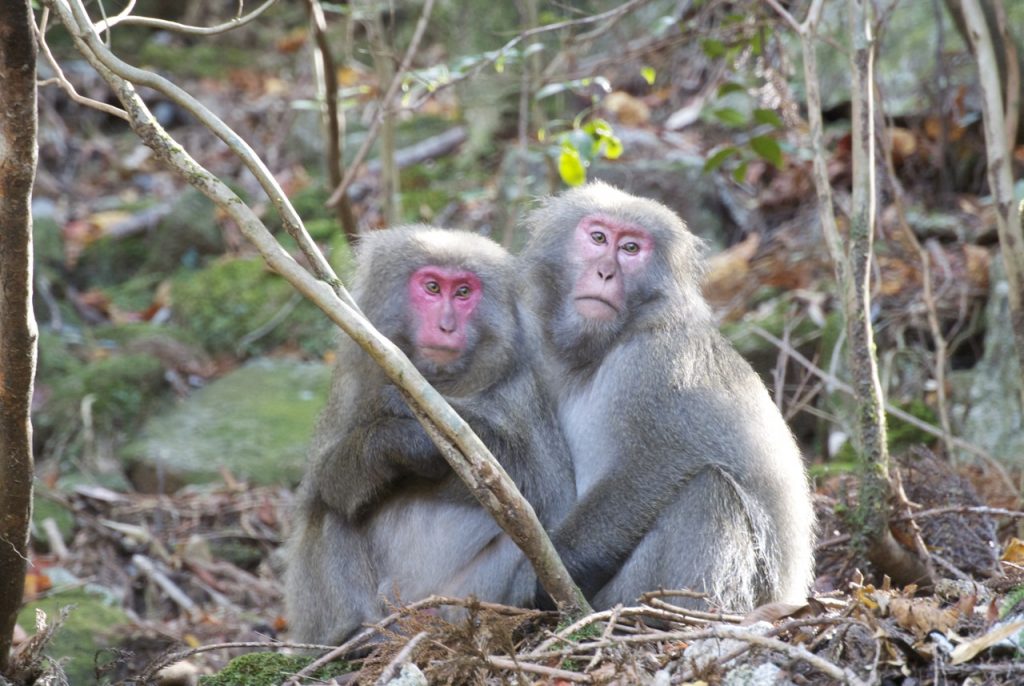
Goodbye, monkeys, it was fun while it lasted! (photo by J. Dougill, Yakushima)

Monkey Miscellany, Kyoto (Year of the Monkey)

Crow in the garden
Steals a fiery persimmon
Off to black boughs


Yellow temple wall
Yawning autumn slow sunlight
Sway leafless shadows


The wars of electricity
fought over dreams
Perhaps peace
when the world wakes up


Fall calico carpet
Forest floor wall to wall
were there walls


The young seek diligently
what the younger have found
and discarded
The old wander joyously lost
and empty handed


Crack clear winter dawn
(news is scarce)
two crows by railroad tracks
pick through steaming vomit

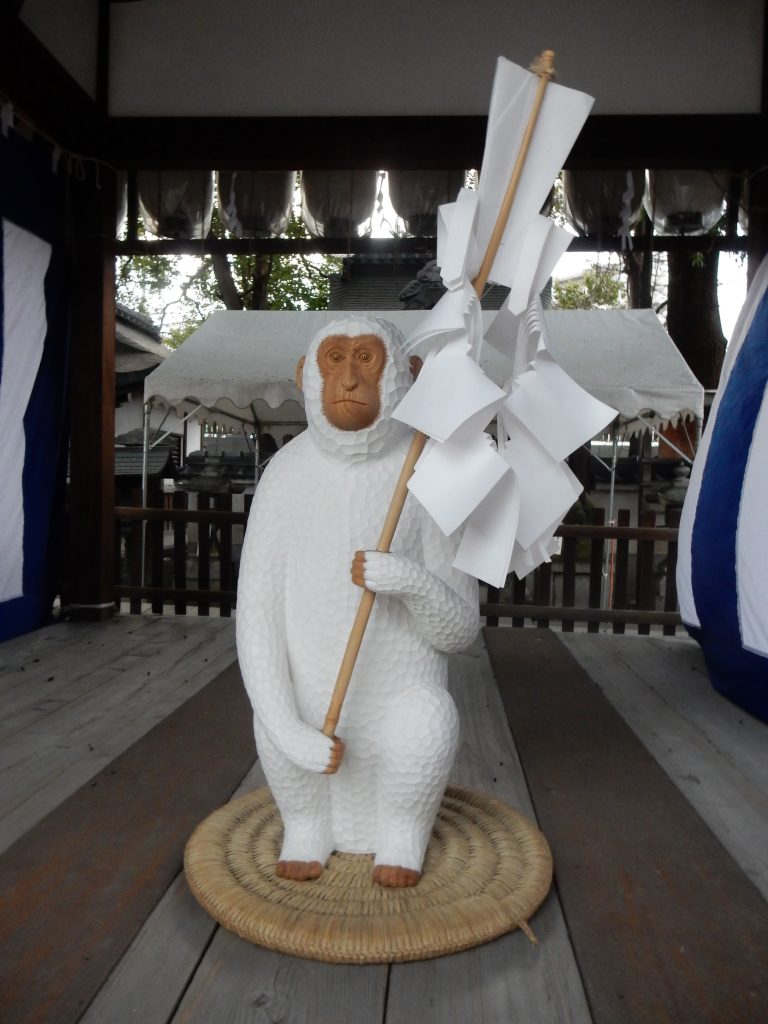
This white monkey at Sarutahiko Jinja (Kyoto) is seeing out the year, getting ready to pass the baton to the white rooster on the morning of Jan 1 (Japanese custom following the Meiji Restoration and the change to the Gregorian calendar).


“Mt. Hiei in the ‘blue hour’”

dark trees
patches of snow
clouds descend with night
escorting more dark
into these words


The New Year
fleeting warmth and laughter
many shoes in the genkan


What has not vanished
is illuminated
all but ghosts come to light


Where and when
Teachers are here
But they don’t appear
There and then


Clouds closing in
Winter wind cotton canopy
Only a blue void left behind


Bernie on publishing

Joe Cronin (left) with a wry smile as Bernie MacMugen holds forth on the processes of publishing and printing

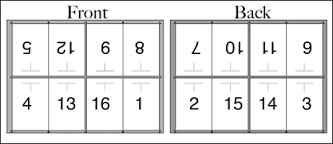
A different view of publishing was provided at an engaging session hosted by WiK member Bernie MacMugen at Cafe Maaru (Dec 11, 2016).  In place of the usual author’s perspective, Bernie pronounced himself an unashamed bibliophile with a fondness for hardbacks and no particular interest in writing.  Instead he aspires to start his own ‘micro-publishing’ venture, producing specially bound books in limited editions.  Among his personal collection of some 3000 books, 75% are hardback.  Despite the costs, he makes every effort to hunt down hardback copies where possible because he considers these to be proper ‘books’ with ‘signatures’ stitched together.  And what is a ‘signature’?

A signature is a group of pages that are printed on both sides of a sheet of paper. The paper is then folded, cut and trimmed down to the finished page size. The number of pages on a signature depends on your page size and the size of the press sheet they fit on.

Bernie brought an example of a 16-page signature and showed how it could fold into a booklet, with the numbered ordering of the pages something of a revelation to those attending (ten people in all).

The talk was based around an impressive coloured handout (visible in the foreground of the picture above) and began with an overview of publishing history, featuring woodblock prints in 200 AD, Gutenberg’s printing revolution, and the exponential increase in the number of books in the eighteenth and nineteenth centuries following the development of the rotary press and paper roll press.

One topic of particular concern to Bernie as a book collector was ‘acid paper’, which meant that books between the 1850s and 1940’s were  prone to deterioration and decay.  Only in the 1930s did the problem become evident, so anti-acid measures were taken and by the 1950s all books were acid-free.

Another area of concern for the would-be publisher is copyright, and again he gave a historical view of developments. Around 1680 England introduced copyright for seven years, though this was not enforced in the colonies. In the US copyright protection was introduced in the 1790s for up to 14 years.  This was extended in several stages since then, notably in the so-called Mickey Mouse protection law.

Bernie then turned his attention to out of copyright books. One example was a celebrated tea book by A.L. Sadler, first editions of which are extremely rare but which was reprinted by Tuttle – with assertion of copyright. How could they justify that? Apparently by simply adding a Foreword, they could then copyright the whole book as a new edition.

The session closed with a postscript as it were, with Bernie introducing a huge collection of English-language books to which he is privy.  Twenty years ago a very rich Japanese eccentric had wanted to set up a bookstore, to which end he travelled to the UK and bought up thousands of classic English Literature works.  His plan never came to fruition however, as a result of which the collection is stored unseen in a climate-controlled room. Catalogues have been professionally prepared by a professor Fujita, but as yet there is no sign of a move towards actual sale.  This means that anyone with an interest can get a private viewing, and as Bernie suggested this might well make an interesting outing for Writers in Kyoto next year.  For expatriates dependent on amazon, this would be a rare and treasured chance to get one’s hands on historical hardbacks – or as Bernie put it ‘real books’.

Our thanks to Bernie for an enjoyable and informative session.  And best wishes to our readers for a festive winter solstice and for the coming New Year of the rooster….

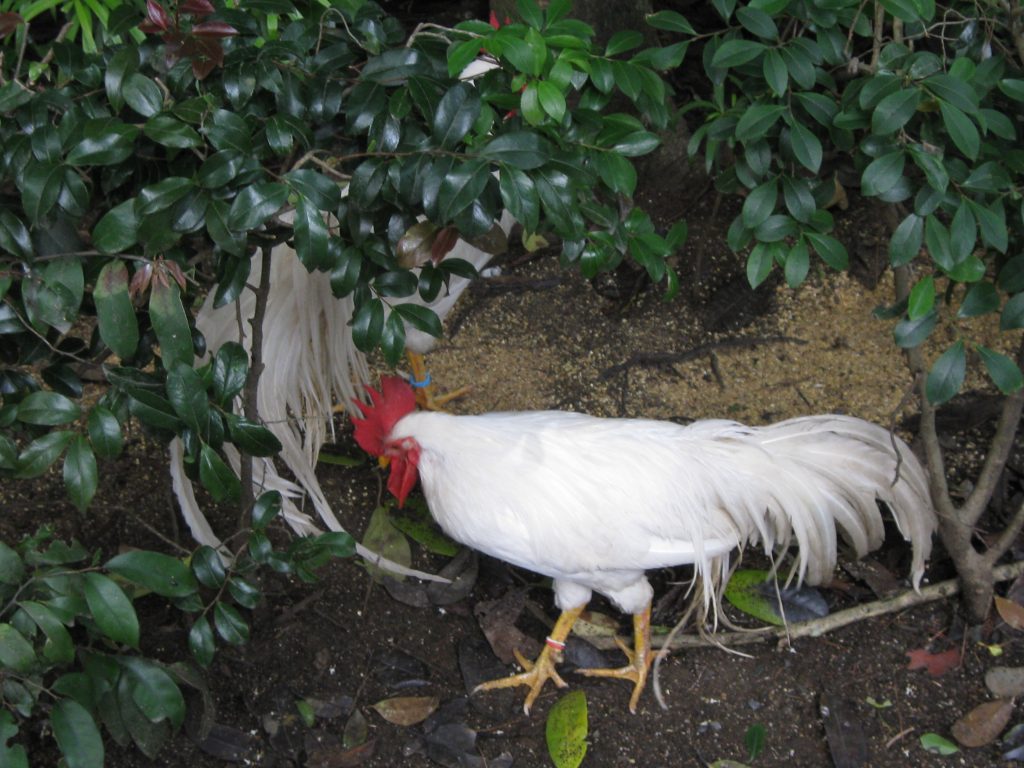
White rooster, herald of Amaterasu and the morning sun, roaming the grounds of Ise Jingu.  An early bird heralding a happy New Year to all WiK members and readers.

Writers in focus

Basho on haiku: 17 Statements

 Basho on How to Make a Haiku

17 statements from his letters and spoken word

Translations and Commentary by Jeff Robbins

Assisted by Sakata Shoko

  (Words of Basho are in boldface)


From the hundreds of passages I have translated from Basho’s letters to followers and from spoken word recorded by followers, I have culled 17 statements on how to produce a haiku. I offer this advice from the greatest of all haiku poets to all you folks writing haiku today. Three statements are from a letter Basho wrote in 1681 to his follower Biji. Throughout this letter, Basho repeatedly condemns “oldness” in poetry; he later said to his follower Doho: Oldness is the worst disease a poet can have. By “oldness” I believe he means what is “conventional, conforming to standards.”

1    Settling for standards and searching for reason places one in the middle grade of poets;  one who defies standards and forgets reason is the wizard on this path.

In the letter to Biji is is this point of advice:

2   Without a sense for how to use ordinary words, you will get mixed up in oldness.

Years later, Basho put this idea in positive terms:

3   Poetry benefits from the realization of ordinary words

                      (Haikai wa eki no zokugo o tadasu nar)  

This Basho haiku illustrates his mastery of the use of ordinary words

Sama zama no               Many, many

koto omoi-idasu           things come to mind,

sakura kana                   cherry blossoms

Basho’s words are completely, utterly simple. No complications: seven ordinary words with the most basic grammar possible in Japanese and likewise in English. He says absolutely nothing new about cherry blossoms or memories – instead he ‘sums up and conceals’ a thousand years of poetic expression on these flowers and the memories that pass from one cherry blossom season to the next. The plain and ordinary words are “realized” through the thousand years of associations of Japanese life with cherry blossoms. Ordinary words take on extraordinary meanings and feelings.

4 Know that a poem combines things . . .

   Poetry is the experience of the heart which goes and returns.

Ami no ko ga                    Fisherman’s child

kujira o shirasu                to announce a whale

Kai fuite                             blows on a shell

This single renku stanza combines the intriguing trio of child, whale, and shell; we start with medium-size child, then move out to enormous whale, return to small shell in boy’s hand, then spread out to fill the area with sound, the whale swimming away, the adults running to their boats, the boy watching excitedly from his post. So much life and aliveness.

5     “The skillful have a disease; Let a three-foot child get the poem

That disease is “oldness,” conventionality, heaviness in writing. A three-foot child would be five or six, so have little higher cortical function to circumvent the native spontaneity of the lower brain.

6   Only this, apply your heart to what children do.

Children’s actions are whole, not divided by the endless conflict of adult concerns. Strive to write poetry with that wholeness.

Ko no moto ni                      Under the trees

shiru mo namasu mo       soup, vinegar salad, and

sakura kana                         blossoms hurray!

The scene is the same in Basho’s time as in ours. The cold of early spring has passed, but there is still a chill in the air. Under a canopy of pinkish white blossoms, on ground scattered with petals, we lay out our favorite foods. The soup is brought to the picnic in an iron pot and heated over a fire. Namasu is commonly translated “fish salad” but cookbooks and experience at celebrations says different: it is raw vegetables (or sometimes fish) sliced thin, and marinated in vinegar, popular at celebrations. Amidst the excited chatter of girls and women in their blossom kimono, laughter of relatives and friends, some more petals have fallen on the food.

At the time of this verse, Basho said,

7       “As I gained some feeling for the rhythm in this verse on blossom-viewing,  I made Lightness.”

Haruo Shirane defines Lightness as: “a stress on everyday common subject matter, on the use of vernacular language, and on a relaxed rhythmical seemingly artless expression” — each of these are conspicuous in UNDER THE TREES.

Basho says that Lightness comes from the kakari, or rhythm of the words. Shirane, from his native Japanese ear, describes the rhythm in UNDER THE TREES in Japanese: the verse “starts slowly with four successive ‘o’ sounds (ko, no, mo, to) and then plunges into a strong consonant beat: (ni shi-ru mo na-ma-su mo sa-ku-ra ka-na) with each new syllable seeming to pick up speed, and then ends on the emotive, exclamatory kana, thus suggesting the inebriated mood of a cherry blossom party.” The final kana is “emotive, exclamatory,” so HURRAY! We are celebrating the season of warmth and new Life. Lightness is Us, real people having fun, sharing food.

To those who love Western poetry, Basho’s verses of Lightness will seem so simple and Light they feel like nothing – but they leave the reader feeling good — as opposed to Heaviness which relies on heavy word associations and allegory to make the reader feel sad. Even without tragedy, sensationalism, or negativity, Basho reaches into the human heart:- in this verse, through taste sensations – soup which could be so many possibilities and raw vegetables imbued with the sour of vinegar. Taste images bring us back to the times when we ate those foods, times we celebrated together.

Four years after the birth of Lightness in the haiku UNDER THE TREES, Basho said at a gathering of his Edo followers before he left on his final journey west to Kansai,

8     Now in my heart the form of poetry is as looking into a shallow stream over sand with Lightness both in the body of the verse as well as in the Heart’s connection

9 – Do not allow your verse to be artificial.

Basho compares an artificial verse by Kikaku with his own naturally occurring verse:

Koe karete                     Hoarse shriek

saru no ha shiroshi         monkey’s white fangs

mine no tsuki                  moon over the peak

Shio-dai no                     Salted bream

haguki mo samushi      their gums so cold

uo no tana                       a fish store  

Kon says “Along a street in the desolation of winter, a few salted bream are lined up on a tray in a fish store. The lips drawn back in death reveal gums frightful in their coldness.”

Basho said, Kikaku surpasses all in exaggeration, so let us forgive him.        

10     The verse HOARSE SHRIEK is Kikaku.

             ‘Gums of salted bream’ is the poetry of my old age.

              The lower segment, “A fish store,”saying only that, is my style.

Basho in his old age has discovered something else: Lightness. Poetry can be excellent without heavy and exaggerated imagery; instead of monkeys shrieking and jagged mountain peaks like monkey fangs, poetry can reveal ordinary scenes in daily life. Kikaku wrote his verse from imagination, not from any actual experience of monkeys or mountains or the moon. It has nothing to give us; once the shock is over, there is nothing in the verse can we learn.

“A fish store” is Basho’s genius. Another poet would have ended the poem with something bold, striking, philosophical, or religious. Basho however just says “A fish store”, with all its daily life associations in smell and sound and sight. Any woman in the temperate zone near the sea can see Basho’s haiku right before her eyes when she goes shopping in winter. Kikaku’s verse is suitable only for people off in some fantasy world where monkeys shriek. It is literary and “old.” Basho’s verse is REAL and Light.

11 In the verses of other poets is too much making and the heart’s immediacy is lost.

What is made from the heart is good; the product of words shall not be preferred.

Words from the heart are good. Words from other words are not.

12 — A stanza may have extra sounds, 3, 4, even 5 or 7; if the phrase has good resonance, it is okay – however if even one sound stagnates in your mouth, scrutinize the expression.

Basho advises that we speak the verse out loud to insure that the phrases have “resonance” (hibiki) and do not “stagnate” in the mouth — like water in a stream stuck behind a wad of fallen leaves, old, foul, and heavy — but rather flow with natural rhythm that resonates in the listener’s ear. For many years I have enjoyed the natural resonance I hear when I speak:

“Many, many,

things come to mind

cherry blossoms.”

Recently I considered changing the middle segment to “things brought to mind” or “thoughts come to mind” to more “accurate” to the original – but when I spoke these phrases out loud, I found that they “stagnate” in my mouth. “Things come to mind” is natural English and resonates. Basho told Kyorai:

13   This is a path of a fresh lively taste with aliveness in both heart and words

In a letter of 1690, Basho offered the following haiku as an example of the qualities which make up Lightness.

Komo o kite           There is a man

tare bito imasu      covered by a straw mat,

hana no haru         glory of spring

14   According to your various talents, make the verse from your heart, whether linked verse or haiku, neither heavy nor merely spinning about.

A beggar sleeps under a straw mat in the freezing cold New Year’s weather. He has an identity, a human dignity within the glory of spring. If not for fortune, I could be him. The verse goes straight to its sociological meaning; it does not “spin about” aimlessly, yet is not “heavy”; it does not shove that meaning at the reader’s face.

15  In poetry is a realm which cannot be taught. You must pass through it yourself.  Some poets have made no effort to pass through, merely counting things and trying to remember them.  There was no passing through the things.

To write poetry, you must “pass through things.”

Kara tsubo ni                 On the saddle

kobouzu noru ya           sits their ‘little monk’ —

daikon-hiki                      daikon-gathering

This is not an actual apprentice monk but rather an ordinary kid whose head has been shaved close. Because ‘daikon gathering’ in Japanese tradition suggests a happy family excursion, I have added in “their”: we feel not this is not just any little boy, but “their little monk”— the youngest son loved by the whole family.

Basho told Doho:

16         “To have the little boy stand out in relation to the daikon-gathering was the making of this verse”

The image of “little monk” makes the child “stand out,” the bald round head on a child‘s body sitting on the horse high above the horizontal field, watching his elders at work. (See the painting.)   This “standing out” is what “makes” the verse. The light color and roundness of the boy’s head are “cute,” while pulling gargantuan white radishes from the ground is dirty and rough. The important word here is “stand out.”   Unless something “stands out in relation” to something else, there is no poem.

Two months before his death, although it was autumn, to his long-time followers aged like himself、Basho wrote a Spring verse.

Kao ni ninu                  Unlike our faces

hokku mo ide yo       may our haiku emerge

hatsu-zakara              as first blossoms

Though our faces are wrinkled and pockmarked by the ravages of time, our poems can be as fresh and vibrant as the first cherry blossoms to emerge on their twigs. About this haiku Basho said:

17 The physical form, first of all, must be graceful, then the musical quality makes a superior verse.

For the “physical form” to be “graceful,” I believe the verse must have a consistent rhythm of beats.

Basho speaks of a “quality of turning,” as in music that quality which gives an “accent” or “resonance,” instead of being flat and boring, yet even with all that “turning,” all haiku are scored with the same steady

four beats per measure. Syllables expand or contract to fit into the four beats: thus in the chorus to We are the World, the one syllable of “world” expands to fill an entire measure, and the six syllables of “ones who make a brighter” contract to four beats. I discuss this at length in my article “Syllables, Words, and Beats”.

By translating with a consistent four-beat rhythm — 3 beats and pause / 4 beats without pause / 3 beats and pause – and using ordinary English words which (I hope) resonate, I aim for a graceful physical form with a musical quality.

*************

I request your assistance in getting out the word on the warm affectionate Basho who wrote hundreds of poems about women and children, about friendship, love, and compassion — hundreds of Basho works few people know, yet I believe the most pro-female, child-centered, and life-affirming works in world literature.

Feedback will be greatly appreciated.
Basho4now@gmail.com

Writers in focus

Hearn in Kyoto

Lafcadio Hearn (1850-1904)

Lafcadio Hearn (1850-1904)

Lafcadio Hearn is famous for his association with Matsue, Kumamoto, Kobe and Tokyo.  Not many people would associate him with Kyoto, yet he wrote a striking cameo entitled ‘Notes of a trip to Kyoto’ following a visit he made on October 23-25, 1895. It was included as a chapter in Gleanings in Buddhafields (1897), and has now been repackaged as a small Kindle production, available for ¥300 and retitled A Trip to Kyoto.

The occasion was the 1100th celebration of the city’s foundation, which had been postponed because of ‘plague’.  By all accounts, it was one of the grandest celebrations to be held in the old capital, and Hearn certainly makes it sound special indeed.

It starts off with one of the author’s most important beliefs, namely the reintegration of cells in different form after death. This is prompted by sight of a young child doing fluent calligraphy of a sophistication even expert adults could not equal.  In Hearn’s view, it is ‘beyond all question the work of ghosts – the countless ghosts who make the compound ancestral soul…  Still, it was not the beauty of the thing itself which impressed me, but the weird extraordinary, indubitable proof it afforded of an inherited memory so vivid as to be almost equal to the recollection of former births.’

Hearn’s sightseeing in the old capital begins with Omuro Gosho, the garden of which unleashes a flood of Hearn superlatives.  It is a ‘marvel’, ‘enchanted’, ‘exotic’, ‘unspeakably magnified,’ ‘a dream’, of ‘immense charm’, creates a ‘vibration of awe’, is of ‘vast antiquity’ with a ‘fresh sweet scent of verdure’.  ‘Only to be a servant in such a garden were a privilege well worth paying for,’ concludes the enthusiast.

The capital is in festive mood for the big celebration and there are numberless shows in the streets. The Japanophile is irritated by the Western furnishings brought from the foreign community in Kobe, but also delighted to come across an edition of the Atlantic Monthly in a second-hand bookshop.  One event to attract his attention is ‘a young man writing Buddhist texts and drawing horses with his feet, the extraordinary fact about the work being that the texts were written backwards – from the bottom of the column up.’  That alone should have made the trip worthwhile!

Omura Gosho

Omura Gosho (Photos and text by John Dougill)

The pre-festival night sees the city filled with stalls and a flood of lanterns, the effect of which is ‘a phantasmagoria’ exemplifying the Japanese genius of creating the beautiful out of virtually nothing – paper, bamboo, ikebana, bonsai, etc.  Hearn makes a strong case for aesthetics as a social good, because delightful objects and visual beauty are enjoyed by all, regardless of class and wealth.  This contrasts with the ‘hideous machinery’ of industrialisation which makes ‘a hell of eternal ugliness and joylessness invented by our civilisation to punish the atrocious crime of being unfortunate, weak, or stupid’.

On the day of the actual procession, with up to a million people jostling for a view, Hearn is taken aback by the orderliness and quiet of the masses.  There is a ‘gentleness and kindliness’, with the crowds arranging themselves ‘in the least egotistical manner possible’. There’s praise too for the beauty and elegance of the Japanese female.  This is all in spite of a scorching sun, which drove some of those wearing heavy armour in the parade to collapse with fatigue.  Because he had purchased a special badge before the festival, Hearn is able to enter Dai-Kioku-Den (Heian Jingu) where he enjoys a cup of miki (saké) in honour of Emperor Kammu, founder of Kyoto.

Before leaving Kyoto, Hearn goes to pay his respects at the tomb of Hatakeyama Yuko, where he pays ‘sincere reverence’ to a young woman much in the news at that time.  She had killed herself to negate the national shame of an attempted assassination on Tsar Nicholas II.  Hearn is much taken with her self-sacrifice, seeing it as proof of the love and loyalty of the nation as a whole.  It is a ‘pure ideal’ that shows the sincerity and self-sacrifice that underlie the national ethic.  ‘By one keeping the heart free from stain, virtue and right and wrong are seen always clearly as forms in a mirror.’

Hearn ends his visit by wandering around a temple district of great open spaces, which prompts more rapture about the beauty of pre-industrial Japan.  The ‘elfish gates’ and ‘great soft hilly masses of foliage’ with the ‘superbly curved roofs … bathed in the gold of the autumn afternoon’ give the author ‘a thrill of pleasure’.  He concludes with justification of the romanticism, showing self-awareness of the rose-tinted nature of his writing.  It typifies Hearn in his glorious honeymoon stage, before the thrill was over…

To view men or nature with delight, we must see them through illusions, subjective or objective…  Happiest he who, from birth to death, sees ever through some beautiful haze of the soul, – best of all, that haze of love which, like the radiance of this Orient day, turns common things to gold.

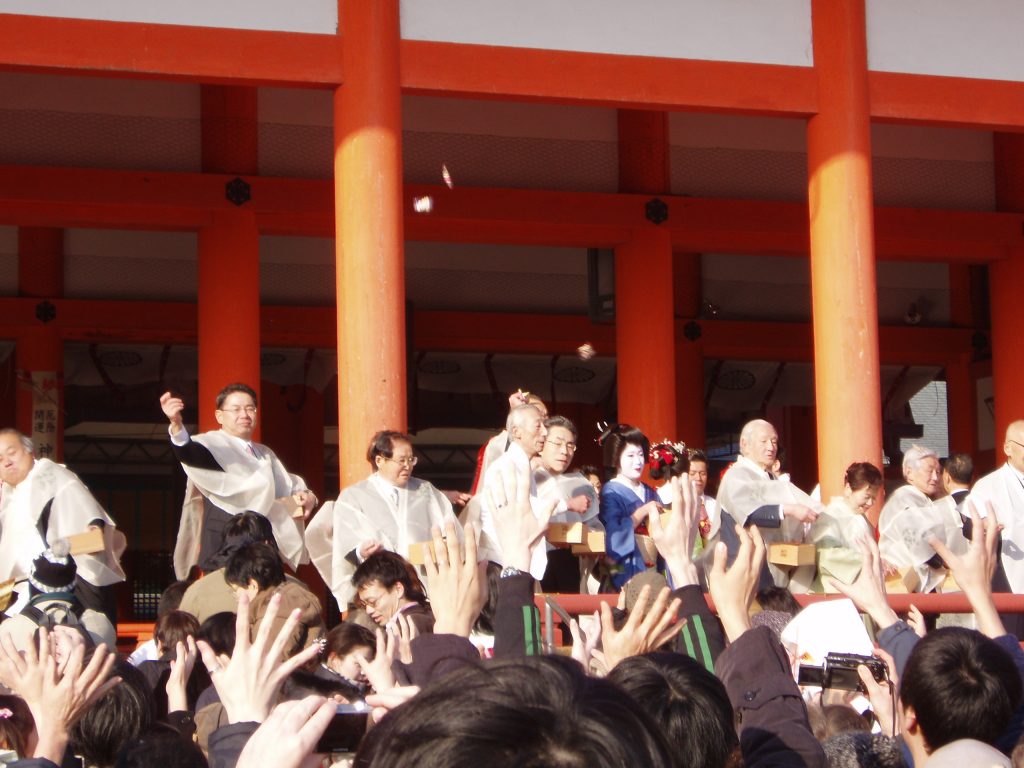
Setsubun at Heian Jingu, built to honour the 1100th anniversary

Heian Jingu on a radiant day, built for the 1100th anniversary in 1895 to honour the spirit of founder Emperor Kammu

Writers in focus

A.J. Pomes

A.J. Dickinson is a longterm resident of Kyoto who writes Daoist inspired poetry.  For previous poems featured on the website, see his Wisdom Crazed poems here or two Kathmandu earthquake poems here.

haunting haunting haunting meA.J.

timeless stars refracting night
light dawn emerging seas

passing sparkles rivulets grains
limitless insubstantial waves

forming anew molecular chains
again again every bubble fresh

ancient oceans foam
lush hardscrabble sands

shifting shores rhythms moments
light sound movement life loam

temporary in this here skin
crystalline resonance deep within

mourning haze renews
chrysalis dusk dawn gaze

origynal     cosmos     face
amazing wild quantum grace


dappled sunlight

1)
dappled light
monk spouts
2 women sit
drawing flowers
that just are

2)
dappled
light
falls

delicate
petals
open

scent
air

draw in
insects

re-cycle
life’s play

caress
eyes

bulbs/buds/rays/eyes
ongoing food delight surprise


here I sit
in a darkened room
strangely at ease
it could be a cave
ever present this breeze


ripples in the stream
made by wind by light rain
and what’s always flowing
underneath all around

Featured writing

Scorsese on the train to Kyoto

The film had been pilloried by conservative Christians for a dream sequence in which Christ has sex with Mary Magdalene. In depicting Christ’s life as a doubt-ridden struggle between his human and divine natures, Scorsese had intended to make a film that was at once an act of doubt and an act of faith. In the novel he was reading, the priest was shown profaning an image of Christ, and yet the act was an act of faith.

The train slid past the mountains. Scorsese turned the pages. This novel spoke to him. All at once he saw it as a picture he would like to make.

The novel was “Silence,” by Shusaku Endo, a Japanese convert steeped in European literature and the history of Catholicism in Japan. Published in Japan in 1966, “Silence” sold 800,000 copies, a huge number in that country. Endo was called “the Japanese Graham Greene” and was considered for the Nobel Prize. Greene referred to “Silence” as “one of the finest novels of our time.”

The Jesuit missionary Francis Xavier brought Catholicism to Japan in 1549. In the next century, it was suppressed through the torture of missionaries and their followers, who were forced to apostatize by stepping on the fumie — a piece of copper impressed with an image of Christ. In “Silence,” Endo took the missionaries’ point of view, casting much of the novel in the form of letters by Rodrigues reporting back to his superior. He goes to Japan with another young priest, Francisco Garrpe, vowing to seek the truth about their mentor, Father Cristóvão Ferreira, but they are captured and shown the dogma-defying reality of human suffering under torture. The shogunate invites the Japanese converts to avoid torture by stepping on the fumie. Many do; some are tortured anyway. Rodrigues sees converts crucified, burned alive, drowned. A magistrate fluent in Christianity makes a grim proposal: Rodrigues can save the lives of the converts under torture if only he will step on the fumie and apostatize.

When Scorsese returned from Japan, he procured the film rights to “Silence.” As the years passed, hardly a day went by without his mentioning the project to the people around him: actors, friends and even his old parish priest, Father Principe. As he made “The Aviator” and “The Departed,” “Shutter Island” and “Hugo,” he insisted that “Silence” was the picture he really wanted to make. A Jesuit was elected pope; Islamic terrorists began targeting Christians in the Middle East. In 2014, with “The Wolf of Wall Street” a hit, Scorsese declared that “Silence” would be his next picture: He wouldn’t commit to another until it was finished. Twenty-six years in, filming began.

What led this great American artist to make a story of missionaries in Japan his ultimate passion project? He is known for his gangster pictures; he is a grandmaster of the profane. From the beginning, he has revealed himself to be an artist of intensely Catholic preoccupations, and the poisoned arrow of religious conflict runs straight through his career. “Taxi Driver”: a Vietnam vet as a spiritual avenger, bent on cleansing the city of filth through violence. “Cape Fear”: a tattooed fundamentalist determined to exact God’s justice. “Kundun”: a young man raised to be a spiritual master, thrust up against spirit-killing communism. Even “Living in the Material World,” Scorsese’s documentary about George Harrison, takes as its theme the conflict between flesh and spirit, between Beatle and seeker.

“Silence” is a novel for our time: It locates, in the missionary past, so many of the religious matters that vex us in the postsecular present — the claims to universal truths in diverse societies, the conflict between a profession of faith and the expression of it, and the seeming silence of God while believers are drawn into violence on his behalf. As material for Scorsese, then, “Silence” is apt, and yet Scorsese’s commitment to it has been extraordinary, even by his exacting standards. To understand that commitment, I spoke with the filmmaker, with members of the cast and the production team and with others who know the novel well — trying to grasp just what kind of an act of faith this film is.

Writers in focus

Shikoku pilgrim Edward J. Taylor

Pilgrim relief

The following is an excerpt from an upcoming book on the Shikoku Pilgrimage, expected to be released in 2017.  Edward J. Taylor will thus become our second WiK member to have a book published about the famed 88 temple pilgrimage, following the release of Running the Shikoku Pilgrimage (2013) by Amy Chavez.

We spent the morning walking a long straight line across Marugame. At the far end was Temple 78, Gōshō-ji, a small hilltop temple with very clean grounds. A trio of men was busy trimming the pines, one of them lying prone across branches that looked too weak to support his body weight. The man’s position reminded me of some of the aerial antics of the shugenja, who dangled themselves off precipices, climbing one-handed along chains over empty space.   In fact, this very temple had once been a center for the mountain ascetics who had fled the usual centers of a more orthodox Buddhism, seeking a life closer to the earth, closer to the truth, or at least whatever particular truth had animated them.

As we walked back down the hill, a man pulled up and handed us a tiny pair of waraji, with the Heart Sutra written inside on a small piece of paper, wishing us luck. There was an interesting, though unintended pun here, in these woven straw sandals representing the outward ritualized practice of the pilgrimage, and the attached sutra the inner. As Richard Payne wrote, “Where sutra is a thread used to string or sew things together, and also the warp on a loom (the lengthwise threads), tantra identifies the weft (also, woof, the crosswise threads) on a loom. As religious texts, sutras and tantras string together teachings.”

We spent the rest of the morning walking another long straight line across Sakaide. At the far end was Temple 79, Tennō-ji. Along the way, we watched an old man slowly bike up the road, stop suddenly, and put his hand over his mouth in reaction to something. He was watching a house being torn down, and I could almost see his mind running through memories he associated with the place, memories of people now moved on. A childhood friend, a high school crush. What was for the workmen just another job was for him the end of a history.

12049342_10154044797442629_5967299426794161480_n

Tennō-ji was a small temple that had been nearly engulfed by the neighboring shrine. Now shaded by many pine trees, Emperor Sutoku had once been exiled here a millennium ago, his body kept in the pond so as to preserve it until news of his death reached the court in Kyoto.   The lotus stems in the water looked equally lifeless. This was the only temple on the pilgrimage where Miki and I were completely alone, not another henro in sight. We sat awhile, enjoying the peace. I could imagine the loneliness that the wandering poet Saigyo had found when he came here to pay homage to his lord, a loneliness broken when the dead emperor’s ghost arose to engage the poet in debate. The nōkyō-jō was in a different part of the grounds, but even here there was no one but a single monk.

As this region was once known as Sanuki, we very much looked forward to the famous, eponymous Udon. We saw on our map that there was a shop along the trail, but were disappointed by the “On holiday” sign hanging from the door. (Ironically, the three times that we tried to eat Sanuki Udon in Sanuki, we found the shop closed.) In the next town was a supermarket just off the trail. Leaving our bags hidden behind an abandoned house, we walked the short distance to the store, but found it had little in the way of ready-to-eat stuff. We had a poor lunch and stocked up for an equally poor dinner and breakfast to eat later on in the mountains. Ever since leaving Matsuyama, we had found restaurants and shops to be plentiful, food and baths easy to come by. Now we faced a sudden return to the insubstantial diet that we’d had in Kōchi, along with a tough climb ahead.

I had taken some time looking over our maps, and after judging distances both vertical and horizontal, decided to climb up to Temple 81 first, continue to the higher Temple 82 and spend the night nearby, then drop down to Temple 80 in the morning (Armin Howald jokingly compares the Shikoku Henro to the Tour de France, with its various mountain stages.) Most of the ascent up to Temple 81, Shiromine-ji, was along a winding road. A school must have been having a field trip of some sort, for a few hundred kids were now approaching from the opposite direction in small groups. Many yelled out the obligatory ‘Harro!” as they passed, to which I’d raise my hand and respond, “Henro!” Miki grew tired of this by the twentieth exchange or so, but the kids and I still laughed every time.

The final push was up an incredible flight of wide stone steps. They were a cliché out of a kung fu film, and I half expected to see Shaolin monks with buckets balanced across their shoulders, carrying water up and down, with a harsh and painful punishment awaiting any who spilled a single drop. The temple grounds themselves were equally magical, with many nods to esoteric Shugendo practices as well as references to Taoism and shamanism. A single building would be standing atop its own individual flight of steps, or at the end of a trail in the forest. A bus group from Kyushu was in front of the Hondo, singing more than chanting, resonating a beautiful energy that took both Miki and I in. It is said that the Heart Sutra’s 260 characters encapsulate the essence of Buddhist scripture, and here we felt it in the rise and fall of every syllable. We chatted with them on the way down, and found in them the only real spiritual feel out of the dozens of bus groups we’d thus met. Yet again, when Miki and I have grown most jaded, and begun to wonder if any of the purity has survived the commercialization, we meet people who set us straight.

Leaving Shiromine-ji, we climbed again, arriving at a saddle where a large statue of Kōbō Daishi sat at the confluence of trails to Temples 82 and 80. Images of the Taishi are easily recognized, and may even contain unintended Chinese elements. As Baquet has noted: “We’re told that on the pilgrimage, we should hold our beads in our left hand when we pray, without being told why.  A cursory inspection will show that statues of the Daishi always show him with a circle of beads in his left hand.  (A circle–remember that.)  In his right, he usually has his vajra if sitting, and his staff if standing. Freud calling.  The circle is feminine, the staff or vajra masculine.  The feminine symbol is in the left (yin, receptive, passive) hand, the masculine in the right (yang, creative, active) hand.”

Ted's Buddhist statue

After a short rest we climbed again. Where Shiromine-ji had exuded its power in spaciousness and light, Temple 82, Negoro-ji, was more severe. It too had all the feel of a shugendo training space, with darkened grounds and halls, and even the figure of a slain ox-demon back in the trees. Baquet again: “In the 16th-century an ox-headed demon was terrorizing the people of the Go-shiki-dai.  A samurai killed him with one arrow, cut off his Bull-headed gods–a motif from time immemorial. […]  This moon-connection runs deep.  A folklorist might look at the slaying of a cow-figure, representing the moon, as a triumph of a sun religion over a moon cult.  And in Shingon Buddhism, Dainichi–“Big Sun”–is the primary Buddha.”

To enter the Hondo, one had to walk through a series of long dark corridors, lined with barely visible Kannon. Chanting in front of the Hondo was a man dressed in black monks robes, carrying the ringed Shakujo staff of a shugenja, and chanting in a powerful voice. We’d met him and his wife a few times during the past few days, he never failing to greet me warmly in English. Here for the first time I saw his full power. We all left the Hondo at the same time, his voice strongly muttering a mantra, punctuated by the sound of his shakujo hitting the floor with a loud ‘Thwack!’

Miki and I moved back into the forest, the darkness pressing in. We had contacted a man about zenkonyado, and he’d offered us free lodging at a former Kokuminshuku. These were once quite the thing during the bubble years, a place where company workers could go to stay and play. This particular one had belonged to the Kawasaki corporation, so we were expecting a huge luxurious hotel that we’d have all to ourselves. Except that there was no one there to let us in. We rattled some doors and banged on some windows, then finally gave the man a call. It seemed like he’d forgotten about us entirely, and quickly came over in his car. There had been a sudden cancellation, so with some space available back at his lodging, he invited us to stay there. A few minutes later, we entered and saw about a dozen people sitting around a low table, waiting to eat. Oryoki style. We’d unwittingly come to a Zen Temple. I suppose the name, Kappa Zen Dojo should’ve been a clue, but as we’d found it on our list of zenkonyado, hadn’t really expected this. The temple was unique, isolated well out of sight upon the mountain, and used predominantly as a place to rehabilitee hikikomori shut-ins in order for them to return to being productive members of society. The meal was more casual than at other temples where I’d done Zen training, and it was followed by a half-hour of the residents talking about their day. Midway through, my hips were screaming as I sat cross-legged on the floor, having immediately come off a 30-plus kilometer day, over two high peaks. After dinner, the top monk explained the schedule, which we were expected to follow. Despite Zen being my primary Buddhist practice, one I’ve committed thousands of hours to, not one part of me wanted to be here. I was exhausted, my backs and legs sore, and I was being denied my own recuperative rituals of writing and reading.   For the walker, self-care and rest are crucial, and I began to worry about the following day. As my fatigue-fed frustration grew, I found myself nearly in tears.

Then I accepted defeat. This acceptance began to build, and I found the zazen that followed surprisingly relaxing. Breath following breath, step following step. Meditation wasn’t that dissimilar to walking in that you could rely on the repetitive rhythm, get lost in it. One could walk for hours in a semi-blank state of mind, and being well conditioned to weeks of that, here on the cushion it was easy to drop in.  Don Weiss wrote about emptiness in his great “Echoes of Incense.” “Hundreds of books have been written about sunyata (emptiness), but all of these books put together teach less than walking the pilgrimage day after day or sitting in meditation every morning. The intellect cannot grasp this idea. But to the heart, it is simple.”

As it was, it was a bit surreal to be sitting in the middle of this meditation hall, with black robed figures sitting completely still on one side and fidgety kids on the other, as if in detention. From somewhere within the hall a girl was crying, and the slumped, seated postures of the kids betrayed a defeat far greater than my own.

All photos courtesy Edward J. Taylor

1505398_10154030961612629_9069550432446565747_n

12049342_10154044797442629_5967299426794161480_n


10391878_10154044797362629_7176021851529753445_n
Relief of pilgrims

Featured writing

Kyoto: An Urban History

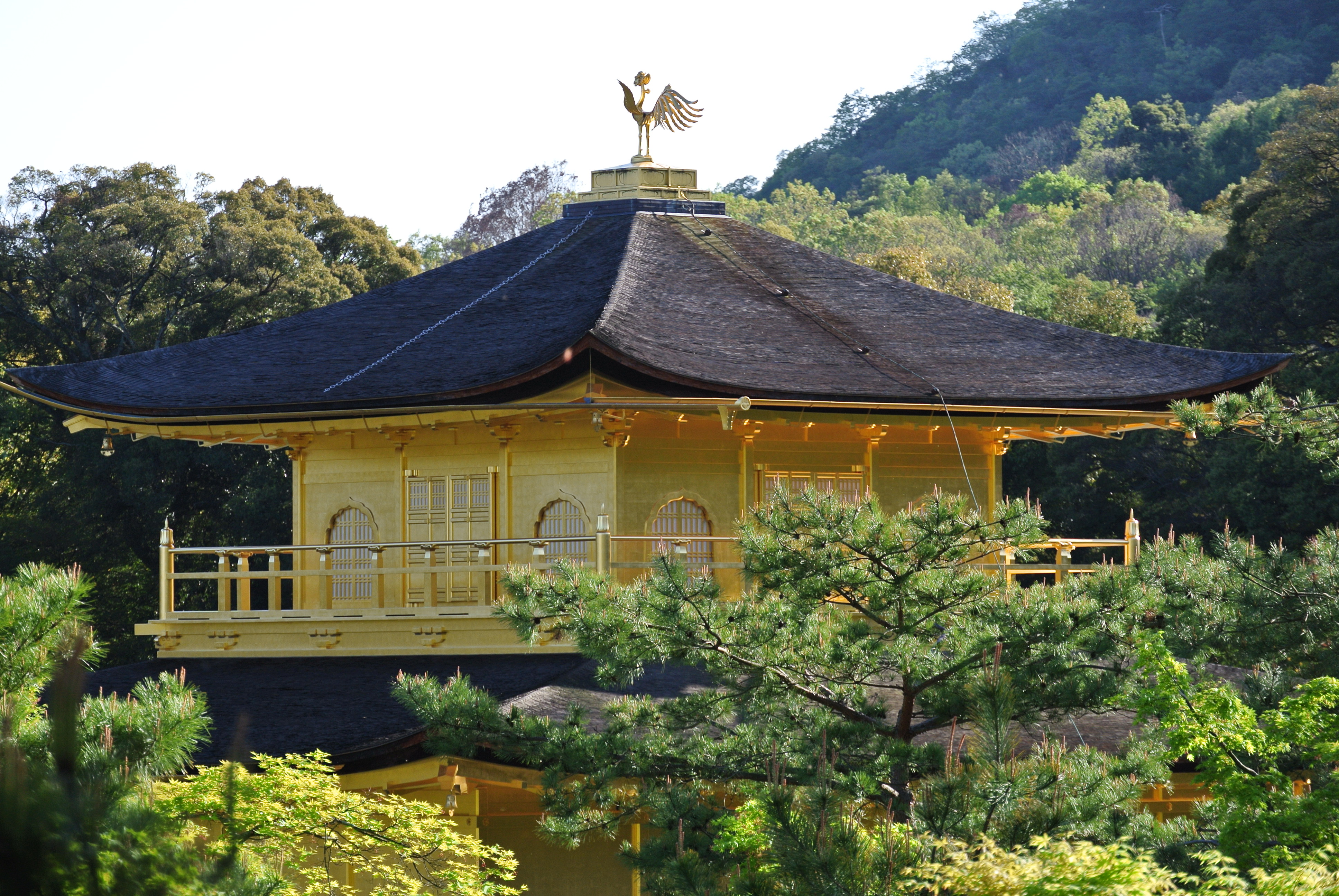
The Golden Pavilion was once part of a huge estate built by one of the Ashikaga shoguns, who between them altered the whole shape of Kyoto and whose misrule led to the way for its destruction in the terrible destruction of the Onin War (1467-77)

The Golden Pavilion was once part of a huge estate built by Ashikaga Yoshimitsu, whose family between them ‘made profound changes to the urban landscape’. Later the misrule of his grandson, Yoshimasa (founder of the Silver Pavilion) led to the terrible destruction of the Onin War (1467-77), which completely devastated the city.

Kyoto: An Urban History of Japan’s Premodern Capital by Matthew Stavros  (University of Hawaii Press, 2015)
Book review by Paul Carty, WiK member.  This first appeared in the Kyoto Journal.

**************

Kyoto is one of the great centers of culture in the world. We can find many traces of its long history as we explore the ancient capital.  Fortunately, we have an excellent new book to help us to read this cityscape, and understand its organization and development. In Kyoto: An Urban History of Japan’s Premodern Capital, Matthew Stavros, a Professor at Sydney University, expertly guides us through the interplay of space and authority. Specifically, how did Kyoto balance its role as imperial capital with being a center of commerce, and later a military headquarters?

OLYMPUS DIGITAL CAMERA

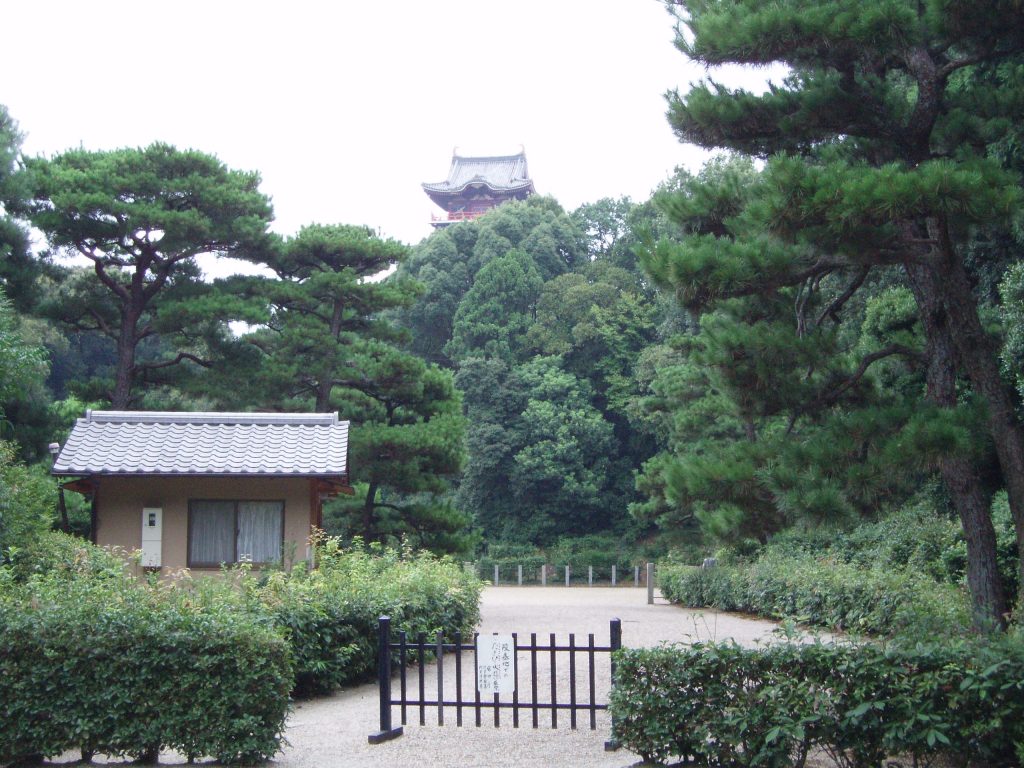
Entrance to Kammu’s burial mound, with a replica of Hideyoshi’s Fushimi Castle in the background – founder and re-founder of Kyoto

The book takes the reader through the first 800 years of the city’s history from the Heian up to the Edo Period, roughly 794 to 1600. In the introduction, Stavros explains that this book is not a comprehensive history of this period. It undertakes to describe the organization and transformations of Kyoto from an imperial city to castle town. The many maps, illustrations and diagrams greatly aid the reader in understanding the dramatic events performed in the urban space. The book is deeply researched and employs primary sources such as letters and diaries to give the reader a great sense of the lived experience of that time. Written in a clear and accessible style, the book covers specific topics with great depth and detail to make larger points on the greater trends that shaped each era.

The first two chapters contrast the ideals of the formation of Heian-kyo with the actual reality. Heian-kyo was established by Emperor Kanmu to support, protect and govern the country. Carefully organized along a grid pattern, Heian-kyo had two market places, a large gate, two temples to the east and west of the gate, and a broad road leading toward the palace. This plan was based on ideas that shaped several Chinese capitals and was meant to reflect the power of the state. Despite this well conceived idea of a capital, the author explains that the residents, both elite and commoners, had their own ideas of how to occupy the space. Most of the original structures of the Heian-kyo slowly disappeared. More importantly, the western part of the original grid was slowly abandoned and the city shifted to the east.

Hideyoshi's moated wall

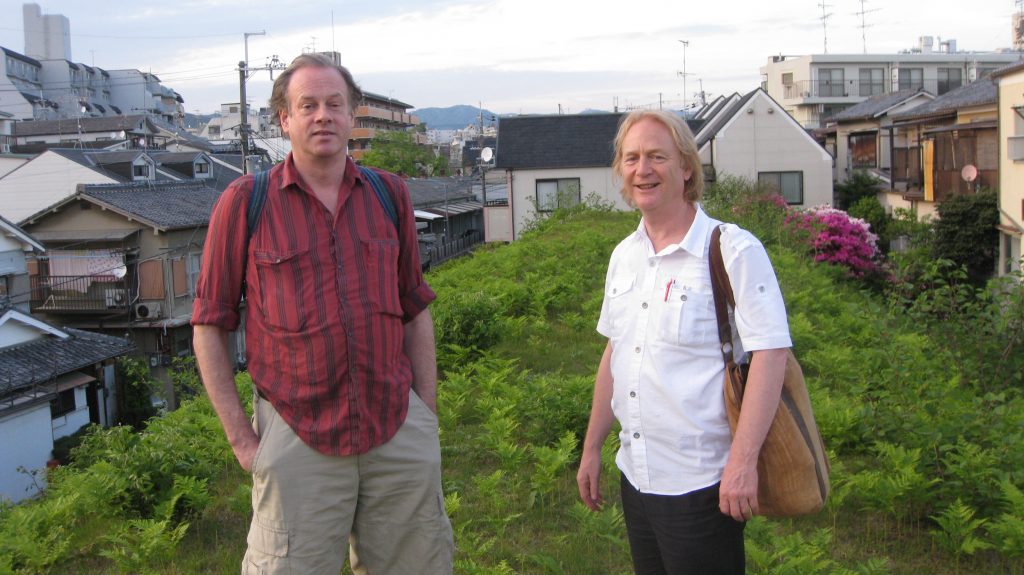
Two WiK members atop what remains of Hideyoshi’s encircling wall around a rebuilt Kyoto

The third and fourth chapters take us into the medieval period where the city develops into two distinct parts, Kamigyo, home to the noble class, and Shimogyo, home to the merchants and a thriving business area. Stavros deftly outlines the profound influence the term rakuchu-rakugai, respectively the inner and outer city, had on the inhabitants of the city. The inner city was roughly from Omiya Street in the west to the Kamo River in the east, Ichijo-ji to the north and Kujo to the south. These were not only geographical terms but also ones that profoundly shaped nobles’ ideas and actions in and about the capital. Basically the imperial court controlled the inner city strictly; therefore, if the elite wanted to build a gorgeous villa complex, they built it outside the inner city during the medieval period.

In the subsequent chapters we learn how the Ashikaga warriors (shoguns from 1333 to 1570) made profound changes to the urban landscape. As the Ashikaga rulers lose power, Kyoto turns into a battleground. After nearly a hundred years of political instability, Oda Nobunaga entered Kyoto (1568) and soon thereafter built Nijo Castle. Stavros explains how Kyoto at this point becomes the prototype of the castle town, which spread throughout Japan. This castle was soon destroyed. Roughly twenty years later (1600) the present day Nijo Castle would be built, but in another location. We can, however, see traces of the first castle in the names of the neighborhoods in that area: Hori no uchi cho means area within the moat.

OLYMPUS DIGITAL CAMERA

Remains of a pillar base at Hoko-ji on which once stood Japan’s biggest ever Buddha, as ordered by Hideyoshi

Hideyoshi follows Nobunaga into power and we learn that he wanted to move the capital to Osaka. Lacking the political and institutional support to control the country, he kept his operation in Kyoto to get imperial and noble support. He followed the traditional route of building important imperial structures in which the ancient rituals could take place. Hideayoshi made the most profound changes to Kyoto including a wall around the city, having most temples moved to a few special locations and the construction of the most fabulous castle and largest Buddhist statue. In chapter seven, Stavros masterfully explains the reasoning behind those changes.

There is also a brief epilogue explaining some major developments during the Edo and Meiji Periods, including Nijo Castle, Takase Canal, and the Imperial Palace.

Anyone with interest in understanding how present day Kyoto took its shape, will be interested in this deeply researched urban history of Kyoto. To those who love Kyoto, this is a great gift.

Kyoto today – whatever would Kammu have thought?

Kyoto today – whatever would Kammu have thought?

Writers in focus

Kyoto Journal no. 87

Kyoto Journal 87

KJ 87

Amazingly, Kyoto Journal is approaching its 30th anniversary—not bad going for an all-volunteer non-profit publication, in any context. Back in the pre-Internet days of monochrome cut-and-paste layout (art-knife and toxic spray-nori) we had no inkling that the magazine would last more than a few issues, or that it would continue to evolve over three decades into its current Asia-spanning digital format. Deepest gratitude to each and every one of KJ’s multitude of supporters: our contributors, subscribers, and editorial/production staff!

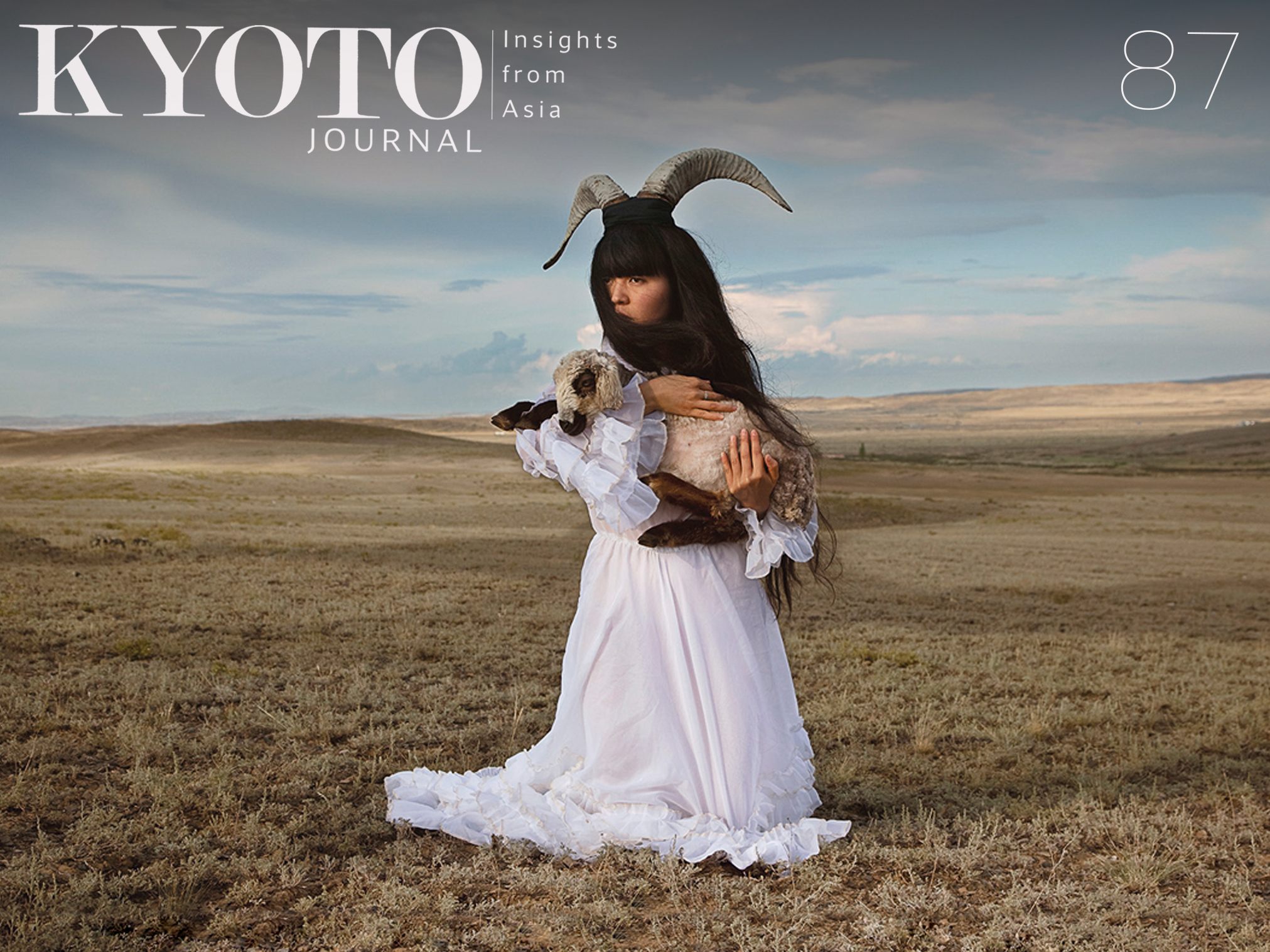
Our soon-to-be released fall 2016 issue, KJ 87(!), features excerpts from three exceptional new books, complemented by a wide-reaching ensemble of encounters with people engaged in extending creative boundaries in Japan, India, Kazakhstan, Cambodia—and North Korea. Marc Peter Keane’s forthcoming Japanese Garden Notes: a visual guide to elements and design, is a feast for the eyes in explicating behind-the-scenes aspects of this quintessential art; the always-thoughtful Alex Kerr’s newest publication, Another Kyoto, is equally rich in insights into the essence of classic Kyoto. Artist activist Mayumi Oda’s autobiography Sarasvati’s Gifts melds her Buddhist/feminist art and social commitment, revealing an intensely-lived life.

In two separate interviews we delve into the evolution of haiku and its world-wide relevance, with Richard Gilbert, a Kumamoto-based scholar and poet, and Kala Ramesh, poet and founder of an ongoing international haiku festival in Pune, India. Toyoshima Mizuho and Hara Masaru, a Kyoto Noh actor, discuss hidden depths of this ancient performance art. Remo Notarianni profiles contemporary Kazakh artists including photographer Almagul Menlibayeva, who documents cultural transitions through a fashion-style lens; George Saitoh interviews artist Tatsuta Tatsuya, who focuses sunlight through a Fresnel lens to transform his sculptures. Elle Murrel mingles with artists from East and central Asia, and beyond, who created installations in Nara for this summer’s spectacular Culture City of East Asia program, “A Journey Beyond 1300 Years of Time and Space.” Raymond Hyma presents the inspiring story of Nika Tath, an entrepreneurial blind massage therapist in Phnom Penh with “seeing hands.” Stacy Hughes joins a pioneering surfing tour in North Korea—the DPRK—helping set up an impromptu surf school; Ilyse Kusnetz visits Tomorrowland, located in Tokyo Bay, and Robert Brady farewells an era beside the shining vastness of Lake Biwa in Shiga. Plus poetry by Ami Kaye, Sushma Joshi, Leanne Dunic—and translations of ghazals by 19th century Indian poet Ghalib—new fiction by Sacha Idell, and a raft of topical reviews.

To be published digitally in mid-November, available by single issue or subscription. Track us on Facebook for updates as we go to press—we’re also fine-tuning plans for our anniversary party in Kyoto in January.

« Older posts Newer posts »

© 2026 Writers In Kyoto

Based on a theme by Anders NorenUp ↑