Page 58 of 65

Writers in focus

Welcoming Jann Williams

Jann Williams

Tasmanian Jann Williams finds a room with a view – in a Kyoto Starbucks

Writing in Kyoto

Jann Williams, May 24th, 2016

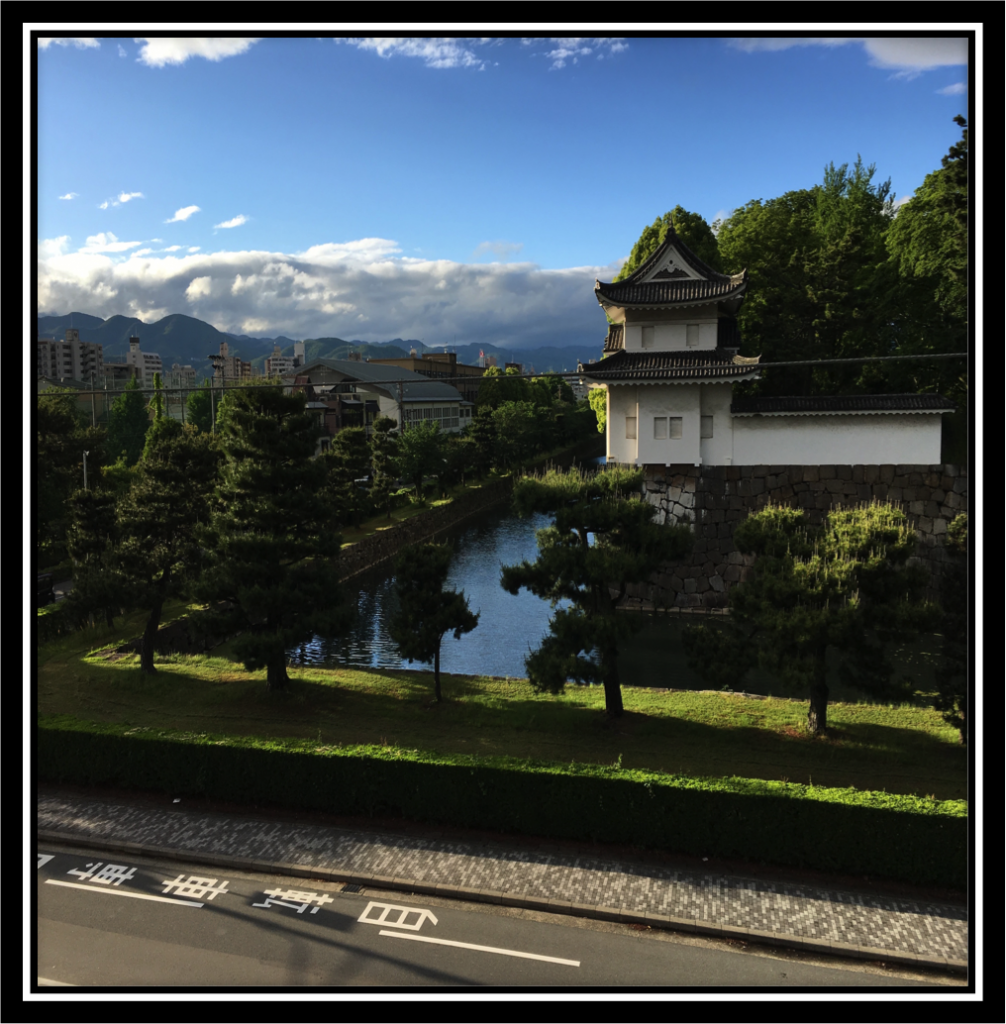
As I sit writing I can see the south-western turret and grounds of Nijo Castle through my apartment balcony door. The research for my book ‘Elemental Japan’ has been rich and rewarding in the two weeks I have been based in Kyoto. For half of that time I have been further afield using one of my JR Rail Passes. I took the opportunity to visit Miyajima and climb Mt Misen, to take a tour of the Temples and Shrines around Murou and Sakarai, and practice taiko with friends near Nagahama on Lake Biwa.

Back in Kyoto I have visited Toji Temple and Kamigamo Shrine, been to the Miho Museum for the day, seen the Zen exhibition before it closed, and walked the local streets to get a sense of daily life in the city. To share some of these experiences along the way I have created a blog called, not unexpectedly, Elemental Japan (see elementaljapan.com). Good fortune has smiled on me in many ways, including meeting and re-meeting some remarkable people during my time in Japan so far. I look forward to making more connections before I head home to Australia in the third week of July. That is why I am sitting here writing in Kyoto – to experience the elemental life and soul of this remarkable city, and beyond from time to time.

Nijo Castle


My Kyoto apartment provides a window to the elements – to behold water, mountains, sky, wind, earth and trees as I sit and write is a real pleasure. Nijo Castle, and the joggers who run around its perimeter, add the human element. All are interconnected and part of the story of elemental Japan.

**************

For Jann’s fascinating blog on aspects of elements worldwide, see Fire Up Water Down.

Writers in focus

Kyoto vs. Home (Basho by Jeff Robbins)

Living in Kyoto vs. Returning Home:
Four Basho Linked Verses of Humanity

Translations and commentary by Jeff Robbins

Assisted by Sakata Shoko

Basho’s well-known haiku offer us transcendental visions of nature usually with no human being in the scene — however beyond these nature poems is another, far most vast world: that of his renku or linked verses; here are hundreds and hundreds of portraits of humanity in endless diversity.  Basho’s linked verses about women, children, men, friendship, love, and compassion can be resources for sociologists and anthropologists, as well as ordinary folk, to explore and start conversations about humanity. The impersonal world of flowers, insects, birds, snow, and the moon is certainly wonderful – but a different sort of wonder awaits us in meeting our own species in Basho’s vision.

Here are four portions of linked verse: two about living in the large populous city of Kyoto, home to the Emperor but also to an array of more plebian characters; and two about returning from the City to one’s hometown. As always, I use bold-face to emphasize Basho’s words:


   Coming down from Court to

street of gossipy neighbors —

“How are blossoms

at the palace?” nun asks

the second nun —

A butterfly among wireweed!”                                                  

all she says, blowing her nose


となりさかしき / 町に下り居る

二の尼に / 近衛の花の / さかりきく

蝶はむぐらに / とばかり鼻かむ


Tonari sakashiki / machi ni kudari-iru

Ni no ama ni / konoe no hana no /   sakari kiku

Chou wa mugura ni / to bakari hana kamu


A female imperial attendant took the tonsure upon the death of the emperor she served, and has come down from Court to live in the ordinary bustle of Kyoto streets. When another nun, a friend of hers who still lives at Court, comes to visit her, the first nun asks about the cherry blossoms she used to know and love. Butterfly is of course an image of feminine elegance, whereas the obnoxious climbing weed mugura –having no name in English, we call it “wireweed” — grows wild over anything in its path without the slightest hint of elegance. The second nun exclaims “Imagine you, a person of the Imperial Court, among these lowly gossips” while she chokes up with tears of emotion filling her nasal passages. Here we have a bit of Anthropology, a tiny conversation between two women in 17th century Japan. The common thread running through the three stanzas is the contrast between elegance and vulgarity – the Imperial Court vs. nose-blowing – in this unique city known for elegance yet with its share of vulgarity

In this pair, Basho begins and Yaba follows:


Calculating

to stand against the flow

living in Kyoto

Again no notice of
daughter’s joyful birth.
算用に / 浮世を立てる / 京住まい

又沙汰なしに / むすめ産

San-you ni / ukiyo o tateru /           kyou-zumai

Mata sata nashi ni / musume yorokobu


From the villages where life goes on at a natural pace, young folk migrate to the cities where competition and the high cost of living make life difficult — but more fun than in the village — so they must “calculate” to survive. The term ukiyo o tateru , “to stand against the floating world,” means to endure the forces of transience which can in one night destroy a lifetime achievement. I translate “the flow.” To stand tall with dignity in that raging flood of ephemerality, to not be knocked over by “the slings and arrows of outrageous fortune,” we must “calculate.” Nowadays Kyoto residents struggle to “stand” against the flood of tourism and modernization for the tourist market.

Many have discussed the peculiar difficulties of Kyoto:  Oussouby Sacko says “they try to keep everything a little bit expensive here, to keep the high standard Kyoto image.” Cara Clegg adds that “Due to its location in a basin, the area has bad wind flow, making it especially cold in winter and escpecially hot in summer” andBuses often run right past their stops without pausing because they’re already filled up with tourists, enraging people trying to get to work or school.” Kaori Shoji says, “Kyoto has always been a snobbish, expensive and unwelcoming kind of place, with surprisingly little in the way of amenities and facilities for the casual traveler.” Alex Kerr says, “After centuries of political intrigue and relentless scrutiny by tea masters, the people of Kyoto have developed the technique of never saying anything.” So in Kyoto today, Basho is right; you gotta “calculate.”

Yaba takes Basho’s thought into an entirely different realm: city people, in their endless calculations, lack reverence for human life — they send out birth notices for boys, but girls are not worth mentioning. Boys bring wealth to the family; girls marry out, exporting wealth to another family. In many places in Asia, by longstanding habit only boys are cherished, and girls considered a liability. One of the ways Japan kept her population constant for 200 years was by strangling unwanted newborns, usually the females. And so “no notice of a girl’s birth” could have a sinister meaning. Yet even if the parents are devoted to her care and the baby girl in fine health and mood, the failure of her parents to send out notice of her birth suggests a subtle marginalization of the female.

Basho, however, in his tanka SPRING PASSES BY, blesses the newborn girl, giving full notice to her. In his letters to his oldest friend Ensui about Ensui’s newborn granddaughter, Basho clearly, more clearly than any male writer, says “cherish the newborn female.” Yaba also does something very pro-female here; he gives the character for “birth” (which ordinarily reads as umu or san) the life-affirming reading yorokobu, “to be joyful,” a clear expression of Yaba’s positive feelings for the birth of a musume.

The point, the learning and the fun, of linked verse is to discover how ‘not sending out  birth notices for girls’ relates to the ‘difficulty of getting through life in the Capital.” Getting inside the mind of Yaba as he responds to Basho’s lead. Above are the ways I have found to connect these two stanzas. You, dear reader, find your own ways.

A young woman goes to the Big City to live, work, and marry. Pregnant, she returns to her natal home where her mother can care for her before and during birth, then help out with the newborn.

Sister from the Capital

here to have her baby

Weaving folded,

at back door she lights

flower incense                


都の妹が / 子をうみに来る

     機たたむ / 妻戸に花の / 香を焼きて


Miyako no imo ga / ko o umi ni kuru
hata tatamu / tsumado ni hana no / ko o yakite


Basho fulfills the theme of pregnancy with specific actions of this woman: the ordinary but eternal work of women to keep children warm and house fragrant (while the average guy really does not care about how a place smells). She has finished weaving the length of fabric she needs to make one robe, so she folds the material and places it down. Then she goes to the back door (in Japanese the tsumado or “wife door,” the door between the kitchen and the back yard which the women of the house pass through a hundred times a day while the husband never does) with the 17th century Japanese equivalent to a lighter, to ignite incense and spread sweet fragrance throughout the farm kitchen. Weaving fabric for baby clothes, making the house smell good, she generates positive energy for the new life. How Basho must have watched his mother and four sisters – one older and three younger — to absorb their consciousness.

Basho sees the pregnant woman in the place she herself was born, prepare her body and spirit for delivery through physical work, moving her body back and forth, up and down, around her swollen belly. Dr. Yoshimura Takashi, whose birth center near Nagoya has delivered babies since 1961, says that the strength and flexibility Edo-era women gained from everyday physical work is what makes childbirth easy: he says, “When the muscles are strong and flexible, the baby just slides out.”  Behind the modern clinic in the middle of Okazaki City is an open area with old-fashioned thatched-roof house, sunken hearth, and wood-burning cook stove. Expectant mothers gather here to do Yoga in the form of work: chopping and sawing wood, polishing walls, making and tending fires – repeatedly squatting and rising to stretch the pelvic muscles – then sit at the hearth, eating rice and vegetables, sharing their experiences of pregnancy. Reading Basho’s take on a stanza about pregnancy, I feel that he would approve of Dr. Yoshimura’s method – and when I showed Basho’s verse and this sentence to him,  I saw tears in his eyes.

Next is a household in which the husband has been adopted into the bride’s family, so the young man has to struggle for dominance with the Father who has been here for thirty years.

Son-in-law and Father

greeting to make-up —

Castle servant

in her home village

close to tears

Things from lacquered box

taken out and put back


むこと舅の / なおる挨拶

御局の / 里下して / 涙ぐみ

ぬつたはこより / 物のだし入れ


Muko to shutome / naoru aisatsu

o-tsubone no / sato kudari shite / namida-gumi

nutta hako yori / mono no dashi ire


For some time now, the two men have not been very cordial to each other.   This morning they greet each other with words that begin to repair their relationship. With her sister and husband taking over the household, a second daughter has gone to the provincial castle to serve in a daimyo’s household.   On her day off, she returns to her native home where her joy at seeing her father and brother-in-law starting to get along brings tears to her eyes. From the fancy lacquered box, she takes out things that remind her of her family members, looks at them, and returns them to the box. (Nowadays these would be photographs in a box, album, or smartphone.) Once we apply the feelings in the verse to our own personal experience of family, the verse becomes all the most important to us.

The two stanzas not-by-Basho are each brilliant and personal, setting the stage with the web of relationships in a family; these are like the “assists” in basketball. Basho then   dunks it in with his vision of female activity and female memories.  Basho’s follower Kyoriku tells us Basho spoke some words which could capsize a few boats in Japanese literature if they became known:              


Many of my followers write haiku equal to mine,

however in renku is the bone marrow of this old man.


Haiku wa monjin no naka, yo ni otoranu ku suru hito oushi.

      Haikai (renku) ni oite wa rourou ga kotzui

発句は門人の中,予におとらぬ句する人多し.

俳諧(連句)においては老翁が骨髄


Basho is over-generalizing here. SOME of his haiku truly shine, however the humanity he revealed by linking his mind with another mind could light up the world.

We have traveled through four sequences of anthropology — meeting older women who are nuns, harried new parents, a pregnant woman, an unmarried sister and her family; we have seen women conversing, crying and getting tears in nasal passage, blowing nose, parents calculating, women at work, in-laws’ wary greetings, and women reminiscing and going through the physical processes of almost crying. In particular in Basho’s first, third, and fourth stanzas, note the lively active verbs describing specific concrete actions of women – speaking, blowing her nose, folding fabric neatly, giving fire to incense, taking out and putting back. We see not one word of abstract philosophy or religious    concept.   All is specific, concrete, and active – so different from the ascetic and impersonal reputation which has formed around Basho.

Multiply the four Basho stanzas in this article by 59, to get the number of Basho stanzas in my Basho4Now trilogy. These 236 stanzas, which I have selected for their emphasis on humanity, are a mere 14% of the 1700 stanzas Basho wrote in 30 years. Furthermore the Basho stanzas are about one-sixth of all the stanzas by all the poets together in 300 sequences – in some sequences only a few stanzas are by Basho; others have just two poets so every other stanza is Basho; sometimes Basho wrote two stanzas in succession. The Complete Basho Renku Anthology has ten volumes, each over 300 pages; each page has an average three stanzas along with commentaries to every single link.   So over 3000 pages and 10,000 stanzas, 1700 by Basho. Such is the vastness of that galaxy of Basho’s linked verse – all of it (with exceptions discussed below) unknown to the world

Of the one thousand haiku Basho wrote, 125 were actually used to begin a renku sequence; some of these have become famous without the stanzas that followed. Aside from these sequence-openers, none of Basho’s linked verse appears in books on Basho haiku in English or in Japanese. A few books of literary criticism include full 36-stanza sequences with no emphasis on Basho’s stanzas, and they get lost among the ever-changing imagery. Even in Japan a select few scholars do study renku, while the average person on the street knows three or four Basho haiku — the poems they were forced to learn in high school — but not even one of his renku visions.

No wonder Basho is thought of as “impersonal, detached, objective” when his many warm, deeply personal, and human-involved works – his linked verses and his letters — are unknown worldwide.   To spread awareness of these remarkable resources for human self-understanding is my mission.

I request your assistance in getting out the word on the warm affectionate Basho who wrote hundreds of poems about women and children, about friendship, love, and compassion; hundreds of Basho works unknown to all, yet the most pro-female, child-centered, and life-affirming works in old-time literature.


Feedback will be greatly appreciated.

Basho4now@gmail.com


Writers in focus

Zen poems by Lawrence Barrow

Lawrence Barrow is a potter and ordained Zen monk who also writes poems and keeps a blog.  As a WiK member, he has allowed us to reproduce some of his poems from his Hikidashi website.  He has also offered a brand-new poem, called The Zero (in reference to the Japanese fighter plane of WW2).

Lawrence listens to the WiK presentation at the Gael given by Brian Victoria

Lawrence listens to the WiK presentation at the Gael given by Soto priest Brian Victoria

Click to see Lawrence’s pottery website.  At present Lawrence is on retreat at the Zen temple of Bukkoku-ji in Obama, Fukui Prefecture.  To learn about life there, see his blog here.

*******************

TOFUKU-JI

December morning –
only the sound of rain
on temple tiles
and scarlet maples
swirling in the gutter

******************

ZAZEN

as the pale light of dawn
bleeds through the shōji
we eat a thin gruel
of rice with a pickled plum
from black lacquered bowls

the rain beat down
during the night
the moss garden
is nearly covered
with scarlet maples

a cold wind blows
we hear the lonesome cries
of wintering gulls
as a temple bell resounds
and a train rattles by

a monk in an indigo robe
strikes a meditator’s shoulders
with a stick of cherry wood
fiercely repeatedly
until it snaps!

*******************

ROUND MIDNIGHT

round midnight
we take our zafus
from the meditation hall
and go out onto the verandah
for night sitting

five of us in a line
overlooking
an immaculately raked
gravel garden
backed by tall cedars

we sit in zazen
and breathe in
and out
the cold
night air

I see the silhouette
of the temple gate
against the starlit sky
the shadow of the eaves
on the white sand

the priest today
talked about non-duality
no separation
but I hear you out there
by the willow weeping

*******************

TWILIGHT ZENDO

here in the twilight zendo
things are not what they seem
once false move can send you
plummeting through the thin ice

here in this frozen landscape
three monks in rags
feet bound with straw
are crossing over

we must be vigilant at all times
there are fissures that are perilous
I drop a stone into a bottomless well
a ruined house leaks moonlight

all signs read no way out
there are shackles of every form and no form
on the frozen dune
we climb to see no one

I stare at a black tile
and see the ten thousand arms of Kannon
we walk the thin ice
with great trepidation

we are nearly over
to the other shore
when I hear a crack
in the ice

here in this twilight zendo
no sound
no river
no ice

*****************

Lawrence writes about the next poem; ‘This is based on my master Tangen Roshi’s experience during the war before he started zen training.’

THE ZERO

there were ten Zero planes
on the airstrip at dawn
as the first rays
of an August sun
streaked across the tarmac

we were all young
most of us only nineteen
the back of each pilot’s seat
had been strapped with
one hundred kilos of dynamite

we bade farewell
to our loved ones
to die for our country
it was my last day
to live

one final cup of saké
the taste of it
mingled with tears
I walked towards the ladder
leading to the cockpit

at that moment there was a voice
from the loudspeaker
the voice of the Emperor
announcing Japan’s
unconditional surrender

Whiting on writing

WiK’s first anniversary event could hardly have had a more prestigious speaker than Robert Whiting, famous not only for his bestselling book on baseball, You’ve Gotta have Wa, but for the even better selling Tokyo Underworld, an exposé of Japan’s influential gangster mobs.  Robert has personally known several of Japan’s leading Robert Whitingpersonalities in sports and politics, and he’s also been involved with Hollywood shenanigans discussing adaptations of his books (the film Mr Baseball was based on his writing).  He resides in Tokyo and is currently treasurer to the Foreign Correspondents Club in Japan (FCCJ).  As writers in Japan go, you can hardly get bigger, so WiK was extremely honoured to have him speak at the Gael on Sunday (4/24).

In his talk Robert drew on his personal experience to reflect on the role of serendipity in life.  Along the way anecdote followed anecdote, some of which induced loud chortles from the audience. He had started out in life with no thought of being a writer.  Born in the US in 1942, he dropped out of university and avoided the draft by working for military intelligence in Fuchu, Tokyo, in conjunction with the CIA programme of U2 spy planes.

He subsequently enrolled and graduated from Sophia University in Tokyo, specialising in political science.  A chance encounter led to him tutoring Watanabe Tsuneo, who went on to become head of the Yomiuri group, responsible for the largest circulation newspaper in the world – a useful connection!  His research topic on the factions of the LDP led him to an interest in ties to the yakuza (though he didn’t mention it, Wikipedia claims his contacts were such that he acted as  ‘informal advisor’ to the Sumiyoshi-kai).

Back in New York, Robert kept up his reading skills by browsing the Japanese baseball pages, building up such a store of knowledge that it was suggested he write a book.  In this way he started writing at the age of 32 for the first time.  Chrysanthemum and the Bat was the result, published in 1977.  Following this he wrote for periodicals, putting in the requisite ‘10,000 hours’ that are said to be necessary for proficiency, whatever the field.

Twelve years later came You Gotta Have Wa with its analysis of the cultural differences between Japanese and American baseball.  The samurai ethos of group harmony, brutal discipline and unceasing endeavour underlay the Japanese game, in contrast to the individualism of the American way.  The book rode a tidal wave of interest in Japan (it was the time of Japan as No. 1) and proved a massive hit in both the US and Japan.  Whiting suggested that in contrast to other studies, his was ‘the taxi-driver’s guide to Japan’.

Being a customer at Nick Zapetti’s pizza parlor in Tokyo turned into his next big break, for the information Zapetti gave him in some twenty hours of tapes was to provide the material for Robert’s worldwide hit, Tokyo Underworld (now being turned into a tv series).  Here Robert divulged that he writes ten drafts of every book he writes.  He also uses a reading out loud technique, testing the written words by speaking them to a mirror.  In this case he first wrote a rambling 170,000 words with no focus or narrative spread.  He then tried it again, this time in the words of Nick Zapetti.  That didn’t work well either, but then he realised that there was a central theme he should concentrate on, namely the paralleling of official US-Japan relations.  It meant that over a period of six years he wrote thirty different drafts (10 drafts of three different versions).  His persistence certainly paid off in the end.

Hollywood is infamous for the way books, authors and scripts get treated.  Robert’s involvement was no exception.  Dreamworks produced 14 different screenplays in seven years, and in the process Tokyo Underworld had been turned into a family comedy!  Paul Schrader became involved and transformed the story into his own personal vision, then Amazon Studios optioned a version written by Robert himself.  Somewhere along the line he made a million dollars from Kodansha for reuse of the screenplay.  Now he’s giving back to the community by acting as treasurer for the Foreign Correspondents Club of Japan (FCCJ), a volunteer job that is taking up so much time that it’s put back his writing by a year.  If he takes as much care with the finances as he does with his drafts, one can only presume the future of FCCJ is in good hands!

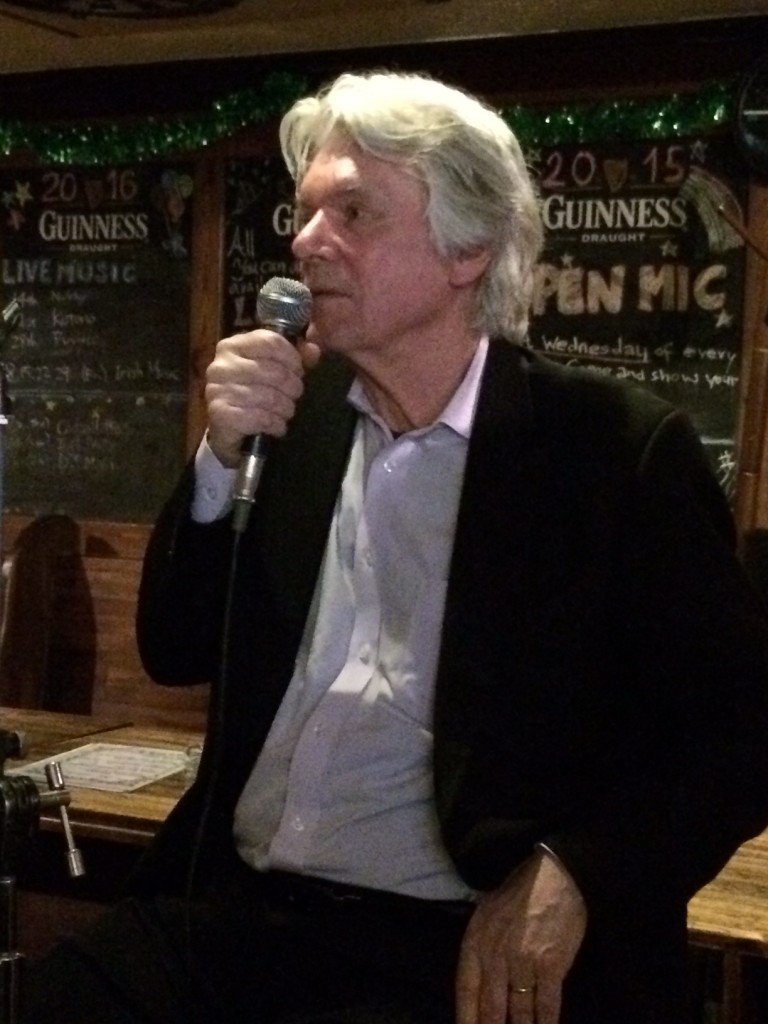
Eric Johnston introduces Robert Whiting to a packed house at the Gael.

Eric Johnston introduces Robert Whiting to a packed house at the Gael.

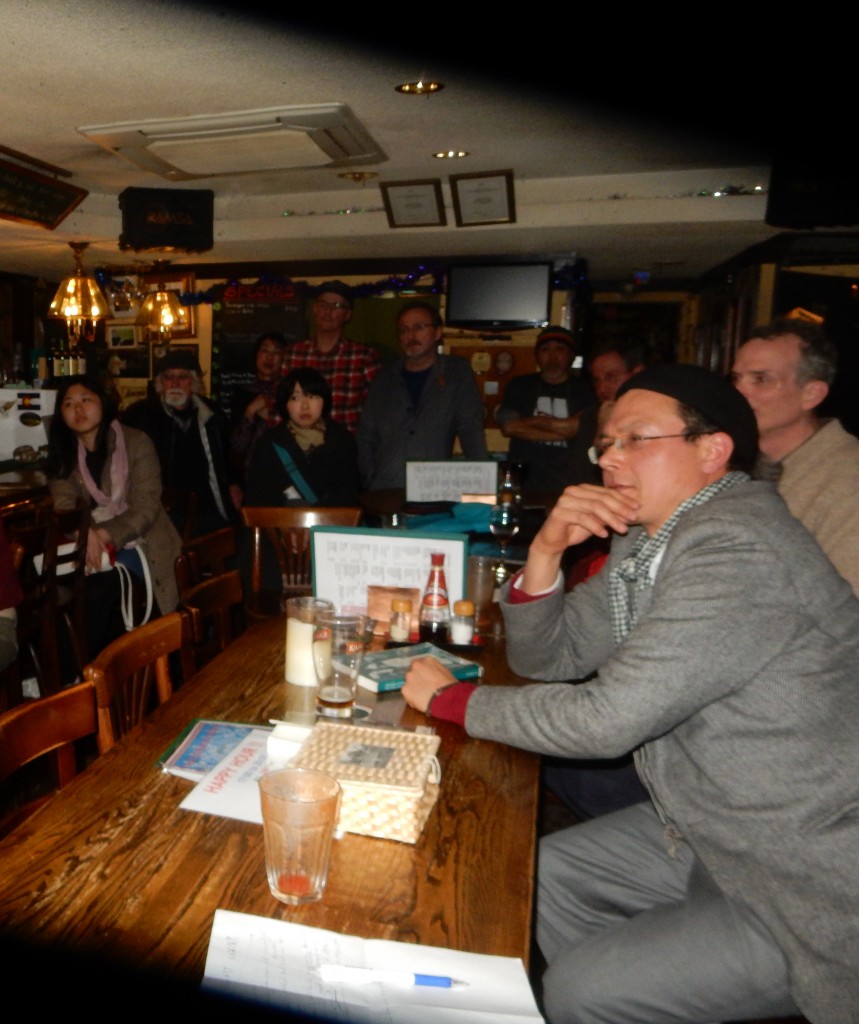
The audience listening intently to one of Robert's many anecdotes

The audience listening intently to one of Robert’s many anecdotes

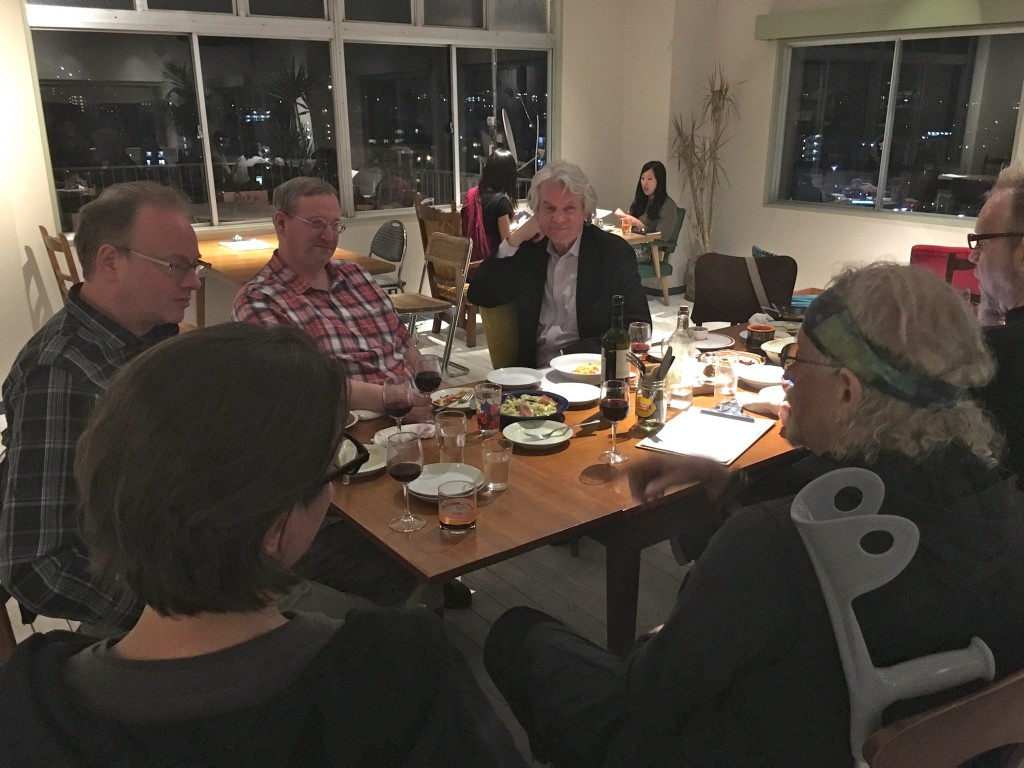
Members of WiK relaxing with Whiting at a dinner party later

Members of WiK enjoy dinner with Robert Whiting at a restaurant with a view.  Robert claimed Tokyo was the best place in the whole world to live, but WiK members were determined to prove to him that Kyoto was!

Featured writing

Steiner on laundry hanging

WiK Essay for March 2016 (Richard Steiner)

I am hanging up the laundry on our veranda. It conveniently faces south.

I see the large forest of the local shrine; others’ laundry waving to mine; new leaves beginning to open on the trees in our garden below; a fat wild cat sunning itself on a neighbor’s roof; moss covering a tile roof nearby.

I hear the nightingale calling for a mate; children playing in the pre-school grounds; the overloud speaker of a newspaper collecting truck; distant sirens; a door closing, then opening again; something falling from a tree.

I smell flowers of early spring; freshly washed clothes; rotting wood of the abandoned house next door; somewhere upwind an early lunch is being prepared; moist mud from last night’s rain.

I feel the sun penetrating my body down to still frozen bones; the wind moving thru my hair; my hands hanging up soft, damp cotton towels; the touch of spring on my face.

My soul tastes all of this Kyoto atmosphere. More reasons to love hanging laundry up in a late morning.

Writers in focus

Basho in Saga (Robbins)


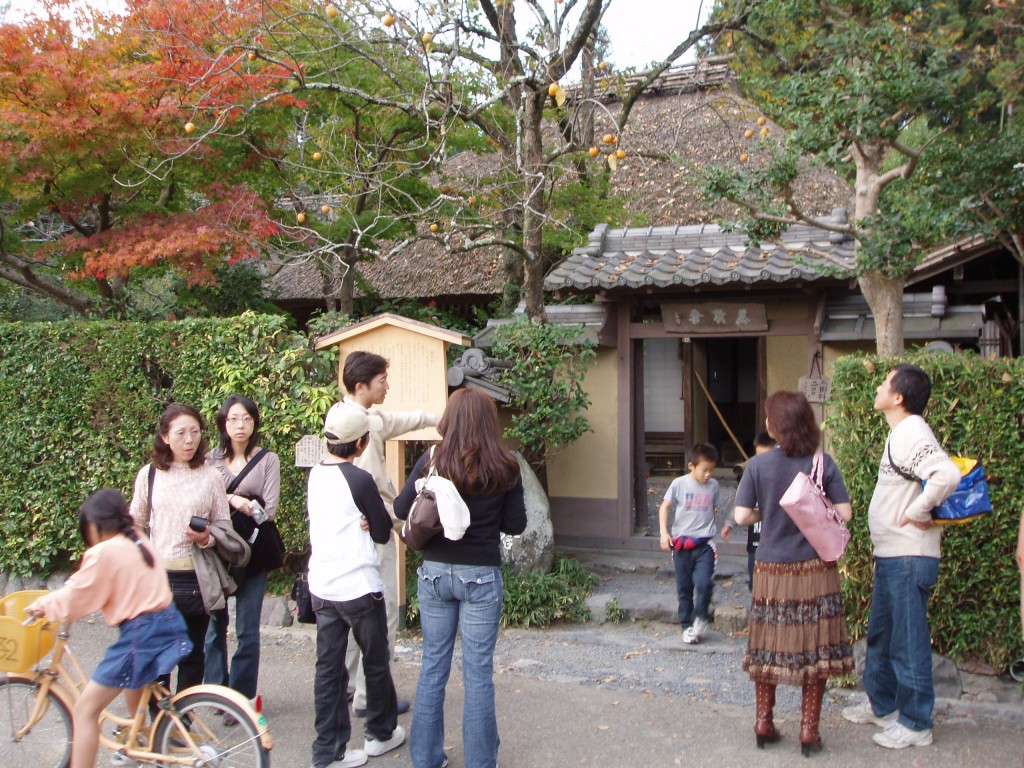
Entrance to the Rakushisha cottage in Saga where Basho stayed in 1691 and 1694

BASHO IN SAGA

Eight Basho haiku, one renku, seven passages of prose and two of his letters,

Translations and Commentary by Jeff Robbins   Assisted by Sakata Shoko

  N.B.   Basho’s own words appear in bold

******************

Basho’s follower Kyorai, the second son of a doctor of Chinese medicine in Kyoto, had a cottage in Saga on the western outskirts.

Basho stayed here for 16 days in 1691 and three weeks in 1694.

The one in Kyoto named Kyorai has a cottage in lower Saga within a bamboo grove, at the base of Mount Arashi, close to the flowing Katsura River. It is a convenient place for leisure, a place where the heart can clear.

Called the River Oi in Basho’s time; I call it by its modern name, the Katsura which bounds the Kyoto area on the west and south.

One autumn Kyorai planned to pick the persimmons hanging over the roof the next day, but you know, man, he did not get around to it, and the rain that night knocked them to the ground, so he called the place “House of Fallen Persimmons.”

This Kyorai is a really lazy guy and the grass stands high before the window, while persimmon trees stick out over the roof.
Summer rains leaking everywhere, tatami mats and paper doors smell of mold, and finding a place to sleep is not so easy.

Sounds like Kyorai was a hippie. On his first day in the cottage, Basho went to see “traces” of a woman. Passages from the Saga Diary are dated according to the Western calendar:
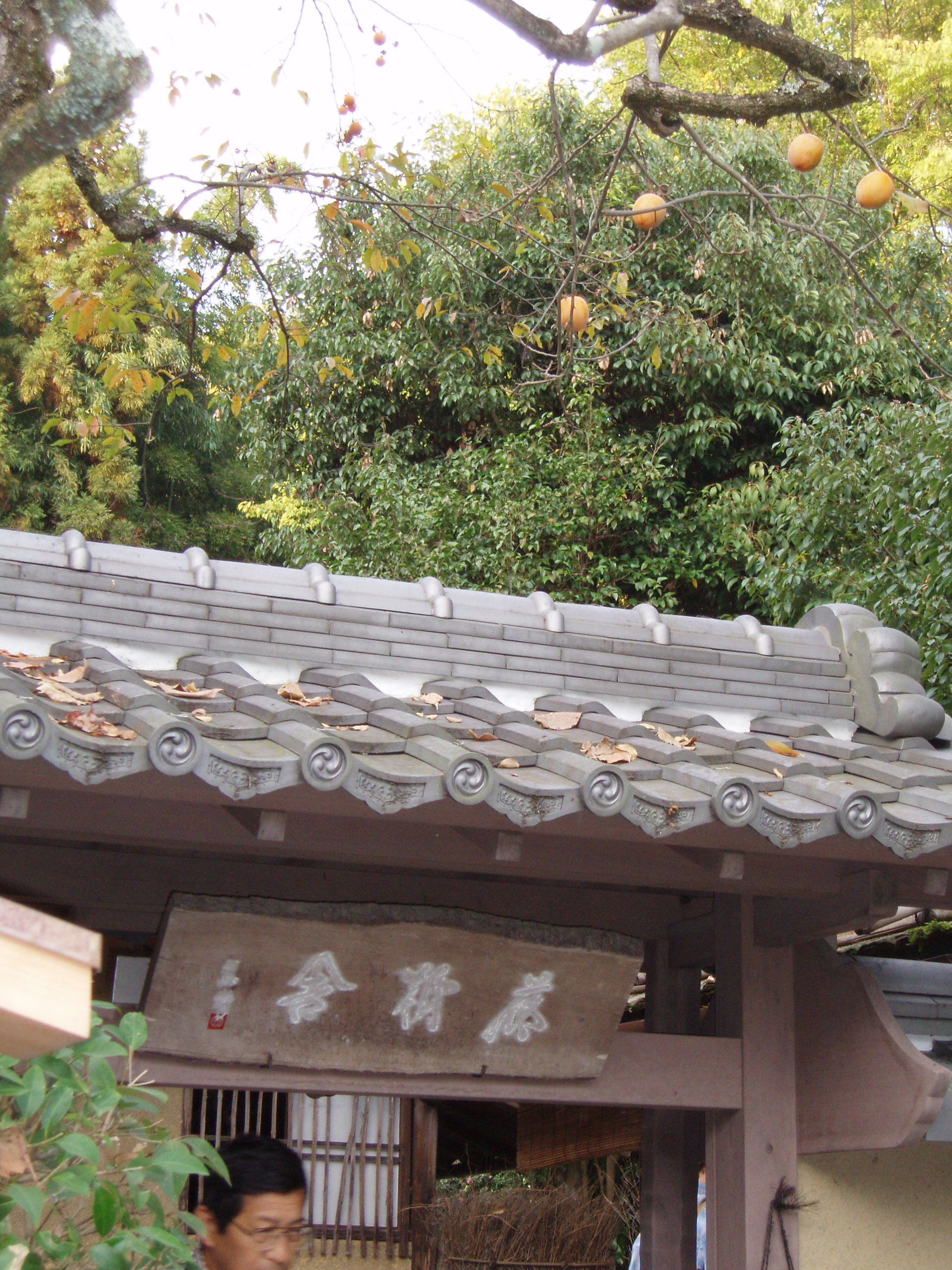
Persimmon overhanging the entrance of Rakushisha

May 16 –

We visit Rinsen Temple. The Katsura flows before, while the heights of Mount Arashi continue from the right down to Matsuo village. Many people come and go to the Kokuzo.  Among the bamboos of Matsuo is said to be where Lady Kogo hid herself in a cottage, although altogether there are three places up and down Saga which make this claim, and the true site cannot be determined.  Matsuo is where Nakakuni stopped his horse, the so-called “Horse-stopping Bridge”, so for the while, shall we say this is it?

Kogo was taken as a courtesan by the Emperor Takakura already married to the daughter of Kiyomori, chief of the Heike clan ruling Japan. Kogo hid from Kiyomori’s rage in an isolated cottage in Saga with many enormous bamboo groves. The anguished emperor sent a palace guard named Nakakuni to search for her. Kogo was a virtuoso on the koto or 13 string harp which suggests the sensitivity in her heart. Nakakuni rode all around Saga until the sound of her koto brought his horse to a stop on a bridge.

Three places in Saga claim to be the site of Kogo’s cottage, but Basho is not one to be fooled by some tourist trap on the other side of town from the Horse-stopping Bridge. Kogo returned with Nakakuni to the Capital, but when Kiyomori found out she was back, he was furious. He forced her into a nunnery and she later threw herself into the river.

Her grave lies in a bamboo grove next to Sangenya and by the gravestone is a cherry tree.  Graciously she awoke and slept on embroidered silk only to become dust and rubbish among bamboos.  Willows in the village of King Sokun,  Blossoms at the Shrine of the Goddess Fujo, the past fills my thoughts.

The final sentence reaches to the Outer Limits of Obscurity: an old Chinese poem compares the arch of willow branches in the village where King Sokun was born to a lady’s eyebrows; and the blossoms at the shrine of the goddess Fujo to crimson lipstick; this sketch of Kogo’s face — just her eyebrows and lips (a motif often seen in modern advertising) — fills Basho’s thoughts.

                                   Nodes of sorrow—

                                   to become bamboo shoots

                                   at her end

Each of the nodes at regular intervals along stems of bamboo forms a solid disk throughout the diameter of the stem, while between the nodes is hollow. Thus a section of bamboo cut below a node will hold pens and pencils. The expression “to grow in nodes of sorrow” suggests that life moves along smoothly but every so often come to a solid mass of sorrow. Kon speaks of Lady Kogo “tossed about in the world, finally to be buried in a bamboo grove where she changed into bamboo shoots, the end of her road so pathetically sad.”

May 17 –

                             HototoGIsu

                             through great bamboo grove

                             moonlight trickles

The towering bamboos form a cathedral of green, with the moonlight trickling through; the clear bright five-note call of the little cuckoo punctuates the feeling of divine presence.

                                     Clapping my hands

                                     day breaks in the echoes

                                     summer moon

 While Basho was in Saga, he helped Kyorai and another follower Boncho compile a major anthology of the Basho school,  Monkey’s Raincoat, to be published later that summer. So Basho would not be lonely, either Kyorai and Boncho stayed the night. On May 16th, Boncho spent the night. His wife, Uko who is a nun, came out to the cottage the next day.
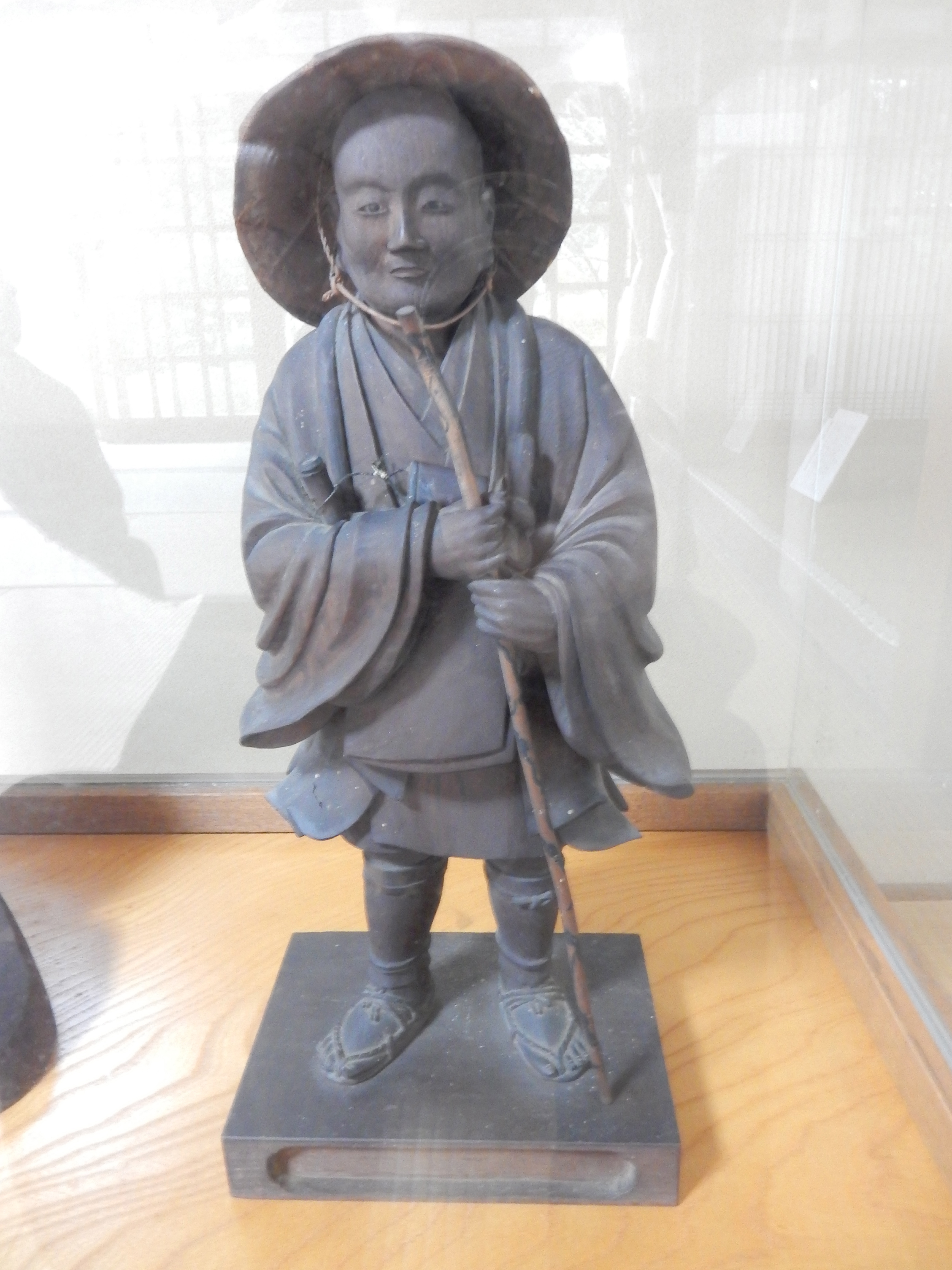
 

Basho as a wandering monk ((statue at Konpuku-ji in Kyoto)

Basho as a wandering monk ((statue at Konpuku-ji in Kyoto)

The nun Uko arrives for a festival in North Saga.  Kyorai also came out from Kyoto.  Kyorai’s brother’s wife sent us cakes and side dishes.


                                             Come here again

                                             strawberries will brighten

                                            Saga Mountain

This verse by Uko is the only haiku by a woman in Basho’s published prose. Uko demonstrates the traditional role of women in Japanese society: providing hospitality. Instead of putting forth her own experience, Uko focuses on Basho, welcoming him to Kyoto and Saga by saying that whenever he comes here, strawberries will redden to celebrate his presence.

Tonight Uko and husband stay over and with five people lying up and down in one mosquito net

The fifth person may be either the delivery guy who brought the cakes from Kyorai’s house, or a fellow named Yohei who lives next door and is caretaker of the cottage when Kyorai is not here. The mosquito net is a special one, made for fishermen to set up over the river, so it’s pretty big – two tatami mats, about 6 foot square. They appear to be lying in alternating directions, “up and down,” my shoulders near your knees, for efficient use of space. In Japan both genders may sleep in the same room, in separate parts of the tatami floor, with no thought of sex. Still, five adults spread out inside one mosquito net is bound to get interesting, especially when one is a woman and furthermore a nun, and there is also her husband who is a doctor, their Poetry Master, the guy who owns the cottage, and someone else, presumably of a lower social class, but they all lie down together in one mosquito net.

. . .even though it is night we cannot sleep  so after midnight we each come out from the net, bring out the day’s cakes and sake cups, then till the approach of dawn our talk grows light. . .                

No one gets any sleep though, so they “each come out from the net” and eat some cakes and drink some sake until everyone gets light and happy and they party till dawn. They sound like college students.

These are not the Japanese Ruth Benedict portrays in The Chrysanthemum and the Sword, all taken up in working off obligations, stiff with the dictates of hierarchy and proper behavior, males always dominating females. Basho says ‘lighten up’ on the issues of obligation, hierarchy, custom, and gender—or maybe that Japanese society was not so severe as Western writers portray it, or maybe that the crowd Basho hangs out with was exceptionally loose.

With daylight Uko and Boncho went back to Kyoto while Kyorai stayed on.

Here are three stanzas of linked verse written in succession by Boncho, Basho, then Kyorai:

His carriage pulls in
the neighbor’s gateway
“Fickle one,
under hedge of spikes
you must crawl!”
Now, before he leaves,
she hands him his sword

She wants him tonight, but is sick and tired of him playing around with other women, so she has closed her front gateway (double meaning alert). He parks his vehicle in the neighbor’s spot to go in a side door. Between the two properties stands a hedge of a tall citrus scrub whose branches divide into twigs ending in inch-long daggers.   She thinks “If you want me, suffer as much pain as you caused me!!”   According to Kyorai, the man passed through the ordeal, and they slept together. A samurai always carries his sword – except in bed. In the morning, the woman hands him the “sword” which is the manhood he lost last night crawling on the dirt like a worm. He crawls back under the hedge to his carriage and leaves.   The cycle is complete.


                                                Good for nothing

                                                 I just want to sleep

                                                noisy bird


The reed warbler adds its irritating squawk, day or night, to the overall oppressiveness of the summer season. The scholar Kons elaborates: “One exhausting endless summer day, having done nothing for days, with no talent for anything, I just want to sleep – but a reed warbler starts to squawk so I cannot.   Oh! reed warbler, won’t you stop squawking for a bit.”

Basho’s friend Tokoku, his traveling companion for four months in 1688, died in 1690 aged 30. Basho’s diary entry for May 25:

     In dreams Tokoku appeared and weeping awoke me.   Time shared with the spirit becomes a dream.

     When yang is exhausted, we dream of fire; when yin declines, we dream of water.

When Yang, the hot, active aspect of the universe, is exhausted, we dream of fire to replenish it — a weakness of Yin, the cold, passive, and hidden part, is replenished by a dream of water. Basho says that through dreams we regulate our own health.


         My dreams are not those of saints or gentlemen.                              

      All day long the illusions scatter about,                                

      and in the night shadows, dreams are just the same.

      Truly to see Tokoku in a dream

      can be called a dream of remembrance.

      He followed me to my old village

      where my aspirations began, and at night

       we lay down and got up on the same floor.

       He helped me in the toil of a pilgrimage,

       for a hundred days he followed me like my shadow.

       At times we had fun, at times we were sad.

       His intentions dyed the lining of my heart.
The words are so very simple, at first they seem not to mean much, however, because they are so simple, they can, if we let them, take on deep personal and social meaning. The image of “dyeing the (kimono) lining,” women soaking fabric in dye to color it before sewing together the two layers of a kimono, adds romantic beauty to the prose. Basho applies this active female image to the innermost places in his heart. Recalling the fun and sadness we shared, friendship soaks the layers inside my heart.

May 29                                                                            

Sora has come to visit: his pilgrimage to the blossoms at Yoshino and the Kumano Shrine went well.   We spoke of old friends and followers in Edo, this and that mixed together.  With the evening sun we rode a boat up the Katsura River past Mount Arashi to the rapids at Tonase. It began to rain and with evening falling, we returned to the cottage.

 May 30  

Last night’s rain continued to fall all day and night without stopping. Together listening and speaking more about those in Edo, finally it dawned.

May 31

Not having slept last night, I lie down and sleep all day.  Around noon, the rain stopped.  


                          Long summer rains—

                                         poetry cards peeled off,

                                         traces on the wall


While it rains for hours, walking around the cottage before leaving it, Basho notices on the wall some rectangular spaces less discolored than the rest of the wall; that a former resident pasted his favorite poetry cards here and removed when he left; in these “traces” remaining from a consciousness here long ago, Basho imagines the lovely fair-weather scenes in the poems no longer there.

After his sojourn in Saga in 1691, Basho returned to Edo for more than two years. In summer of 1694 he again came west to the Kyoto area. Here he is on his way again to Kyorai’s cottage:

                             Wicker basket’s

                                 cool weight on one shoulder

                                 first musk melon

The sensations in this verse are remarkable: the coolness of round melon seeping through the willow-branch basket on one shoulder, the body adjusting to compensate for the extra weight on one side, the anticipation of sharing the sweet juicy melon with good friends when he arrives.                                                                              

On July 24th at the House of Fallen Persimmons, Basho wrote in a letter to his neighbour Ihei at home in Fukagawa near Edo:

  These days impoverished followers of mine from Kyoto and Osaka gather about and we eat up all the food in the house and spend our time with great laughter.

Basho sounds like a fun guy who enjoys eating and laughing with young people. Makota Ueda translates this passage,

“Penniless students of mine in Kyoto and Osaka rush here  one after another these days: they eat all the food available and spend their time in loud laughter.”

In Ueda’s words, Basho is not a part of the eating, drinking and laughing; he sounds like a fussy old man annoyed with his followers. The Japanese (as usual) is vague; it can be taken either way   — Basho eating and laughing with them, or Basho annoyed at their eating and laughter – but Japanese Language Instructor Shoko can see no sign of annoyance in the original. Ueda’s translation is heavy, coming from the “no-fun” Basho image. Our translation is light and leads to “Dear Uncle Basho.”


On the 23rd day of the Intercalary 5th Moon — July 15, 1694 –Basho in Saga sent his follower Shiko presents and a letter :

           The two things you sent with your best wishes will be most valuable, especially on a journeyToday Kyorai was cleaning the pipe for me, and this being the first time he did this, “pipe cleaning” shall be a seasonal reference to the Intercalary 5th Moon.


One of the presents Shiko sent was a kiseru, a long thin pipe with   bamboo shaft and metal mouthpiece and bowl. The bowl is tiny, only big enough for two or three inhales. Wikipedia says “Kiseru were used for smoking a fine, shredded tobacco, as well as cannabis.” (Before World War II, cannabis was often smoked both for recreation and medicine.) Basho makes the absurd suggestion that ‘pipe cleaning’ become a reference to the Intercalary 5th Moon because the illustrious non-smoker Kyorai cleaned a kiseru for the very first time during this Intercalary 5th Moon. So, when the next Intercalary 5th Moon comes in twenty or thirty years, it will be remembered as the season of Kyorai cleaning the kiseru. How ridiculous! but then that’s par for the course in this letter.

     You sent your other present in the wrong season so from now on, it too will refer to this season.

     Always remember what you have learned here.  This evening why don’t you come visit me?

                     Basho                                       

    p.s.  In fact, by chance, at this time  last year in Bufu, I forgot my gaiters  so now shall “gaiters” set the season?

“Bufu” is a funny-sounding way to say the province where Edo is. Gaiters made out of straw or cloth, are worn to protect the lower legs while travelling. If Basho was smoking cannabis there in Kyorai’s hippie cottage, that helps to explain his bizarre sense of humor.

Here beside the river in Saga, Basho wrote this haiku:

                               River Katsura

                               no dust in the ripples

                               summer moon

 Basho’s ideal of Purity seen in moonlight on flowing water.

Five months later, after midnight on November 24, on his deathbed in Osaka wrote his famous haiku about dreams wandering about on withered fields. He went to sleep; when he awoke the next day, he asked Shiko

“do you remember this summer, when I was in Saga that verse about the Katsura River?”  

Basho told Shiko to revise that verse to:

                                       Clear Cascade

                                       into the ripples fall

                                       green pine needles

 This was actually Basho’s final poem, although scholars do not count it as such. Because the season in the poem is summer while the season in reality was winter, scholars say CLEAR CASCADE does not belong to the end of Basho’s life; it appears in the chronology of Basho poetry in summer where nobody notices it. Basho, however, wrote the verse upon waking from sleep, so it appears to record his dream. In sleep Basho left his sick old body dying in the cold winter night to dream-travel back to summer in Saga beside the raging river.  As a dream-haiku, this verse does belong to this early winter night and is Basho’s death verse.

The pine needles, still green and full of life, fall into the rushing water,  swirl about and rush away, leaving no traces of their existence.  The flow never returns and what is gone is gone forever.

You can visit the replica of Kyorai’s cottage a fifteen-minute walk from JR Saga Arashiyama Station. Google “House of Fallen Persimmons” to find various prose accounts and many pictures.

******************************

Author’s afterword:
I request your assistance in getting out the word on the warm affectionate Basho who wrote hundreds of poems about women and children about friendship, love, and compassion in works unknown to the world, yet the most pro-female, child-centered, life-affirming works in old-time literature.

Feedback will be greatly appreciated.

                               Basho4now@gmail.com

*******************************

For Jeff’s previous posting, see his piece on Basho’s Shijo haibun.
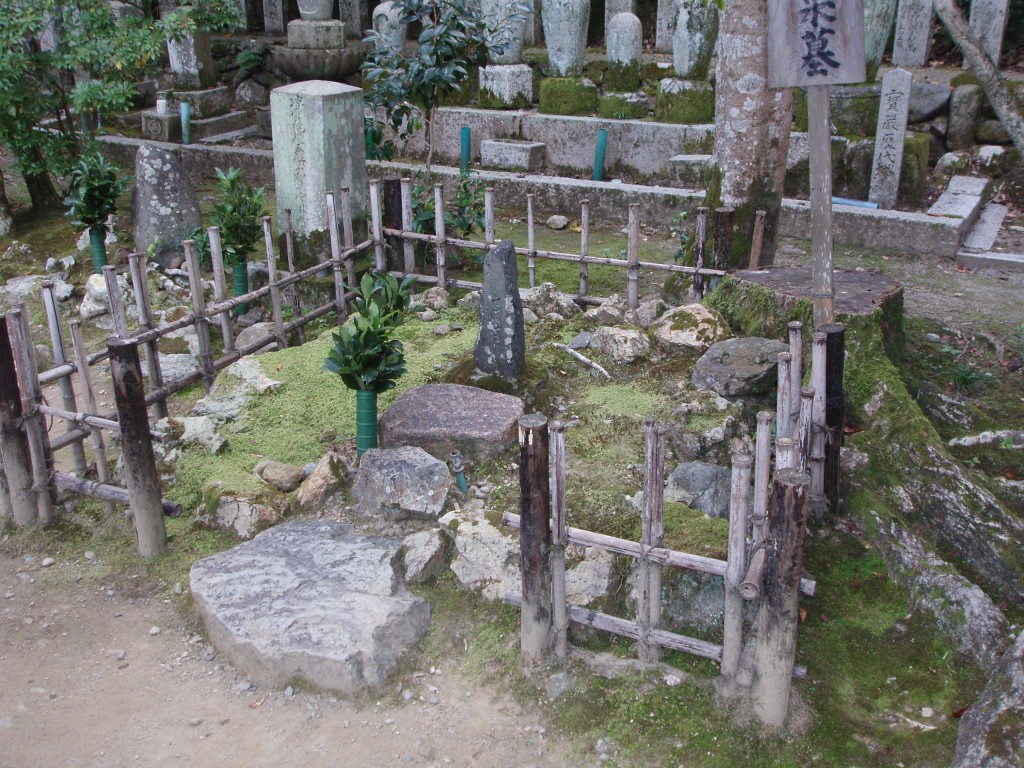
 

Kyorai’s grave, close to the cottage of Rakushisha in Saga

Featured writing

WiK Competition winner: Kimono memories

Peter Mallett is a university professor and writer based in Kobe, Japan. Originally from the UK, he has an MA in Creative Writing from Bath Spa University. Former Arts editor of Kansai Time Out and publisher/editor of Artspace, he has written for The Asahi Evening News, Gramophone Japan, Opera NePeter Mallettws, The New Internationalist etc. His textbook From Word to Letter was published in 2007. He is seeking publication of his first novel Appassionata and is now working on a historical novel.

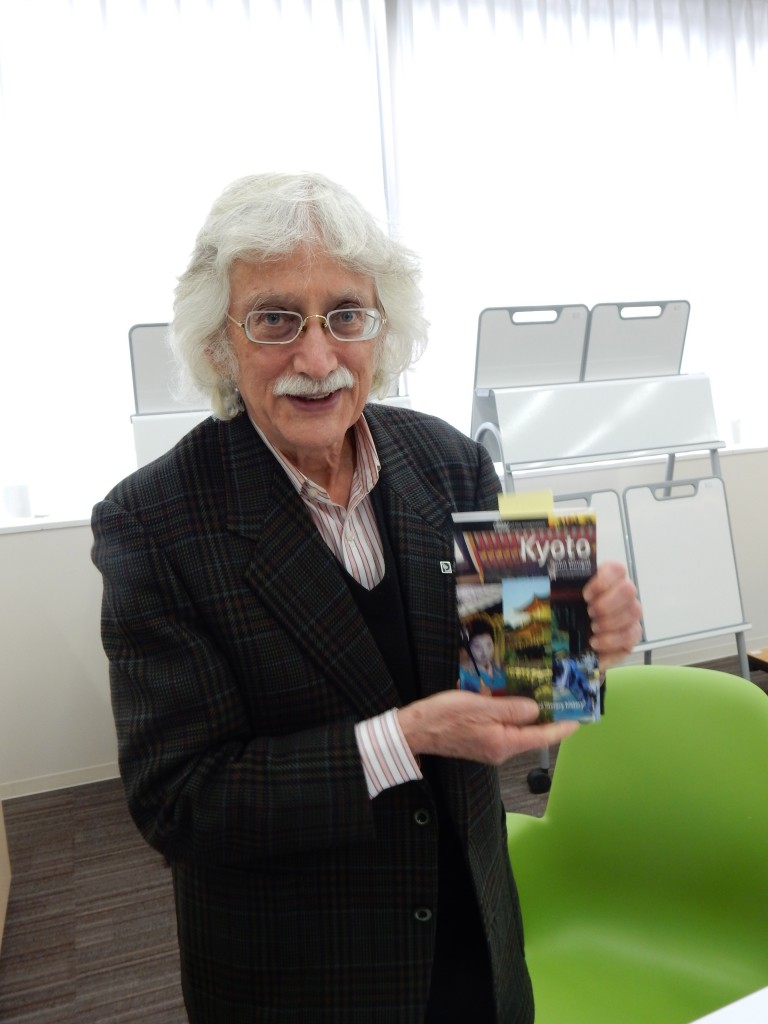
The judges felt this got under the surface of life in Kyoto by revealing something of the feelings that lie beneath those elegant kimono.
Moreover, it seemed an opportune and appropriate subject matter, given the importance of Nishijin weaving and the ‘outbreak’ of kimono-wearing females in the past year on the streets of the city.

****************

Kimono Memories

Mothballs. The odour of naphthalene hit her nose as she opened the chest. She unwrapped and took out the carefully folded kimono – the formal black one, the one she would need. Beneath it, the autumn kimono with its pattern of maple leaves she’d worn for her daughter’s shichi-go-san ceremony at the Kitano Temmangu Shrine, in the Nishijin district where the silk for the garment had been woven.

Layers of a life: her history entwined with the fabric.

At the bottom of the pile lay the exquisite furisode kimono she’d worn for her engagement ceremony. She stroked the soft silk lovingly, admiring once again the shibori embroidery. Such fine work: it had cost her parents dearly. A necessary expense, however, to ensure a good marriage into a suitable Kyoto family.

An expense for an item she never, of course, wore again once the marriage negotiations were settled. She’d hoped her daughter might wear the long-sleeved kimono when she became of age but patterns and colours had changed and Megumi refused to contemplate a 25-year-old hand-me-down.

Had it been a ‘good’ marriage? Hiroshi had certainly been eligible – a doctor with his own clinic in downtown Kyoto. She’d enjoyed the privilege of his status, the material rewards of high salary. He’d denied her nothing. Nothing but the one thing she’d wanted.

As her mother-in-law demanded, she pretended to be ignorant of the betrayals, his string of infidelities. The traditions of this city had bound her as tightly as the obi she’d tie around her waist for the ceremony tomorrow.

The black kimono would still smell of mothballs in the morning. How could she have prepared it for her husband’s funeral? Who could have expected him to die of a heart attack, aged only 56, in such a compromising situation?

Featured writing

WiK Writing Competiton: Second Prize

Jesse Efron has an M.A in English literature as well as an M.F.A in creative writing. He lives and teaches in northern Kyoto prefecture.  The judges felt his piece provided an interesting look at questions of identity in a global age and at a time when tourist numbers in Kyoto have surged dramatically.

****************

Jesse Efron

Jesse Efron

Nippon

Nippon leaves his one story apartment, gets the newspaper and acknowledges March’s grey sky, then returns to make soup using actual ingredients with spices like parsley and turmeric. He prepares vegetables, indulges in the broth’s piquancy before adjusting and re-tasting until he’s achieved a healthier mirroring of those powdered packets that have usurped what used to be home-cooking. He shakes his head at the misfortune of generations growing up on packaged foods, though this isn’t even his real preoccupation. He wants to know what he stands for; a nation? And if I am to stand for a nation, then why do I hide here in the Enmachi district of Kyoto? He knows the answer, that he uses Kyoto as his mooring in what’s become a diffusive world.

So he finishes his meal and walks to Kinkakuji, taking solace in the lack of skyscrapers. Tourists are reflected in the gilded leafing and paneling of the Golden Temple and Nippon stands among them guessing nationalities, but as he has a difficult time even picking himself out, he gives up and leaves, not even wanting to make conclusions about who he believes to be Japanese.  

Ryoanji is quieter and famous for its fifteen-stone Zen garden. He pays the entrance fee and before entering the temple is reminded in English to remove his shoes. He can’t understand the couple speaking French or the German sounding man talking to his boy, but it’s distracting. The carefully swept garden is designed such that only fourteen of the fifteen rocks are ever visible at once, yet despite the impossibility of the stones he searches. Someone speaks Chinese. Another, Korean, perhaps. And eventually, when Nippon is deep within the stones, all of the languages become one.

Featured writing

WiK Competition Third Prize

Richard Steiner displays his love of Kyoto.

Richard Steiner displays his love of Kyoto.

The winner of the third prize is Richard Steiner, who is a longterm resident of Kyoto, a noted woodblock printmaker, and a member of WiK. (See his piece on writer’s block.)

The judges felt that while the piece was simple in conception, it captured the charm of the city which lies beneath the tourist veneer.  There is no mention here of famous sights, but anyone familiar with Kyoto will recognise the references in the listing – and be able to add their own.  It is after all in the back streets and small interactions of Kyoto that the true appeal of the city lies.

*****************

To live in Kyoto,

IS

to be one part of this city, to wander the back streets anew, to smell dinner being prepared, to hear at night feral cats in heat, to be given a seat on a crowded bus, to see mothers gossip while watching their kids play in the park, to hear dogs barking for no reason whatsoever, to smell the air after a storm, to realize you’ll never be able to taste all the endless variety of pickled veggies made here, to step on melting streets in August, to yell out THANKS to the garbage collectors, to give coins and mikan tangerines to a trio of begging monks, to see a building being torn down which you saw being built a couple decades before, to cry noticing a fine old house being ripped out of history, to overhear screams from a window of a child not wanting to do anything it’s told, to listen thru the night to countless ambulances, to greet the old woman tending her flowers on the curb, to climb Mt Hiei and marvel at the city below, to join the thousands coming to the Setsubun celebration on Yoshida Hill, to eat hot nisshin soba in a small local restaurant, to wonder why a foreigner naturally bows to strangers who bow back, to always marvel at Kyoto Station’s 0 platform, to take in the rarefied atmosphere of a very old coffeehouse, to take a bath in the sento and wish to die in that liquid pleasure, to walk like a kid thru temple markets, to always be commenting on the weather, to slowly understand why this city is so precious and unique and necessary, and to love it daily.


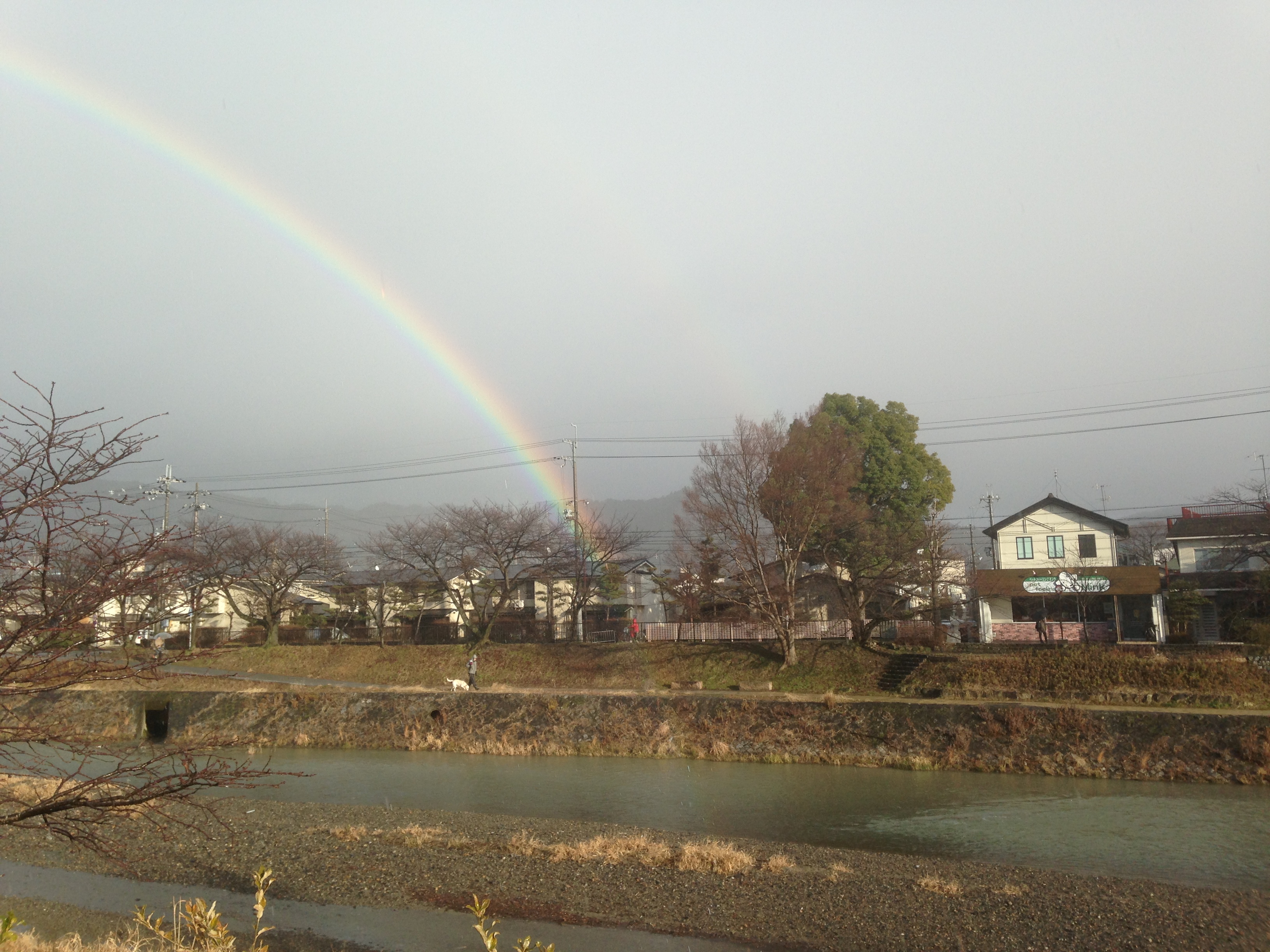
Kamogawa rainbow

Featured writing

WiK Competition Local Prize

Mayumi Kawaharada, winner of the local prize

Mayumi Kawaharada (photo by Micah Gempel)

Mayumi Kawaharada grew up, lives and works in Kyoto.  She started writing English haiku in 2004, as a member of the Hailstone Haiku Circle led by Stephen Henry Gill.  Many of her works appear on their blog and in their books.  Recently she self-published her first bilingual haiku and photo booklet, Three and half years passed in Fukushima (Shimauma Print, 2015). She also maintains a bilingual blog “Veggie life in Kyoto” about vegetarian friendly restaurants in and around the city.

The judges were taken with the concept of a series of haiku to highlight the changing seasons of the Kyoto year.  The execution is effective, giving rise to different emotions, and the ending links back to the beginning to give the sense of an unending cycle.

*****************

In the spring, summer, autumn, and winter – Colors in Kyoto


Beside the bamboo forest –

Nobody near, but

A scent of paper-whites


Alighting on my black shirt,

A firefly pauses, waits –

My first gold medal!


Unexpected bathing —

Rain drops dancing

With winds and thunder


Dot stripes

Drawing on a bus window –

Morning typhoon


In the dusk

A dog barks and chases

The shadow of a dragonfly


An orange color

Rises in the moonlight –

Ripe persimmons


Red maple leaves

Arrayed around the stone fox –

Lingering autumn


Fragile white lace

Drifts into a faint halo –

Snowflakes


Green dots shoot

Up through the snow –

A breath of life

« Older posts Newer posts »

© 2026 Writers In Kyoto

Based on a theme by Anders NorenUp ↑