Page 59 of 65

Writers in focus

Ted Taylor on the road

DSC00907b


Based in Kyoto, Edward’s work has appeared in a variety of print and online publications.  Co-editor of the Deep Kyoto Walks anthology, he is currently at work on a series of books about walking Japan’s ancient highways. (For an interview with him conducted by Michael Lambe, see here. For his blog, click here.)

******************

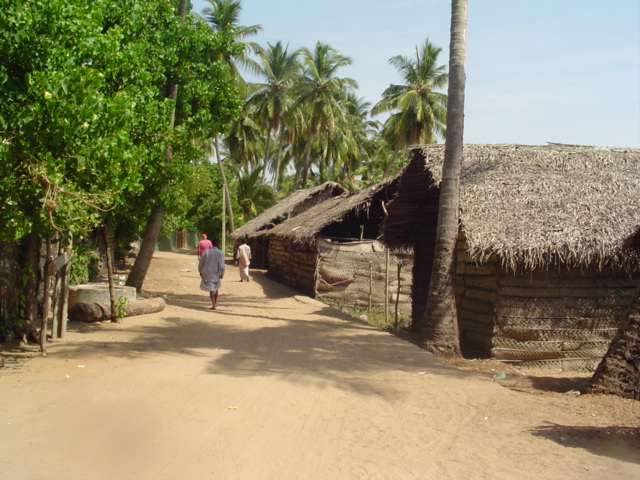
Around 11:00, we set off down Ella Gap, becoming part of the scenery that I’d been enthralled with since yesterday afternoon. We eventually left the main road for a smaller, rougher road trafficked heavily by trucks loaded with sugarcane, moving through dry scrub stretching desperately for dry earth. It was a desolate landscape, dotted with simple huts of thatch unprotected by walls. I wondered whether such extreme desolation and poverty is a factor in breeding rebellion, since this area has long been a hotspot in this country’s long Civil War.   As if to emphasize this idea were the multiple police checkpoints, each one fortified and heavily armed. One village had one of those “School Crossing” signs except that the legs of one of the kids pictured had faded away. I thought of landmines and irony.

At one point we nicked the southern edge of Lahugala National Park. Three small elephants were standing in the shade and further off, a huge male was heading toward a large body of water. The road continued, arrow straight, until we reached its end at the dusty town of Pottovil. A group of foreigners, looking huge next to the locals, bought bananas from a vendor. Nearby, a cow lay in the shade atop a pile of leaves.

beach scene

We drove across the bridge into Aragam Bay. Our first stop was Stardust, where I’d hoped to stay, but they were filled up with the surfers who were in town for the 1st Annual British Surfing Competition. We settled on lunch, during which I talked awhile with Per, the hotel’s Danish owner.   He told me of the changes he’d seen during his 24 years here. Property was selling well, especially since, due to the lull in the war, they were soon to introduce flights geared toward surfers. Affiliated with Sri Lankan Air, one of the Surf Contest’s sponsors, these flights would land directly on the lagoon. There were rumors that the town’s fishing village would be moved further south. Families that had been here for generations could stay, but those newer to the area would have to go. In five year’s time, there’d be high hotels towering over the fishing huts, negating all the charm this town now had. Per himself was doing all he could to slow this. This friendly, charming man had had the foresight to buy vast amounts of land, and was now screening potential buyers, selling not to hotels but to families wishing to build homes here. (I was saddened to learn that he’d been carried off by the Indian Ocean Tsunami six months later.)

On the way out, I noticed on the bookshelf a copy of “The Inheritance of Loss,” the book I’d accidentally dropped from the train outside Kandy. I tried to convince Per’s wife to sell it to me, but she wouldn’t, saying that she doesn’t sell old friends. (“How about introducing your friend to someone new,” I thought.) I tried flattery, I tried flirtation, but she wouldn’t budge. Never underestimate an old woman’s sentimental attachment to her books.

We drove down the town’s single road, lined with English signs for hotels, Internet, food. Plenty of young foreigners were around, many carrying surfboards, all with dissatisfied cool written on their faces. Aragam Bay was the first backpacker haven I’d yet seen in Sri Lanka. There was lodging available at Rupa’s Guest House, down in the fishing village. It was a collection of about a dozen bungalows set on a small lane. It was the closest lodging to the surf break, so on every porch there were surfers drinking and smoking and chatting throughout the heat of the day. It seemed a mellow little scene, with many of these guys staying for a month or two. Over lunch I got to talking with an Israeli guy and a Swedish guy who told me that this spot had been on the international surf circuit for years. The Aussies had come even during the worst parts of the war. On one occasion, when heavy fighting broke out in the town, the surfers had grabbed their boards and had met at the break, ready to paddle far out if things got too intense. But with the strong currents around here, I doubt that that would have been very safe either.

After lunch, the guys all went out to surf and I tagged along. Being Sunday, there were lots of local families around. Kids splashed in the still shallow water of the lagoon, while their mothers and sisters stood nearby in their saris. The fathers seemed to enjoy ogling the foreign women. I sat in the sand at the break watching the surfing. There was no shade and it was very hot.   I was eventually joined by some locals, no doubt because I was sitting on my own. They came in groups of two, in their baseball caps, jeans, and T-shirts. I wondered if these had been given to them by friendly surfers, or if it was some sort of booty. One especially talkative guy was leaning toward me, his hand uncomfortably close to my bag. Once again I thought about how there is no privacy or personal space in a village. Here in Sri Lanka, I suppose it must be rude to talk to someone without making eye contact. I was fine with chatting, so long as I could watch the surfing, but they kept stealing my attention by saying, “Hello,” or tapping on my shoulder. When one guy sat down right in front of me, in my line of view, I decided I’d had enough. I joined a Japanese girl and a Swiss girl sitting on the dune behind. The sand here was a bizarre reddish-orange color. The Japanese girl was travelling with her surfer boyfriend. Originally from Nara, she’d lived in Santa Barbara for 5 years, though not at the time when I had lived there. We chatted awhile about familiar places and things, though she didn’t seem to want to talk in Japanese, something I’ve noticed about Japanese I meet on the road. A Hawaiian guy eventually came over to sit with us. I asked him about surf etiquette here. He said that there wasn’t any, everyone dropping in on everyone else. I’d assumed so, since there were few locals and no one knew each other. We sat until we were in shade, the sun dropping below the dune behind us. Down on the beach, a wave surprised a group of women sitting in the sand, soaking their saris.
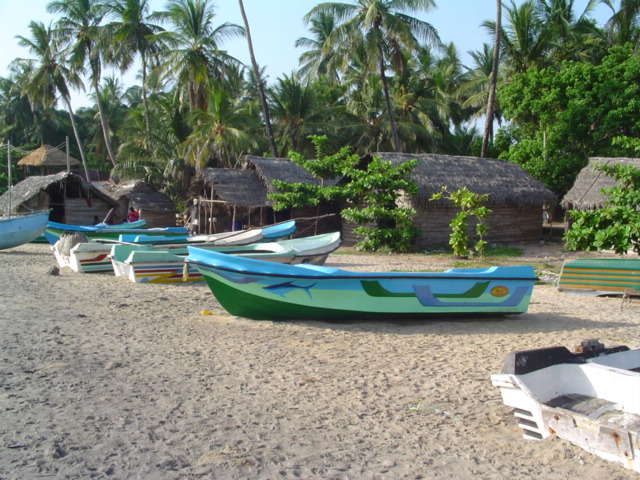
Sri Lanka fishing boats

Back at Rupa Guest House, our driver Somadasa was slightly upset. When he’d called this morning to check on the availability of rooms, he’d been told that there were driver’s facilities, but here he saw they were like a dog’s quarters, with no bed. I asked him what he’d do, and he said he’d find a place in town, even if it were expensive. Usually he’d sleep in the car but he’d been sick so he wanted a bed. Plus he was afraid. This was a Tamil area, and he was Singhalese. On the drive in, I could sense his fear. With all the security and guns, the tension around here was definitely high. But his fear had roots deeper than this. I was to find out later that on his last trip out here 15 years ago, he’d lost his car, and four other drivers had been killed. Looking around at the surfers on their porches, listening to the Beastie Boys and getting high, I thought about how stupid we all were. Stupid to be partying and hanging out in a war zone. Despite the Norwegian-led peace talks, things have a way of changing quickly here. Makes a good travel story, but… I had a hard time relaxing here, despite the perfect water, beautiful beach, good food, friendly people. Something felt a bit off.

Somadasa had called Rupa’s owner a bad man. I wasn’t so fond of him either. A Tamil who called himself Peter, he was a seedy man who walked around in a Body Glove tank top and a sarong. His speech and gestures were not what I’d come to expect from Sri Lankans. I’d noticed this about the other locals here too. Perhaps that was what had disturbed me most about Aragam Bay: the people were too Westernized, becoming this strange hybrid that didn’t quite work. It seemed off because they were Westernized in all but lifestyle. They still lived in thatch and grass huts on the beach. They still fished from dugout canoes, in the style of their ancestors. In my experience, most backpacker towns have the tendency to isolate you from the local population. But here we had constant contact with them and their dichotomy. Maybe this is how all these places are, and I just hadn’t seen it.

My bungalow shared an attached porch with my neighbor, Fred the Swede. We drank beer and talked travel until night fell. Nearby, someone was playing U2’s Joshua Tree album. This led us to talk about music, jokingly debating the worldwide impact of Abba vs. Elvis. When Lee joined us later, we headed up our dark quiet dusty road into town, passed by young men on bike and motorcycle. Further on were the silhouettes of large, hulking bodies in search of dinner. We decided on the buffet at Siam View, a treehouse restaurant run by a smiley Thai woman. The menu bragged about their neutrality during the war. The place was filled with foreigners, including the English couple that I’d met in the train station in Kandy. It was weird to see this many tourists, probably numbering the combined total I’d seen in country thus far. Above our heads were two TVs with the sound turned off, showing subtitled Thai versions of Dirty Dancing and some supernatural Hong Kong Kung Fu flick.

On our way back, Lee bought some pretty sketchy ice cream. A party down the beach was throwing a glittery strobe light through the palm fronds overhead. Bass boomed in my chest. At the top of town, Stardust was having an intimate party for 200. No one I talked to seemed to want to go. We instead sat again on our ‘stoop’ talking nonsense until it was late enough to sleep.
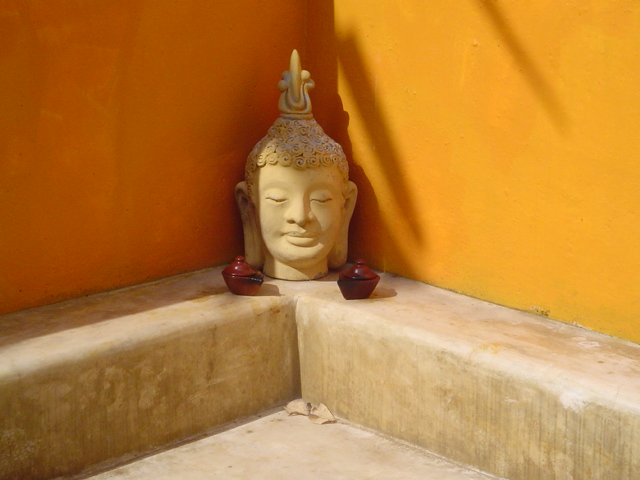
Sri Lankan bust

I awoke early, having not slept well for the heat and the noise. The beach was quiet, deserted. A lone fisherman was tossing his net into the surf, letting its drifting movements snag a collection of colored fish and even one sea snake. There were already a few surfers out. The waves weren’t as big as yesterday, but those in the water were rewarded with beautiful tubes. A few of them must’ve been pro. I sat on the dune talking with a Japanese guy from Kagoshima. He’d been here four times.

I cooled off in the water but like yesterday, I got out quickly. The water was warm but shallow over the reef, and the large swells and quick currents threatened to drag me across the coral. So I walked down the beach awhile, round the bend and out of sight of people. I gazed at the shape of the shoreline stretching south. The waves broke heavily on the rocks and reef, sending spray 20 feet into the air. I thought that if I kept walking, I’d probably never leave beach, and in a month or so, I’d have traced this island’s teardrop shape back here to the same spot. The sea was turquoise, the jungle green, the dunes red. It was beautiful and on this sunny morning, it was all mine. Then I remembered that this was still Tamil Tiger territory, and suddenly, that green jungle grew eyes. I turned back, each step quickening across the sand. I no longer noticed the natural beauty here, my mind far too busy preoccupied with landmines and the science of probability.
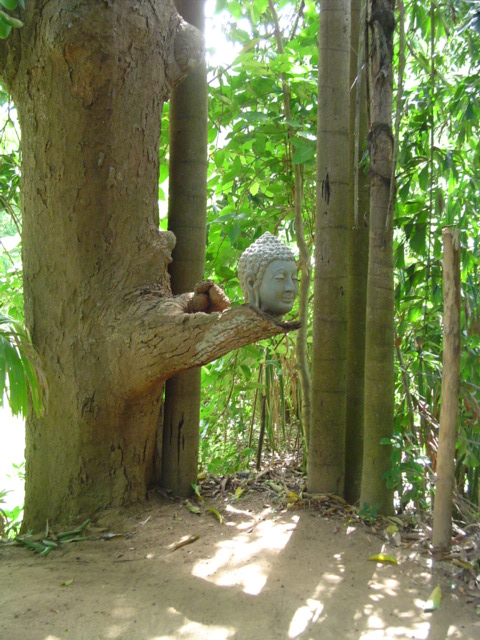


Sri Lanka head

Featured writing

Kawabata’s Old Capital (Koto)

Writers in focus

WiK Writing Competition Winners

The judges of the first WiK Writing Competition are delighted to announce the winners, as listed below.  Each of the three prize winners will receive a small gift from the Kyoto Convention and Visitors Bureau, in addition to which the First Prize will feature in the forthcoming WiK Anthology.  The Local Prize Winner will receive a gourmet meal for two at Tadg’s Irish Bar and Restaurant.

First Prize “Kimono Memories”
Name: Peter Jonathan Mallett

Second Prize “Nippon”
Name: Jesse Efron

Third Prize  “To live in Kyoto”
Name: Richard Steiner

Local Prize Winner “In the spring. summer, autumn and winter – Colors in Kyoto”
Name: Mayumi Kawaharada

The judges wish to express their appreciation to all those who entered, and the high quality of submissions made the final decision difficult.  Indeed, each of the judges chose a different piece as their favourite!  In the end though consensus was reached as to the outstanding pieces.  (It should be noted that the judging process was done on a completely anonymous basis throughout to avoid bias.)

The 21 entries came from a surprisingly wide range of places.  Nearly half were submitted from different parts of Japan, not just within Kyoto but such areas as Miyazaki and Fukuoka.  Others came Malaysia, Kathmandu, Philippines and Montreal, suggesting that our publicity must have reached at least some people overseas.  As it happened, however, the winners are all resident in Japan – two in Kyoto, one in Kyotango, and one in Kobe.

In form the entries ranged from a single haiku to essays, pieces of fiction, poems, conversations and personal impressions.  By and large, the prose was more successful; some of the poetry was too slight, some too obscure.  The best pieces were those that got under the skin of Kyoto life, and this was the case with the overall winner which used the Nishijin connection with kimono to reveal something of the secrets that lie behind the courtesies of Kyoto manners.

The one surprise was that some applicants thought a single haiku would carry enough weight to win a prize. Unless you’re a Basho or a Buson, this seems improbable.  However, one of the prizewinners did string a series of haiku together to convey images of Kyoto throughout the year, and this amounted to a substantial and impressive portrayal of seasonal changes.   An alternative approach, which no one attempted, would be to write a poetic essay-cum-haiku in a genre known as haibun.  This form has become more widely known in recent years, and WiK member, Stephen Gill, helps run an English-language competition devoted to the genre which is the only one of its kind in Japan.  (Please see here to learn more.)

This year’s competition has been a learning experience for WiK, and we’re very pleased with the way the process has gone.  Our thanks to the sponsors, the Kyoto Convention and Visitors Bureau, Tadg’s Irish Bar and Restaurant, and for the backing from the International Community Center (kokoka).  I’d also like to publicly thank Karen Tawarayama in particular for facilitating the whole process, as well as Tadg McLoughlin and Shigenori Shibata for acting as judges.  Finally, thanks to all those who took the time to enter the competition.  Your entries made the whole thing worthwhile, and each one was appreciated.

We are eager to build on this year and make next year’s competition even better, so if you have any suggestions or feel you could contribute in any way, please don’t hesitate to get in touch with me at dougill<at mark>mbox.kyoto-inet.or.jp.

Featured writing

Kevin Ramsden’s sequel

Kevin Ramsden’s novel The Drop was a gripping read of the London underworld, and personally I was impressed by the mastery of different voices and the weaving together of the plot.  The link for the book is here – not only is it highly recommendable, but all profits go to provide educational opportunities for children in the developing world.   (JD)
.
****************

Dear WIK members,

I was asked to offer something to the group by John D., and have decided to take this opportunity to kickstart writing the sequel to my first self-published effort The Drop by lobbing out a hastily penned ‘taster’ draft of the first 1,000 words for your scrutiny.  This second book will be as grim, violent and uncompromising as the first, which, given my “man of peace” stance and outlook, may confuse some.  However, I love crime/thriller fiction, too, and this serves to balance me out.
Ha ha!  –  Kevin

Marseilles

Khalil stood, hands clasped behind his back, looking down on the loading bay ten metres beneath him, an immense smoked glass window effectively hiding him from the attention of the many bodies feverishly working away below. Ash tipped from the stubby Cuban clenched between his teeth, and spiraled lazily down to the thick, pile carpet at his feet, as an involuntary spasm set his lower jaw trembling. Spitting out the remains of the broken stogie, he wheeled round to face the room and the three men who had been waiting nervously for his attention. When he spoke, his voice was calm and extra virgin smooth. His eyes, by contrast, conveyed the real message. “Did I ask for so very much”, he began, arms now outstretched. “Did I ask for so very, very much”. The miserable trio were like statues, not sure of how to respond: with words, with silence, look up, look down. Between them they managed all four. Cristophe, the eldest of the three, grew a voice. “It was the bastard Turk”, he blurted, “he gave us no choice, it was him that brought …”. Khalil silenced him with a hastily raised finger pressed firmly to his lips. He sighed, and then with the volume rising on each syllable, spoke. “The Turk”, he spat, “The Turk is now with his God. He can not answer for himself”. His gaze swept across them once more. “But you are here, and you … you will answer to me”. The terrified men looked to the floor as one – an act of appropriate submission, but actually one of rather poor judgment. With a few measured strides, Khalil crossed the short distance between them, and with lightning speed, struck mercilessly. Cristophe in the centre barely had time to raise his head and blink before the curved blade of the dagger that had appeared seemingly from nowhere sliced a perfect arc across his neck, severing his jugular and spraying the men on either side of him with his lifeblood. As he crumpled to his knees and started to pitch forward, Khalil reached out to clutch a fist full of hair, jerking the man’s head back and widening the gaping wound even further. Addressing the shocked foot soldiers on either side, both of whom had hastily distanced themselves by several feet, he continued in calm, measured tones once more. “This is the price of failure gentlemen – you would be well advised to take note”.

~

Later that afternoon, Khalil’s jet black Bentley prowled through the waterfront district of Marseilles. Lined with the sheds and warehouses of a hundred different enterprises, it was familiar territory, and a long time home to the man reclining on the sumptuous leather upholstery covering the back seat of the fine automobile. He had arrived in this place some thirty years earlier, an abandoned Algerian immigrant child, scared, friendless and without hope. He should, by all rights, never have been able to survive more than a few days in the hostile, unforgiving environment in which he had been placed, but he did – and he not only survived – he flourished. Alone, and seemingly undetected by the authorities, for the first few years of his existence in this new world, he endured unspeakable abuse at the hands of the numerous miscreants that inhabited the area – a victim of savage beatings, forced labour, and witness to rapes, torture, and even murder. His young mind was shaped by all that was evil, and he forgot not one thing. Every brutal act, each and every one of the numerous deceits perpetrated against him, he learnt from and stored away as valuable experiences. He came to know this place as home, and knew it better than anyone who lived. A hundred alleyways and rat runs, each bolthole and doorway, he knew them all – by sight, sound, smell, and in the dark of night, touch. Then, as he grew, became stronger, he learned to embrace the violence that surrounded him and turn it to his advantage. With an extraordinarily high threshold for pain and a very low regard for a conscience, he was soon able to exert his dominance over the felons and lowlifes around him, eventually coming to the attention of the criminal elite that ran the docks. Year on year, he carved out his legend, one outrageous grisly deed after another, until he stood atop the heap. But now the area was no longer the maze of grimy, odorous thoroughfares of his youth. Vast tracts had undergone extensive gentrification, and many of the warehouses and shipping merchant offices lay empty, or had been converted into chic restaurants, shops and hotels. Despite this, and though he chose to live in far more salubrious surroundings commensurate with his wealth and standing, he still knew it intimately; it was without doubt his domain. Khalil was the boss of bosses. He didn’t just have fingers in every pie, he had hands, toes and feet, too.

His driver, Charles, half turned to speak, “Straight to the pier, boss?”. Khalil leaned forward to touch the rear of the driver’s seat, “No, swing by Bay 42 first, I want to see how our boy is shaping up”, he said. “Sure boss, “ the driver growled, the huge shaven dome of his head facing front again, and with his meaty paws gripping the steering wheel hard, he pressed down steadily on the accelerator and urged the Bentley forward with a throaty purr.


Writers in focus

Gabi Greve on Kyoto

Gabi Greve lives in the Okayama countryside and is known to many web users because she has compiled multiple websites of information about Japan. Born in Germany in 1948, Gabi is a medical doctor with a degree from Heidelberg University. She has been living in Japan since 1977 as a freelance translator and writer about Buddhist art. She and her husband live in Okayama Prefecture, Japan, where they opened the Daruma Museum in 2003. She began to study haiku in Kamakura about thirty-five years ago and is now the head of the WHC World Kigo Database. For the Daruma Museum and her online haiku gallery, see Daruma San in Japan, and Haiku and Happiness.

***********************

The following list of Kyoto poetry is adapted from a listing by Gabi Greve.  The original can be found at http://worldkigodatabase.blogspot.jp/2010/07/kyoto-hana-no-miyako.html.

Kyoto 京都 ”Hana no Miyako’ season word for spring

Explanation
capital of blossoms“, hana no miyako 花の都
Kyoto in cherry blossoms, Kyoto during the cherry blossom season
miyako no hana 都の花 the flower of the capital (cherry blossom)

. Cherry blossoms (sakura 桜)

The Monk Sosei 素性法師 (around 910)
Kokin Wakashu Poetry Collection 古今和歌集

見わたせば柳桜をこきまぜて
都ぞ春の錦なりける

miwataseba yanagi sakura o kokimazete
miyako zo haru no nishiki narikeru

gazing over the capital
green willow threads entwine
soft red cherry blossoms
as if the Heian capital
had spread a spring brocade


source : yoshida sanso.com

Kaiseki meal in memoriam of the above waka poem.

. Poetry and Japanese Food .

:::::::::::::::::::::::::::::::::::::::::::::::::::::::::::::::::::::::::::::::::::::::::::::::::::

CLICK for more photos

Kyoto 京都

Heian-kyō, Heiankyoo, Heiankyo (平安京 “tranquility and peace capital”), became the seat of Japan’s imperial court in 794, beginning the Heian period of Japanese history. In Japanese, the city has been called Kyo (京), Miyako (Miako) (都) or Kyo no Miyako (京の都). Keishi (京師), meaning “metropolis”.
© More in the WIKIPEDIA !

Kobayashi Issa

蚊柱の穴から見ゆる都哉
ka-bashira no ana kara miyuru miyako kana

through a hole
in the mosquito swarm…
Kyoto

The mosquitoes are swarming in a column (ka-bashira).
The “capital” (miyako) was Kyoto in Issa’s day. This is where the emperor and his court lived. Political and military power was centered in the Shogun’s city of Edo, today’s Tokyo. Sakuo Nakamura pictures Issa, as he approached Kyoto, feeling heavy pressure to do well in this cultural and literary center. “Those pressures stood before him like a mosquito swarm.”
Issa, 1814 (Tr. David Lanoue)

:::::::::::::::::::::::::::::::::::::::::::::::::::::::::::::::::::::::::::::::::::::::::::::::::::::

. Fushimi 伏見 .

visited by Matsuo Basho and Yosa Buson.

:::::::::::::::::::::::::::::::::::::::::::::::::::::::::::::::::::::::::::::::::::::::::::::::::::::

Rakuchuu (洛中) Central Kyoto

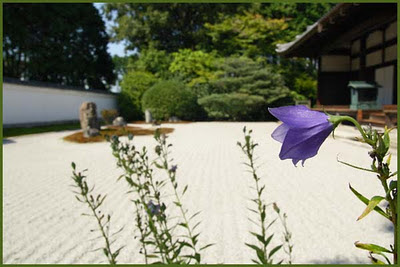
洛中に桔梗の花が三日咲
Rakuchu ni kikyoo no hana ga mikka saki

in central Kyoto
bellflowers boom
three days long

Haifu Yanagidaru Senryu Collection 誹風柳多留

Temple Daikomyo-Ji 大光明寺

:::::::::::::::::::::::::::::::::::::::::::::::::::::::::::::::::::::::::::::::::::::::::::::::::::::

Shimogyo-ku (下京区)
is one of the eleven wards in the city of Kyoto. First established in 1879 as an administrativev unit, it has been merged and split, and took on its present boundaries in 1955, with the establishment of a separate Minami-ku. Kyoto Tower and Kyoto Station are major landmarks in Shimogyo-ku.
Shimogyo-ku has a population of 74,897 and an area of 6.82 km². Three rivers, Horikawa, Kamogawa and Takasegawa, are in the ward.
© More in the WIKIPEDIA !

Kobayashi Issa

下京や闇いうちから花の春
shimogyô ya kurai uchi kara hana no haru

Shimogyo Town–
in the dark before dawn
spring blossoms

. . . . .

下京の窓かぞへけり春の暮
shimogyô no mado kazoe keri haru no kure

counting the windows
of Shimogyo Town…
spring dusk

Tr. David Lanoue

:::::::::::::::::::::::::::::::::::::::::::::::::::::::::::::::::::::::::::::::::::::::::::::::::::::

Bridges 橋 hashi


shijoo oohashi 四条大橋 big bridge at Shijo


gojoo oohashi 五条大橋 big bridge at Gojo

. Ushiwaka-maru and Benkei at Gojo Bridge .

春水や四条五条の橋の下
shunsui ya Shjoo Gojoo no hashi no shita

water of spring –
at Shijo and Gojo
under the bridges

. water in spring, haru no mizu 春の水 .


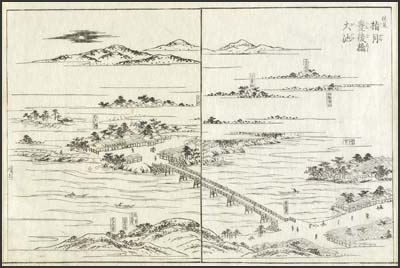
source : www.nichibun.ac.jp/meisyozue

Bungobashi 豊後橋 Bungo-bashi Bridge
now Kangetsukyoo 観月橋 Kangetsu-kyo Bridge in Fushimi ward 伏見, spanning the Yodogawa river 淀川.

This bridge has already been there in the Kamakura period under the name Katsurabashi 桂橋
Ryoogunbashi 両郡橋 or Shigetsubashi 指月橋.  Later it was rebuilt by Toyotomi Hideyoshi at a length of about 200 meters and called Bungobashi. During the Edo period, the pillars were replaced about 18 times.

Yosa Buson

asagiri ya enokoro hitotsu Bungobashi

Misty morning.
The sleeping Bungo-bridge
is crossed by a puppy.
Tr. ? – source Terebess

. Yosa Buson 与謝蕪村 in Edo .

:::::::::::::::::::::::::::::::::::::::::::::::::::::::::::::::::::::::::::::::::::::::::::::::::::::

Oohara 大原 Ohara Kyoto

quote
Ohara is a rural town nestled in the mountains of northern Kyoto, about one hour from Kyoto Station, but still technically located within Kyoto’s city limits. Ohara is best known for Sanzenin Temple and particularly popular in mid November during the autumn leaf season, which typically occurs about one week earlier than in central Kyoto.

source : www.japan-guide.com


by Kitao Shigemasa 北尾重政

Ohara is also famous for the “women from Ohara”, ooharame 大原女, Oharame, who used to carry vegetabels and firewood to the market in Kyoto and make a good living.

observance kigo for late winter

oohara zakone 大原雑魚寝 (おおはらざこね)
sleeping together at Ohara
…. zakone 雑魚寝(ざこね) “group sleep”
“like all kind of fish”, all crowded together on the night before setsubun, February 3 at shrine 江文神社 Ebumi Jinja

This is the night of the zakone in Ohara,when all the people of the village, young and old of both sexes, masters and servants, all are allowed to lie down together and sleep in the Ebumi shrine. It is a kind of vigil before setsubun, a religious custom, and for once no restrictions whatsoever are placed on what the sleepers may venture to do. Many couples found together on this night.
This is based on a legend of a large man-eating snake, which came down to the village when hungry, and the villagers all bundled together to be safe.
But it has been forbidden to do this since the Meiji period.

The custom of zakone is also alive in other temples and shrines in Japan, sometimes during O-Bon in autumn or on the last night of the year.

Kobayashi Issa 一茶

から人と雑魚寝もすらん女かな
karabito to zakone mo suran onna kana

lying down together
with people from China –
these women

Tr. Gabi Greve

………………………………………………………………………

Yosa Buson

にしき木の立聞きもなき雑魚寝かな
nishiki ki no tachigiki mo naku zakone kana

. Yosa Buson 与謝蕪村 in Edo .

………………………………………………………………………

Takada Chooi
(1886−1930)

高田蝶衣雑魚寝布団夢の豺狼越え歩く
zakonebuton yume no sairoo koe-aruku

:::::::::::::::::::::::::::::::::::::::::::::::::::::::::::::::::::::::::::::::::::::::::::::::::::::
The Philosopher’s Path   tetsugaku no michi 哲学の径 / 哲学の道
a pedestrian path that follows a cherry-tree-lined canal in Kyoto, between Ginkaku-ji and Nanzen-ji. The route is so-named because the influential 20th century Japanese philosopher and Kyoto University professor Nishida Kitaro is thought to have used it for daily meditation. It passes a number of temples and shrines such as Hōnen-in, Ōtoyo Shrine, and Eikan-dō Zenrin-ji. It takes about 30 minutes to complete the walk, although many people spend more time visiting the sights along the way. On the norther part of the walk, there are good views of the nearby Daimonji. The walk is a popular destination for tourists and locals, especially during hanami.
© More in the WIKIPEDIA !

Sakiko Fujishima 藤島咲子

はつ冬の哲学の径一詩人
hatsufuyu no tetsugaku no michi ichi shijin

beginning of winter
on Philosopher’s Road
one poet

source : Tr. Fay Aoyagi
© More in the WIKIPEDIA !

Chen-ou Liu
Ajax, Ontario, Canada

東の東山山麓の細い道が、ドイツ・ハイデルベルクの
「哲学者の道」と地形がそっくりともいわれる.

Philosopher’s Walk
a squirrel in the path
looking to and fro

source : haibuntoday.com

………………………………………………………………………

Place name in Sakyo 京都市右京区

. Omuro 御室 .

:::::::::::::::::::::::::::::::::::::::::::::::::::::::::::::::::::::::::::::::::::::::::::::::::::::::


Modern Kyoto in Winter
Tokuriki Tomikichiro (1902-2000)

*****************************

Kobayashi Issa

初夢の不二の山売る都哉
hatsu yume no fuji no yama uru miyako kana

year’s first dream–
Mount Fuji is sold
in Kyoto

Tr. David Lanoue

*****************************
HAIKU

Matsuo Basho, 44 years old (笈の小文)
written at Narumi 鳴海

京までは まだ半空や 雪の雲
Kyoo made wa mada nakazora ya yuki no kumo

until Kyoto
it is just half-way –
clouds with snow

. . . . .


source : suisai-blog.com

Matsuo Basho
stayed at Genjuu-An 幻住庵 Genju-An in Shiga in the year Genroku 3 (1690), but had been to a visit in Kyoto.

京にても 京なつかしや 時鳥
Kyoo ni te mo Kyoo natsukashi ya hototogisu

even when in Kyoto
I long for Kyoto –
hototogisu

Tr. Gabi Greve

This haiku has the cut marker YA at the end of line two and the name of the bird, hototogisu, as the last line.
Alternative translations:

Even in Kyoto —
hearing the cuckoo’s cry —
I long for Kyoto.

Tr. Robert Hass

Bird of time –
in Kyoto, pining
for Kyoto.

Tr. Lucien Stryk

. Little Cuckoo, Cuculus poliocephalis,
hototogisu ホトトギス, 時鳥 .

…………………………………………………………………..

. shio ni shi te mo iza kotozuten Miyako-dori .

miyakodori 都鳥 hooded gull
Larus ridibundus. lit. “bird of the capital”
kigo for all winter

…………………………………………………………………..

天秤や京江戸かけて千代の春
. tenbin ya Kyō Edo kakete chiyo no haru .
balancing Kyoto and Edo on a giant scale

MORE – Visiting Kyoto
. Matsuo Basho 松尾芭蕉 – Archives of the WKD .

Paintings about Basho from the Kyoto Museum Collection
京都国立博物館所蔵
source : www.bashouan.com

:::::::::::::::::::::::::::::::::::::::::::::::::::::::::::::::::::::::::::::::::::::::::::::::::::::

Kobayashi Issa, 1816

のらくらや花の都も秋の風
norakura ya hana no miyako mo aki no kaze

loafing around –
even in the capital of blossoms
now autumn wind

Maybe Issa stayed in Edo ?
Issa stayed in Edo not in Kyoto. So I think 花の都 is not necessary to be Kyoto.
Nakamura Sakuo Haiga

. . . . .

行秋やすでに御釈迦は京の空
yuku aki ya sude ni o-shaka wa kyoo no sora

autumn ends–
already the Buddha
fills Kyoto’s sky

or

autumn ends–
already the statue of Buddha Shakamuni
is under the sky of Kyoto

Tr. Gabi Greve

In a prescript to this haiku, Issa alludes to an image of Gautama Buddha being returned to its temple in Kyoto.
Seiryooji 清涼寺 Temple Seiryo-Ji, Shakado 釈迦堂 in Saga, Kyoto, is quite famous for the statue of Gautama Shakyamuni which is about 160 cm high and rather simple in a robe of Indian style of Gandhara Buddhas. It was made in China and had the intestines made of silk inside.

The statue had been shown at the temple Eko-In 回向院 (Ekooin) in Edo in 1810.

More about the temle Seiryoji and haiku . Saga 嵯峨 Spring Festivals .

:::::::::::::::::::::::::::::::::::::::::::::::::::::::::::::::::::::::::::::::::::::::::::::::::::::

Yosa Buson

ほととぎす平安城を筋違(すじかい)に
hototogisu Heianjoo o sujikai ni

this cockoo –
it criss-crosses over
Heiankyo

御火焚や霜うつくしき京の町
ohitaki ya shimo utsukushiki kyoo no machi

bonfire ceremony –
the frost is so beautiful
in the town of Kyoto

. Yosa Buson 与謝蕪村 in Edo .

. Bonfire ceremony (ohotaki 御火焚)

:::::::::::::::::::::::::::::::::::::::::::::::::::::::::::::::::::::::::::::::::::::::::::::::::::::

Kobayashi Issa

京辺や冬篭さへいそがしき
miyakobe ya fuyugomori sae isogashiki

Kyoto people
stay busy outside
all winter long

Tr. Chris Drake

This hokku was written in the 11th month (December) of 1816, when Issa had left his hometown for a while and traveled back to Edo to see poets there. The difference between his hometown and Edo must have been extreme in winter. In Edo people went outside and kept busy during the whole winter, unlike the home confinement people experienced during much of the winter in the snow country, in which Issa’s hometown was located. In this hokku, however, Issa evokes not Edo, the location of the shogun’s castle and actual center of power in Japan, but the ancient capital of Kyoto, nominally the capital though the “reigning” emperor or empress was merely a figurehead. Perhaps Issa focuses on Kyoto because even more important annual events were scheduled there than in busy Edo.

In addition to being the site of a diligent court that continuously carried out empty rituals, Kyoto had hundreds of Buddhist temples, many of them the head temple of their school, and perhaps even more Shinto shrines. Numerous important ceremonies, festivals, performances, and events took place there every single day throughout the winter, and Kyoto’s thriving economy also continued to operate at a rapid pace. To speak of “winter confinement” in Kyoto is a contradiction in terms, and the phrase was used there and in the other larger cities of Issa’s time mainly as an elegant euphemism for staying indoors a bit more in winter.

Chris Drake

. Kobayashi Issa 小林一茶 in Edo .

:::::::::::::::::::::::::::::::::::::::::::::::::::::::::::::::::::::::::::::::::::::::::::::::::::::

plant kigo for early summer

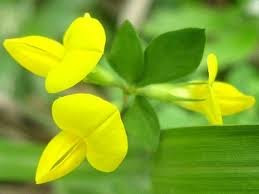
miyakogusa 都草 (みやこぐさ) “capital plant”
It used to grow wild around the capital of Kyoto in the old days.
Now it is found everywhere in Japan. Its yellow flowers look like enchanted butterflies.

Lotus corniculatus is a common flowering plant native to grassland temperate Eurasia and North Africa. The common name is Bird’s-foot Trefoil (or similar, such as “birdsfoot trefoil”), though the common name is often also applied to other members of the genus. It is also known in cultivation in North America as Birdfoot Deervetch.
© More in the WIKIPEDIA !

Books set in Kyoto

A listing of writings about Kyoto

Books set in Kyoto start with the classics…

Murasaki ShikibuThe Tale of Genji (Genji Monogatari) (c.1000-21)
Sei ShonagonThe Pillow Book (Makura no Sōshi) (1002)
Kamo no Chomei An Account of a Ten Foot Square Hut (Hojoki) (1212)
anonŌkagami (the Great Mirror) date unknown
anon – The Tales of the Heike (Heike Monogatari) mid-13th century
Yoshida KenkoEssays in Idleness (Tsurezuregusa) (c.1330-1332)

Also many collections of poetry have originated in Kyoto, three of the most celebrated being:

ed. Ki no Tsurayuki et al Kokinshu (Collection of Old and New) c. 905
anon  Tales of Ise (Ise Monogatari) 10c
ed. Fujiwara TeikaOgura Hyakunin Isshu (One Hundred Poems by One Hundred Poets) (early 13c)

Isabella Bird visited in 1878 and met with Doshisha founder, Niijima Jo amongst others. (Her account is in the original two-volume edition of 1880, not however in the later one-volume paperback.)

Lafcadio Hearn wrote an account of his visit to Kyoto at the time of the 1100th celebration, and seven of his short stories are set in the city.

Amongst modern Japanese classics the following in particular stand out:

Akutagawa Ryunosuke – ‘Rashomon’ (1915)
Ogai Mori – ‘Boat on the River Takase’ (‘Takasebune’) (1916)
Mishima YukioThe Temple of the Golden Pavilion (Kinkakuji) (1956)
Enchi FumikoMasks (Onna men) (1958)
Kawabata YasunariThe Old Capital (Koto) (1962); House of the Sleeping Beauties (Nemureru Bijou) (1961)
Tanizaki JunichiroThe Key (Kagi) (1956); also ‘The Bridge of Dreams’ (in Seven Japanese Tales, 1963)
Kajii Motojiro, – ‘Lemon’, 1924 [see here]

Foreign authors of note include the following:

John Haylock One Hot Summer in Kyoto (1980)
Pico IyerThe Lady and the Monk: Four Seasons in Kyoto (1991); Autumn Light (2019) also touches on Kyoto, though its focus is Nara
Deborah Bollinger BoehmA Zen Romance (1996)
Arthur GoldenMemoirs of a Geisha (1997)
Liza Dalby – The Tale of Murasaki (2000)
David Zoppetti Ichigensan: The Newcomer (2011)
Hans Brinckmann ‘The Tomb in the Kyoto Hills’ (2011)

Foreign poets who have treated the city in their poetry include:

Gary Snyder  – The Back Country, 1968
Cid Corman – various
Harold StewartBy the Old Walls of Kyoto, 1981
Edith Shiffert – various, including Kyoto: The Forest within the Gate,  2014
Margaret ChulaGrinding My Ink, 1994
Robert BradyFurther on this Floating Bridge of Dreams, 1990
Philip WhalenScenes of Life at the Capital, 1970
Robert MacleanWaking to Snow, 2021; Wintermoon, 2022

Walks in Kyoto:

Judith Clancy Exploring Kyoto: On Foot in the Ancient Capital (2008); new ed. Tuttle, 2018
John H. and Phyllis G. Martin Kyoto: 29 Walks in Japan’s Ancient Capital (2014)
Michael Lambe and Ted Taylor ed. Deep Kyoto: Walks (2014)

Kyoto Gardens:

Marc Treib and Ron Herman A Guide to the Gardens of Kyoto (2003)
Thomas Daniell and Akihiko Seki Houses and Gardens of Kyoto (2010)
Judith Clancy and Ben Simmons Kyoto Gardens: Masterworks of the Japanese Gardener’s Art (2015)
Marc Keane et alhttp://kyotogardens.org/
John Dougill and John Einarsen  Zen Gardens and Temples of Kyoto (2017)
Allen S. Weiss Zen Landscapes : Perspectives on Japanese Gardems and Ceramics (2013)

Histories: 

John Dougill  Kyoto: A Cultural History (2006)
Richard Ponsonby-Fane  Kyoto: The Old Capital of Japan, 794-1869 (1956)
Matthew Stavros  Kyoto: An Urban History of Japan’s Premodern Capital (2014)
Herbert E. Plutschow Historical Kyoto (1983)
Fosco MarainiKyoto in the Fifties (1995)

Guidebooks to the city:

Gouverneur Mosher Kyoto: A Contemplative Guide (1964)
Diane Durston  Old Kyoto: A Guide to Traditional Shops, Restaurants and Inns (1986; updated)
Diane Durston Kyoto: Seven Paths to the Heart of the City (1987; 2014)
John H. and Phyllis G. Martin Kyoto: A Cultural Guide to Japan’s Ancient Imperial City (1994)
Christopher Rowthorn Lonely Planet Kyoto (2015)
Judith Clancy Kyoto City of Zen (2012)
John Dougill and Patrick Hochner 100 Kyoto Sights (2020)
Judith Clancy Kyoto Machiya Restaurant Guide (2012)

Other notable works:

Alex KerrAnother Kyoto (2016)
Ivan MorrisThe World of the Shining Prince (1964)
Iwasaki Mineko Geisha of Gion (2002)
Isabel StirlingZen Pioneer: The Life and Works of Ruth Fuller Sasaki (2007)
Matthew Stavros Hojoki (2020) subtitled The Hermit’s Hut as Metaphor
Arthur Golden – Memoirs of a Geisha, 1997

Kyoto sections in larger works

* Fosco Maraini Meeting with Japan (1959)  150 pages, 4 chapters, devoted to Kyoto by a keen observer.
* Isabella Bird  Unbeaten Tracks in Japan (1880) Kyoto chapters are omitted from the modern abridged version. See p.224 of this link.
* George Sansom A History of Japan to 1334 (1958) Large portion is about Kyoto, by a historian who’s a joy to read.
* Nicolas Bouvier The Japan Chronicles tr. Anne Dickerson (1975, tr. 1992)
(see article on Kyoto section by Robert Weis)
* Alex Kerr ‘Three Old Men of Kyoto‘ (Hal Stewart, David Kidd, William Gilbey) in Echoes: Writers in Kyoto Anthology 2017


Literary Kyoto

Kyoto: A Literary Guide (2020) ed. J. Dougill, P. Carty, J. Cronin, I. Higashinaka, M. Lambe and D. McCullough, Camphor Press, 2020

Cycle Kyoto has a four-hour tour of the city to visit places with a literary association. These concern the following authors: Murasaki Shikibu, Sei Shonagon, Matsuo Basho, Tanizaki Junichiro, Kawabata Yasunari, Mishima Yukio, and the Beat poet Gary Snyder.  For details, please click here.

****************

For those who read Japanese, this is a very comprehensive list of everything set in Kyoto. https://ja.wikipedia.org/…/%E4%BA%AC%E9%83%BD%E5%BA%9C…
京都府を舞台とした作品一覧 - Wikipedia
JA.WIKIPEDIA.ORG
京都府を舞台とした作品一覧 – Wikipedia

Other listings

For an overview of the many crime novels set in the city, see this article.

For an exhaustive list of historical novels and mysteries set in Japan in general, scroll down to the Kyoto section at this link.

There’s an eccentric list of books set in Kyoto which looks like it might have been selected by computer here.  Similarly Goodreads has a rather odd listing here.

Film and anime

Wikipedia has a list of films set in Kyoto.

For a listing of recent anime set in Kyoto, see this link. For a description of the top 15 anime set in Kyoto, see this link. For a location map of anime in Japan with a huge cluster set in Kyoto, click on this.

Featured writing

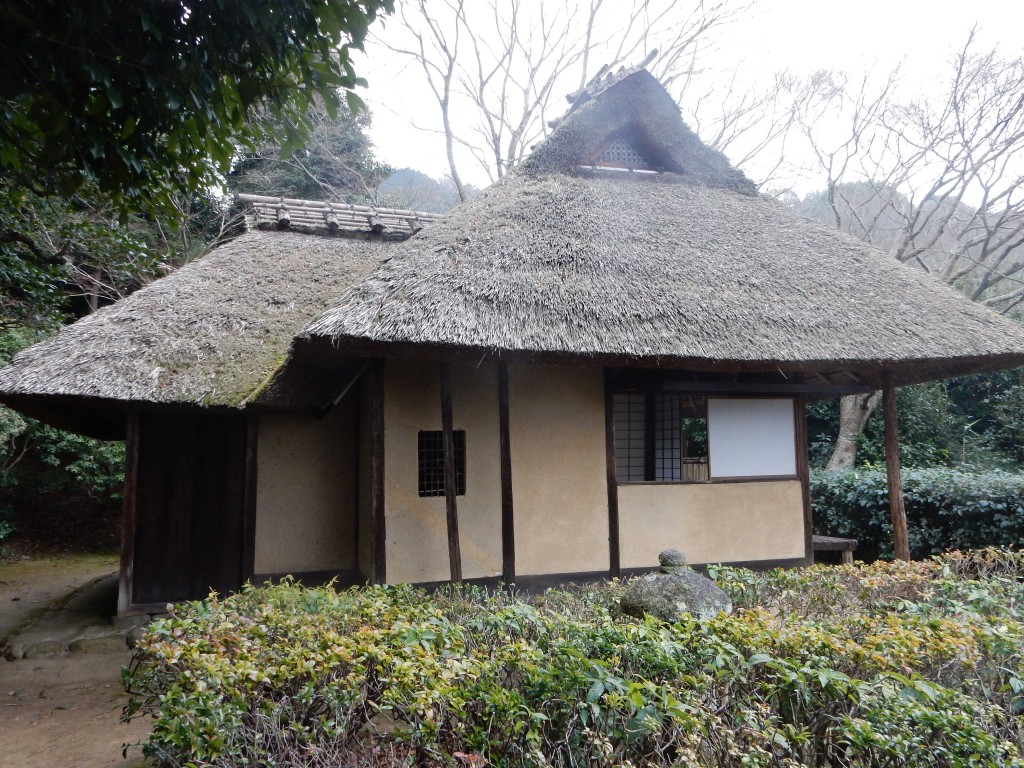
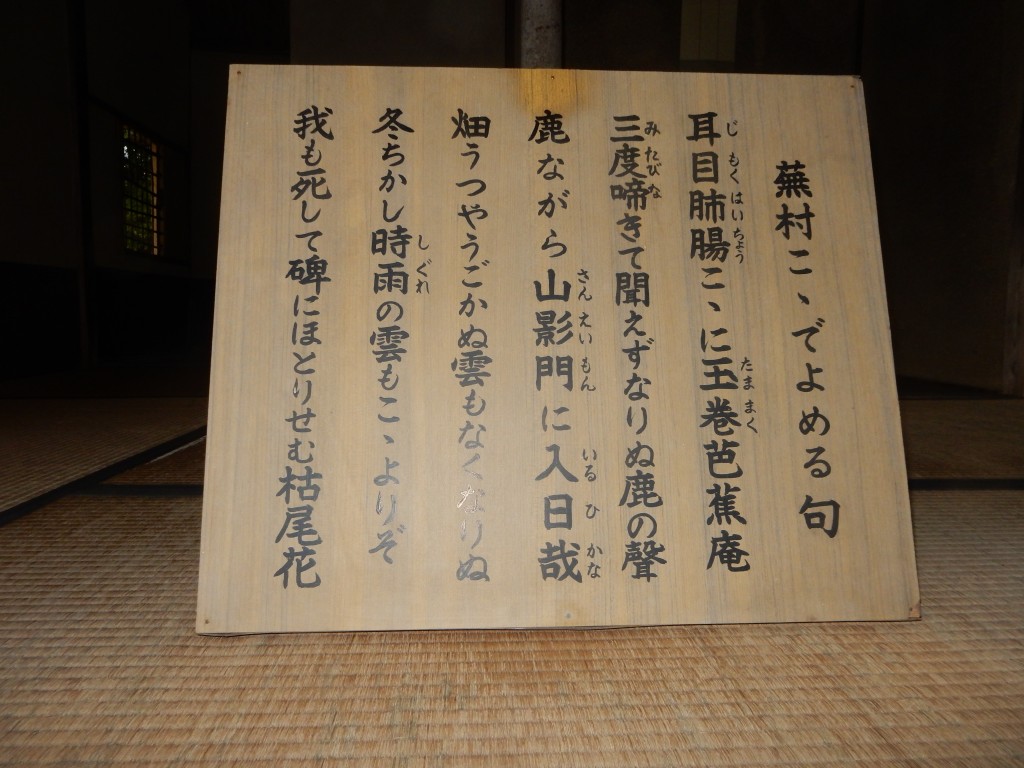
Buson at Basho-an

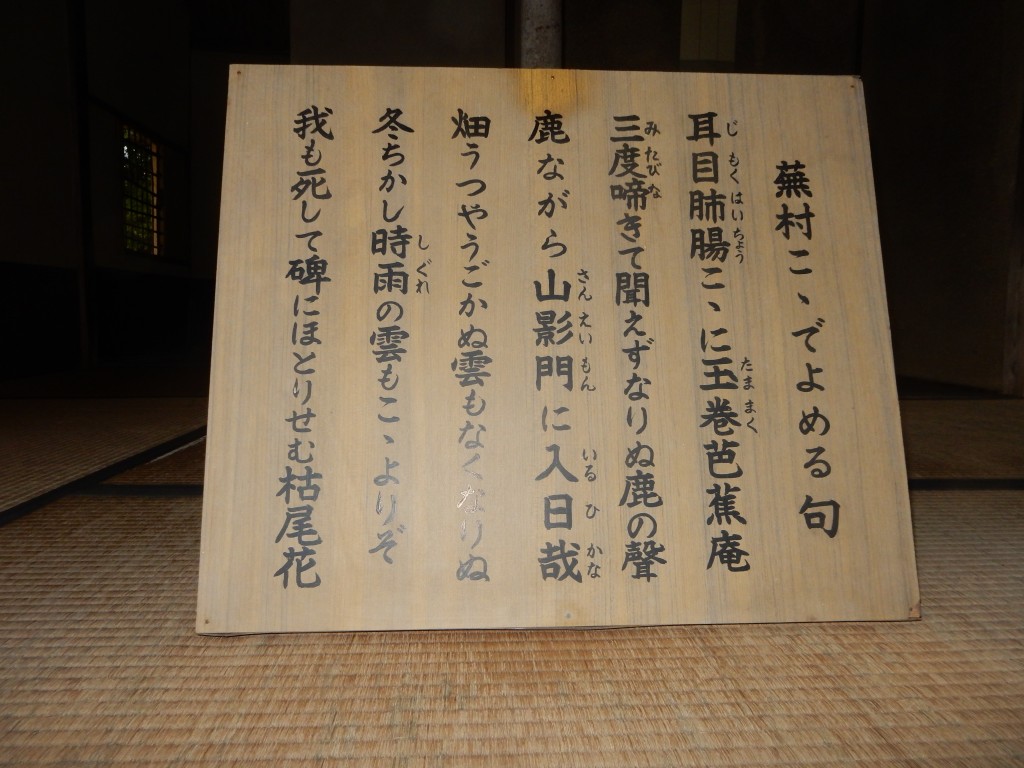
Six Buson haiku written at Basho-an and displayed in the teahouse

Six Buson haiku written at Basho-an and displayed in the teahouse at Konpuku-ji

As you can see from the picture above, the Konpuku-ji temple in north-east Kyoto has recently made efforts to display its haiku connections as best it can.  This includes setting up a board inside the Basho-an hut that Buson restored in honour of his predecessor.  On the board are six haiku which Buson wrote, presumably at the literary events he held here.  I’ve had a go at translating them, but haiku are notoriously ambiguous and it’s impossible to capture all the nuances of the original.  (Thanks to Joe Cronin and Itsuyo Higashinaka for their help.  Any errors are mine and improvements welcomed.  JD)

*********************

ji moku hai chou koko ni tama maku Basho-an

giving our all
as the new leaves appear –
Basho-an

**********************

mitabi nakite kikoezunari nu shika no koe

three times it cried
then couldn’t be heard –
the deer’s voice

Sawa and Shiffert translate this as:

Three times it cried out
but now not heard anymore,
a deer in the rain

**********************

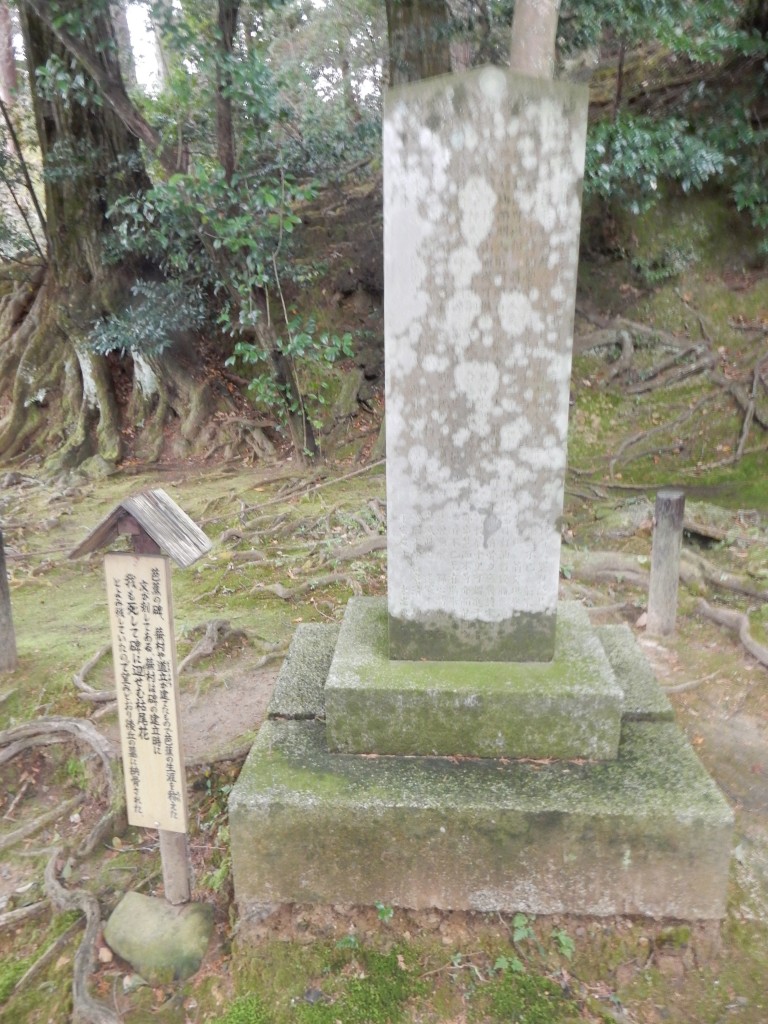
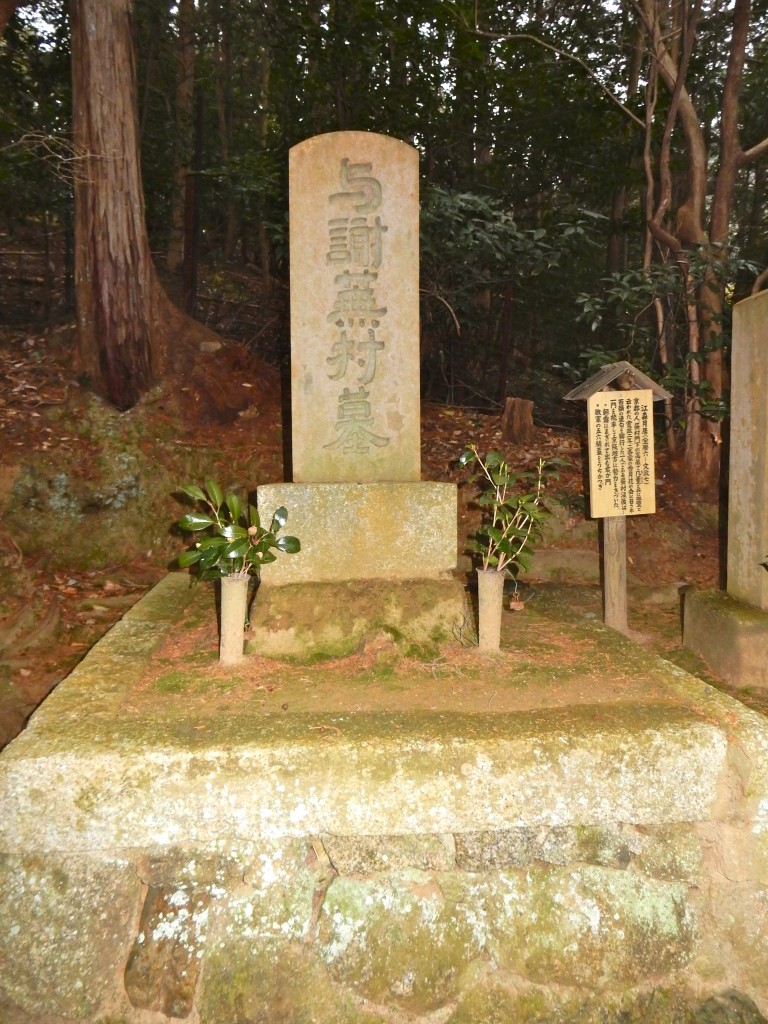
The stone monument Buson erected for Basho next to the Basho-an

The stone monument Buson erected for Basho next to the Basho-an

shika nagara saneimon ni iru hi kana

In the temple gate
deer and mountain shadow together –
the sinking sun

R.H. Blyth translates this as:

.The slanting sun:
The shadow of a hill with a deer on it
….Enters the temple gate.

**********************

hata utsuya ugokanu kumo mo naku nari nu

While working in the fields
the cloud that never moved
disappeared

Sawa and Shiffert translate this as:

Ploughing a field!
Though the clouds did not move
they have gone.

***********************

fuyu chikashi shigure no kumo mo koko yori zo

winter is near –
there’s a rain cloud
rising from here

Sawa and Shiffert translate this as:

Almost winter,
and the cloudiness of a shower
where it begins from.

***********************

ware mo shi shite hi ni hotorisemu kareobana

When I die
bury me close to his monument –
withered pampas grass

Sawa and Shiffer’s translation runs as follows:

I too when dead
want to be near this stone marker –
the withered pampas grass

************************

Click for more about the associations of Basho and Buson with Konpuku-ji.
Reference:  Haiku Master Buson by Yuki Sawa and Edith Shiffert (Heian International, 1978)

The Basho-an that Buson put up on the site where Basho stayed. Buson held literary events at the teahouse, including linked verse collaborations.

The Basho-an at Konpoku-ji that Buson put up on the site where Basho stayed on a slope at the back of the temple. Buson held literary events at the teahouse, including linked verse collaborations.

Writers in focus

Brian Victoria on Zen terrorism

Brian Victoria

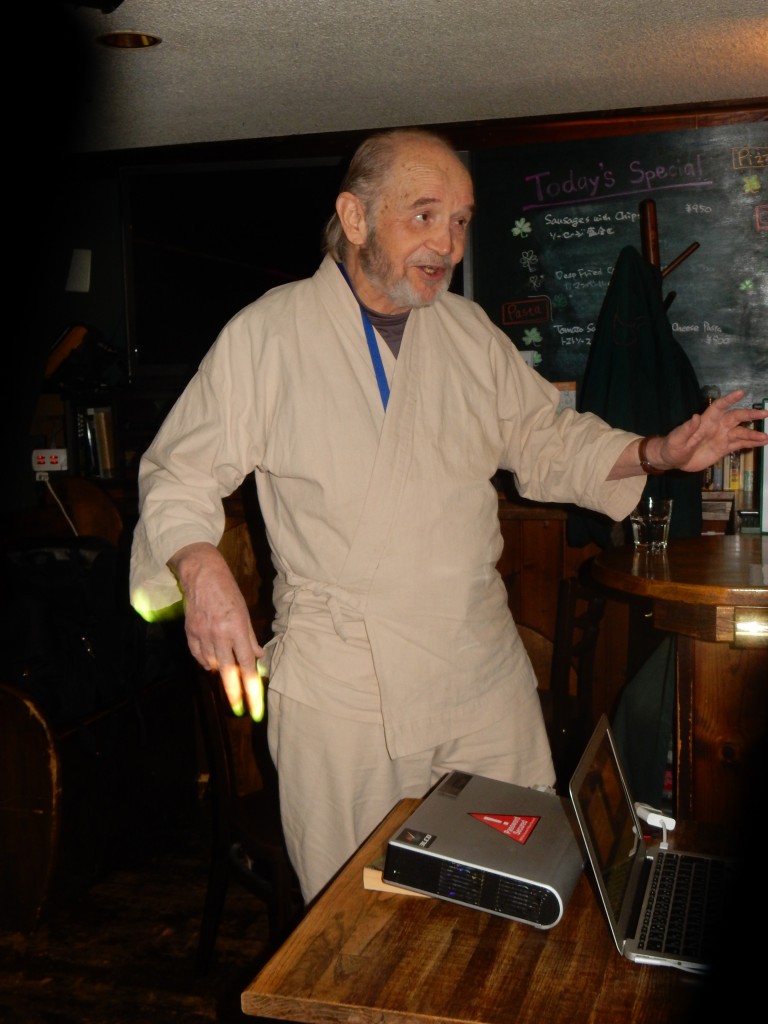
WiK’s February event featured Brian Daizen Victoria, a Soto Zen priest, talking about his current work on Zen and terrorism in the 1930s.  Brian is widely known for his book on Zen at War, first published in 1997 with a new edition in 2006.  It has its own Wikipedia page, and has been influential enough to have prompted apologies by senior Zen figures for the part played by their predecessors in promoting Japanese militarism in WW2.

Born in Nebraska, Brian first came to Japan in 1961 as a short-term missionary for the Methodist Church, teaching at Aoyama Gakuin University in Tokyo. He took this position in order to fulfill his “alternative service duty” as a conscientious objector to military service. Later, he became active in the anti-Vietnam war movement in Japan where he helped to counsel and organize US military personnel stationed at Yokosuka Naval Base opposed to the war.  He obtained a MA from the Soto Zen Komazawa University, then a PhD from Temple University.  He also trained as a priest at the Soto Zen head temple of Eihei-ji, which as anyone who has read Eat Sit Sleep will know ranks among the most severe types of training.

Brian has been a senior lecturer with Adelaide University in Australia, and with Antioch University in the US.  Since 2013 he has been a fellow of the Buddhist Centre in Oxford and a research fellow with Nichibunken in Kyoto.  He has written numerous books on topics related to Buddhism in the years around WW2.  On this occasion he addressed the topic of Zen terrorism in the 1930s, notably the Blood Oath Corps Incident of 1932 (also known as The League of Blood Incident).  What he had to say was eye-opening.

Consideration was given first to the uses of Zen mindfulness and its connection with the samurai.  This went along with a quotation about D.T. Suzuki to the effect that Zen can be applied to anything intuitive.  There was mention too of Nansen’s Cat, a shocking koan about a Zen master cleaving a cat in two apparently out of compassion.  The conclusion seemed to be that mindfulness is a powerful tool that can be applied to virtually anything – as the events of 1932 showed.

Brian then outlined how a group of assassins were masterminded by a Zen trained layman named Inoue Nissho.  His denomination is disputed, because he’s often described as a Nichiren follower though Brian insisted he was an independent under the influence of Zen.  The conspiracy was intended to do away with 20 people supposedly leading the country in the wrong direction.  In the event only two were killed (in the first wave) – both high ranking financiers.

At the trial that followed the assassinations, Inoue was defended by one of the most senior Zen figures in Japan – Yamamoto Gempei, a Rinzai Zen master at Ryutaku-ji founded by Hakuin.  Brian had translated his testimony which he put up on a screen for us to consider.  The argument rested on the nebulous notion of murder by a person with selfish motives being evil, whereas murder by someone with a pure mind was justifiable.  Pure in this case meant without self-interest, i.e. for the good of the community rather than for one’s own benefit.  Some of the thinking was ominous, some of it convoluted, and some blood-chilling.

Perfect wisdom is like a mirror that reflects humans, heaven, earth, and the universe.  Inoue further realized that the true form of humans, heaven, earth and the universe is no different than the true form of the self.  The manifestation of this truth of the universe is the Spirit of Japan, that is to say, the polity of Japan.  It is in these things that Inoue’s spirit is to be found…  It is true that if motivated by an evil mind, someone should kill so much as a single ant, as many as one hundred and thirty six hells await that person…. The Buddha, being absolute, has stated that when there are those who destroy social harmony and injure the polity of the state, then even if they are called good men killing them is not a crime.

The justification for murder here rests, ironically, on the nature of self-sacrifice and acting for the good of others.  In this case the assassinations were intended to benefit the Japanese as a nation and allegedly committed out of compassion for them.  But surely, one might well think, the actions were totally outside Buddhist morality and the Eightfold Path?  It was a question Brian had obviously thought deeply about and on which he had a lot to say…  but with time running out, it was decided to keep it for another day (possibly with the showing of a Dutch documentary of Zen and War about European and Japanese reactions to the book).

For the moment Brian’s conclusion seemed to be that the involvement of religion with the state led to unfortunate results.  Religion can be an enabling mechanism (but not a cause) of terrorism – as seen currently in the Middle East, for instance.  In Japan’s case there had been an overreaction to the Meiji Restoration adoption of Shinto as a state religion, when Buddhism was attacked in the haibutsu kishaku movement (abolish Buddhism and destroy Shakyamuni).  To overcome the suspicion of a ‘foreign religion’, some Japanese Buddhists had adopted a superpatriotic way of thinking that spilled over into fanaticism and violence.

***************************

For Brian’s latest article on a visit by the Hitler Jugend to Eihei-ji in 1940, together with his thoughts on the ramifications, please click here.


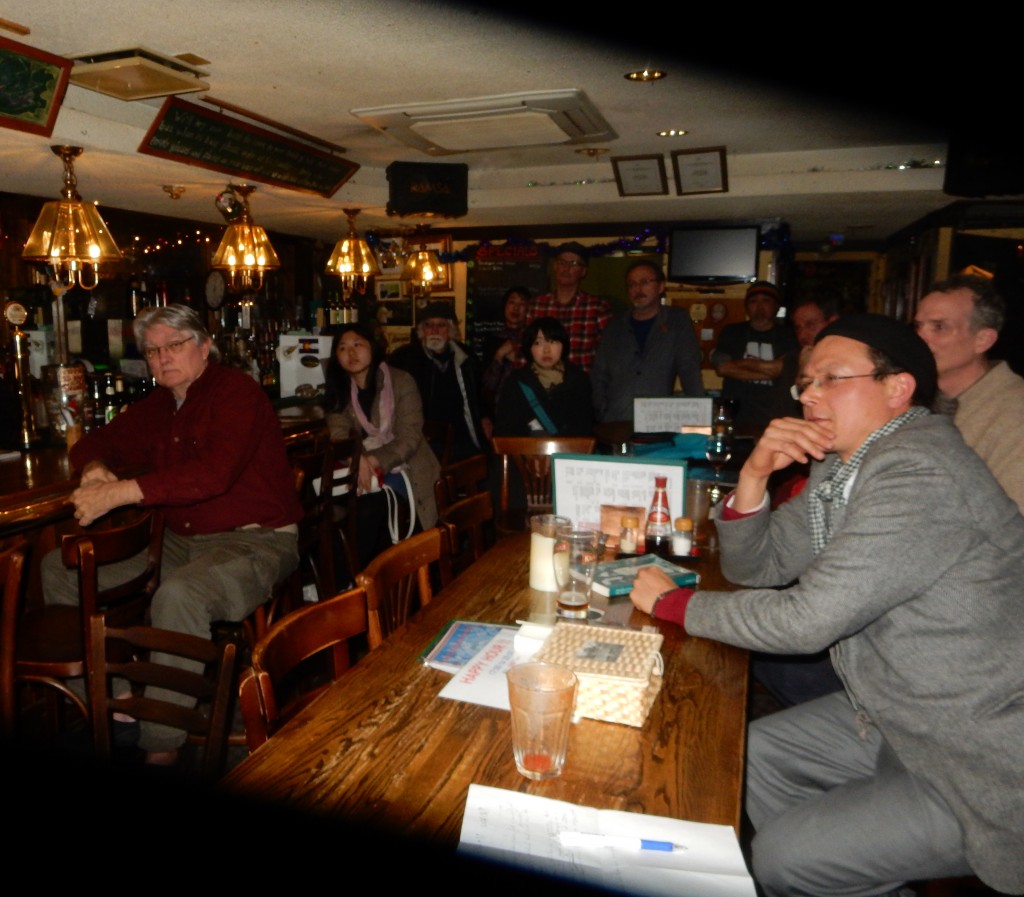
Audience at Brian Victoria

Writers in focus

Buson on Kyoto

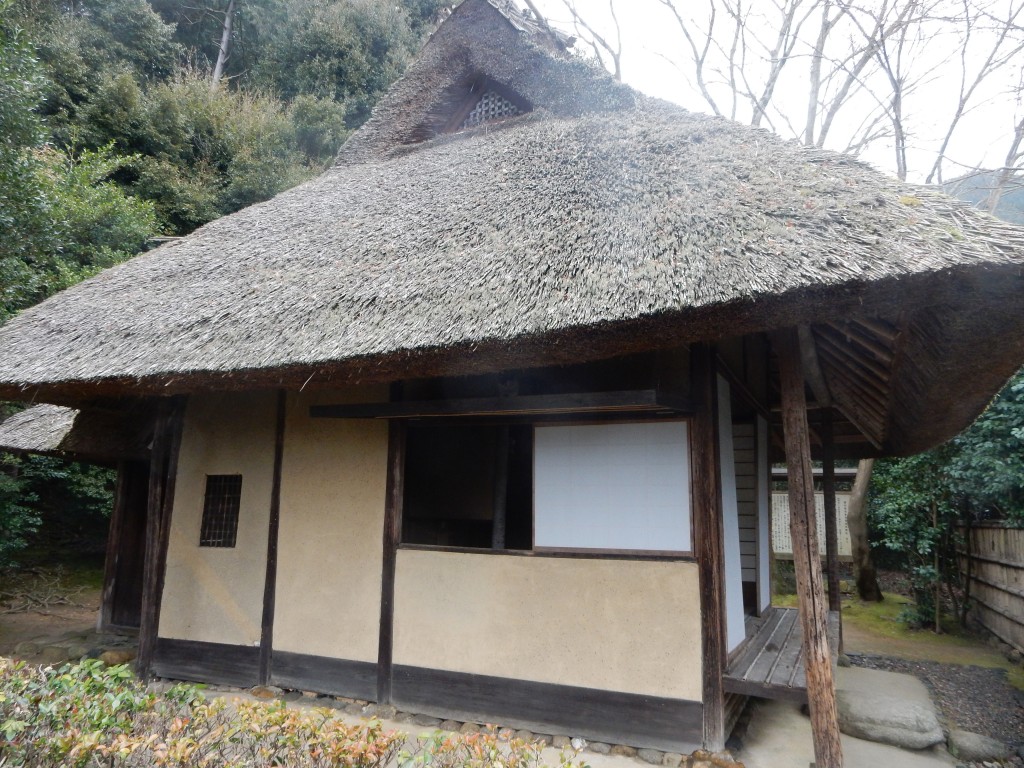
Basho-an, the hut at Konpuku-ji that Buson built in honour of his predecessor

Basho-an, the hut at Konpuku-ji that Buson (re-)built in honour of his predecessor who stayed at the temple

The well-known haiku poet Yosa Buson (1716-84) ranks among the finest of Kyoto’s literary figures.  Born in what is now Osaka, he moved to Edo and studied poetry.  After years of moving around, including following the footsteps of Basho to The Deep North, he settled in Kyoto at the age of 42 and took the name of Yosa (after his mother’s birthplace in Tango).  He married at 45, had a daughter and made a career as a successful painter as well as teaching poetry.  In 1776 he tracked down the Basho-an where the poet had briefly stayed nearly a hundred years earlier, and rebuilt it as a teahouse where he held poetry gatherings.  It stands still on an incline at the back of Konpuku-ji, a Zen temple in north-east Kyoto (near Shisendo).  Near it is a well said to have been used by Basho and a stone monument that Buson erected bearing poems by his predecessor.  The artist-poet wrote a haibun about the restoration (translated in Yuki Sawa and Edith Shiffert Haiku Master Buson), and he was so enamoured of the place that he wrote:

When dead let me lie
Near the Basho monument –
Withered pampas grass

Buson’s grave lies just above the Basho-an, surrounded by the graves of several of his followers.  With its panorama and natural surrounds, it provides a fitting setting for reflection on the nature of haiku and Buson’s poetry in particular.  Ars longa vita brevis.

“He always loved Kyoto’s beautiful landscapes and never forgot to view cherry blossoms and the red maple leaves of the eastern suburbs and western mountains.” (taken from Yuki Sawa and Edith Shiffert’s Haiku Master Buson Heian International, 1978)

Ganjitsu futsuka kyo no sumizumi kasumikeri

New Year’s Day
and on the day after,
fog from place to place in Kyoto.   (tr. Sawa and Shiffert in Haiku Master Buson)

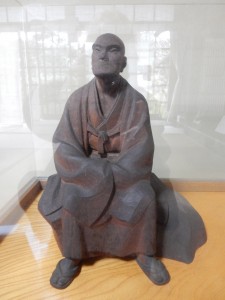
Statue of Buson exhibited at Konpuku-ji


At Basho-an

Fuyu chikashi shigure no kumo mo koko yori zo

Almost winter,
and the cloudiness of a shower
where it begins from  (tr. Sawa and Shiffert)


hana ni kurenu waga sumu kyo ni kaen’nan

Darkness on the blossoms –
back to Kyoto where I live
now I will return      (tr Sawa and Shiffert)


(Daimonji ya tanima no tsutsuji moen tosu)

Daimonji –
Azaleas in the dale
Just about to blaze


Amid white plum blossom
night turns to dawn –
the time has come.

(written when dying)


黄昏や萩にいたちの高台寺

Kodaiji temple;
A weasel in the bush clover
at dusk.        (Tr. Blyth)


kyou no mizu no ai yori idete kakitsubata

From Kyoto’s
Indigo water born –
Irises in bloom


nawashiro ya Kurama no sakura chirinikeri

Beds of young rice plants –
Mt Kurama’s cherry blossoms
have all fallen off

(tr. Sawa and Shiffert)


hottotogisu Heianjo o sujikaini

Hototogisu
over the Heian castle town
flying aslant.

(tr Sawa and Shiffert)


水仙や寒き都のここかしこ (1777)
suisenya samuki miyako no kokokashiko

Daffodils –
In the capital cold
Here and there

(tr. Saito and Nelson)


水鳥や提灯遠き西の京  (1769)
mizudori ya chouchin tooki nishi no kyou

Waterfowl –
Lanterns, distant
Westerly Kyoto

(tr. Saito and Nelson)


The selection that follows is courtesy of Gabi Greve from her Buson page … (tr. Greve unless otherwise stated)

すゞしさや都を竪にながれ川  (1768)
suzushisa ya miyako o tatsu ni nagaregawa

splitting Kyoto
with its coolness –
the Kamo River  (tr Dougill and Higashinaka)

Six haiku written by Buson at the Basho-an


遅き日や谺聞ゆる京の隅
osoki hi ya kodama kikoyuru kyoo no sumi

The slow day;
Echoes heard
In a corner of Kyoto.


みじか夜や暁早き京はづれ
mijika yo ya akatsuki hayaki Kyoo hazure

on these short nights
up early at dawn
in Kyoto’s outskirts

(tr Dougill and Higashinaka)


shira-ume ya Kitano no chaya ni sumahi-tori

The white blossoming plum
at the Kitano tea shop
a sumo wrestler


haru no mizu ni utata u nawa no keiko kana

How serious the training
of cormorants with ropes
on the water in Spring!


tenzoo no niwa no kogiku ya ginkakuji (1777)

the small chrysanthemum flowers
in the garden of the temple cook –
Silver Pavillion


Buson's grave

Buson, R.I.P.   The grave at Konpuku-ji is set at the edge of woods overlooking the city in a site conducive to poetry.


A fire festival –
Beautiful in the frost
In Kyoto city.      (tr. Saito and Nelson)

ohitakiya shimo utusukushiki kyou no machi  (1769)
御火たきや霜うつくしき京の町


としひとつ積るや雪の小町寺
toshi hitotsu tsumoru ya yuki no komachidera (1773)

Another year
Accumulates — Snow at
Komachi Temple.      (Tr. Nelson/Saito)

Gabi Greve notes: Fudara-Ji 補陀洛寺(小町寺 Komachidera )
. Ono no Komachi 小野 小町 .
c. 825 — c. 900. Waka Poetess and Famous Beauty


The following from Gabi Greve’s Edopedia site, concern kaomise (showing the new faces at Kabuki), though whether it’s the Kyoto kaomise I can’t be certain as there was also kaomise for kabuki groups in Edo.  When Buson was young, he spent time in Edo.  However, the dates given below are from the period after he’d made Kyoto his home.  Moreover, the mention of Higashiyama is clearly indicative of Kyoto…

kaomise no maku ni yahan no arashi kana

Against the theatre curtains
At the season’s start
Blows the midnight tempest.    (Tr. Nelson/Saito)

*******

顔見世やふとんをまくる東山
kaomise ya futon o makuru Higashiyama

********
顔見世や夜着をはなるる妹が許
kaomise ya yogi o hanaruru imo ga gari

********

kaomise ya sude ni ukiyo no meshi jibun
(1776)

A theatrical season, its first day enjoyed–
Already in this world of sadness
Time to eat    (Tr. Nelson/Saito)

********

tabidachi ya kaomise no himo miyuru naru
(1768)

Leaving on a journey–
Lights are seen
The theatrical season begins.   (Tr. Nelson/Sait)

Featured writing

A. J. Dickinson: 3 poems

photothis deep sky sea  

these deep currents
well up
the way below

roiling riding
your waves your curls your shores
your sea our sea this deep sky sea

••••••••••••••••••
first rays

first rays
illuminating
new fresh green
reflections
still
golden
on the pond
in the stream


**************

in the wind     

the temples are far away now
the caves too
in the wind

went in the wind
caressing the earth
with bare feet

seeking knowing
undergoing such stints
in sacred spaces

in the wind
all in the wind

so many lovers
such wonderful secret smiles
skin shining so soft beyond velvet

so many memories
touching feeling each taste
as if yesterday as if last night

in the wind
all in the wind

i’ve lived my life in the wind
went in the wind so young
these years going in the wind too

Himalayas Sierras Appalachians
behind now looking out from
my fourth floor one room walk up

above a noodle factory
backstreet Kyoto canal below
such brief shining beauty

this riot of cherry blossoms
for the heart the eyes the spirit
before rains and wind take them

take all
our white hairs
our longing skin too

in the wind
all in the wind

photo


« Older posts Newer posts »

© 2026 Writers In Kyoto

Based on a theme by Anders NorenUp ↑