Page 65 of 65

Quotations, articles and other items of interest

Walking and Writing

by John Dougill

At the end of March 2015,  I attended a stimulating conference on Coleridge and Contemplation at Notre Dame University. A couple of the sessions were of particular relevance to a theme that has long intrigued me – the connection of writing and creativity. When doing my PhD, I was amazed to learn that Oxford dons of the nineteenth century regularly took afternoon walks of four to five hours through the surrounding countryside. Healthy body, healthy mind for sure, but there’s something more underlying the practice which has to do with what the Romans called ‘solvitor ambulando’ (it is solved by walking). How and why should this arise?

In his talk on ‘Walking, Contemplation, Writing’, Prof Eamonn Wall of the University of Missouri-St. Louis spoke of the formative effect of activities on the human mind.  Nicholas Carr for example in his book The Shallows had demonstrated the deleterious effect of the internet on the way our brain functions, significantly shortening attention span by providing adrenalin rushes for the thrill of the new. The practice of deep reading can be presumed then to shape the brain in other ways, by slowly augmenting what is already there and allowing the imagination room to roam. ‘True enlightenment comes only through contemplation and introspection,’ claims Carr. Walking too can be a form of contemplation, which in turn fosters creativity as evidenced by such notable walkers as Rousseau, Kant, Nietzsche, Thoreau, R.L. Stevenson, Rimbaud, Kerouac – and most famously, Coleridge, Wordsworth and other Romantics.

For Coleridge walking was a primary way of engaging with the world, bringing mind and body into alignment as the pedestrian passes through the surrounding nature. Rather than being disinterested, the walker is immersed in the environment and constantly stimulated by the changing scenery. Moreover, the regular rhythm of the gait induces an almost hypnotic, self-absorbed state conducive to reverie as passing images become fused with the brain’s store of ideas and memories, creating new and liberating patterns of thought. The walking reverie is thus a means of tapping into the fertile realm of semi-consciousness. ‘An author who composes while walking .. is not the slave to other volumes, not swollen with verifications, not weighted with the thought of others,’ writes Frederic Gros in A Philosophy of Walking, before offering this advice: ‘Think while walking, walk while thinking, and let writing be but the light pause, as the body on a walk rests in contemplation of wide open spaces.’

Continue reading

Writers in focus

Amy Chavez, freelance writer and columnist

Amy Chavez will be giving a talk upstairs at Roars Pub on April 19 about being a freelance writer in Japan.  It will mark the official launch of Writers in Kyoto, and in advance of the occasion she kindly told us of her writing career so far.

Could you tell us a little about yourself and your background?

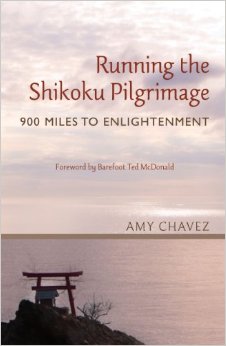
Cover: Running the Shikoku Pilgrimage

I had always wanted to be a writer. In fact, my first submission was when I was 12 years old after my sixth-grade English teacher encouraged me to submit one of my essays to the publication “Stone Soup.” That was also my first rejection. There were hundreds more to come! But I knew I wanted to write professionally, and perhaps because of that early rejection, I knew it wasn’t going to be easy, so I put my dream on hold and concentrated on getting a job where I could make a living. I earned my M.A. in ESL and came to Japan in 1994 to teach at university. I lived in a 6-tatami mat room for four years, used the public bath (sento) and saved money, never forgetting my dream to become a writer.  In 1997 I moved to a small island in the Seto Inland Sea and the following year started writing full time.

What kind of things have you written?

Japan opened doors for me and I was soon writing ‘Japan Lite,’ a weekly column for the Japan Times (18 years now). Other publications

Continue reading

Writers in focus

Introducing John Dougill, non-fiction writer

This week’s featured writer is John Dougill, author of Japanʼs World Heritage Sites (Tuttle, 2014), In Search of Japanʼs Hidden Christians (Tuttle, 2012) and Kyoto: A Cultural History (Signal/OUP, 2004). He also co-authored Shinto Shrines: A Guide to the Sacred Sites of Japan’s Ancient Religion (Uni. of Hawaii Press, 2013).

First, can you tell us a little about yourself?
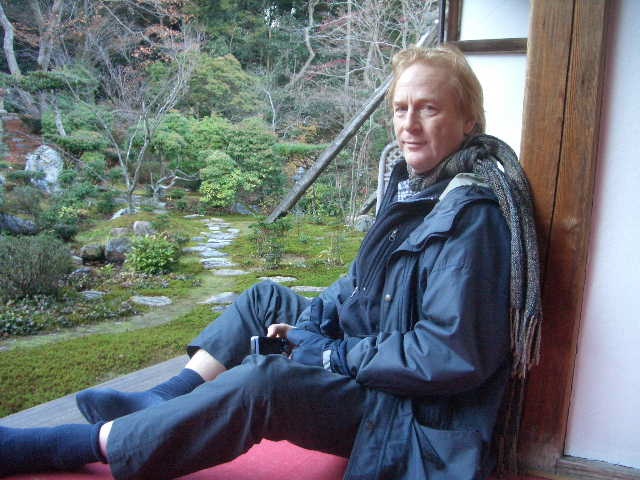
Iʼm British, a baby-boomer and longtime expat. Iʼve lived in Kyoto since 1994 and teach at Ryukoku University. Most of my time is spent writing, walking or playing chess.

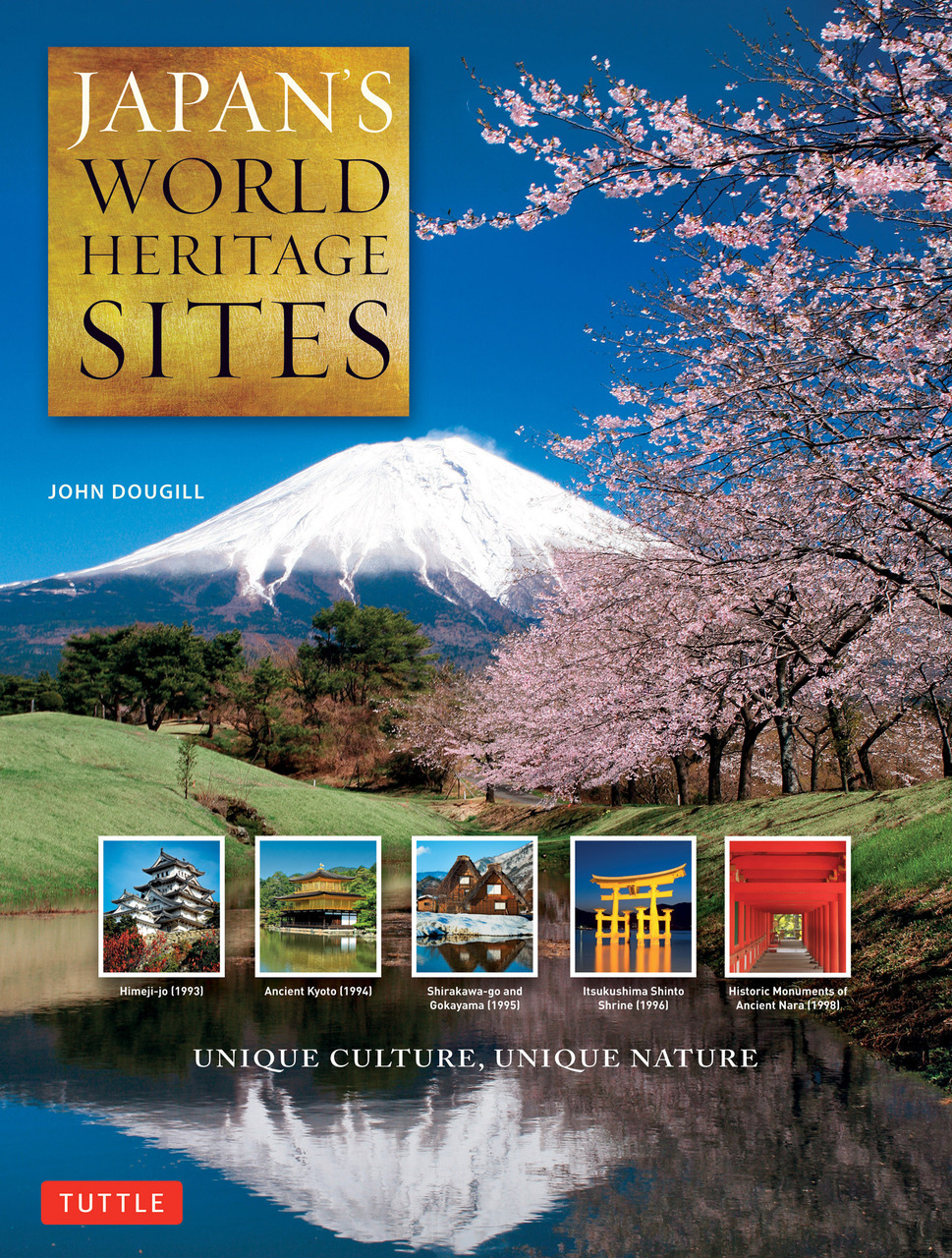
"Japan's World Heritage Sites" by John Dougill

How did you begin writing?
My first experience with publishing was three EFL books back in the 1980s. They were well-received but didn’t make money, which has been the story of my writing life! I also self-published guidebooks to Oxford under my own Oxface Publications label and sold them through seven or eight local outlets. Iʼm proud to say that the most popular, Oxfordʼs Famous Faces, is still going after some twenty-five years.

How many books have you written in all?
It depends what you call ʻa bookʼ, doesn’t it? Some are booklets at best, which take a matter of weeks. My biggest project, Oxford in English Literature (Uni. of Michigan, 1999), took more than seven years and several major headaches!

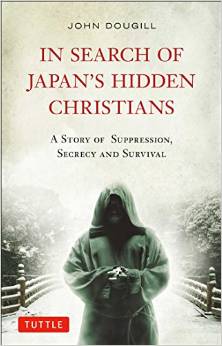
"In Search of Japan's Hidden Christians" by John Dougill

Anyway to answer the question: 3 Oxford guidebooks (one co-authored). 12 Japanese college textbooks and an academic work on British film called Gentleman and Hooligans (Ryukoku Press, 2009). Also 4 books on Japan — Japanʼs World Heritage Sites (Tuttle, 2014), In Search of Japanʼs Hidden Christians (Tuttle, 2012), Kyoto: A Cultural History (Signal/OUP, 2004) and the co-authored Shinto Shrines (Uni. of Hawaii, 2013). Finally, an essay in the e-book anthology Deep Kyoto Walks (2014).

Which are you most proud of?
Undoubtedly Japanʼs World Heritage Sites. It involved travelling the length of the country taking pictures and the finished product far exceeded my expectations. It was the kind of thing I dreamed of when I was young, and to have it come true is a source of great satisfaction.

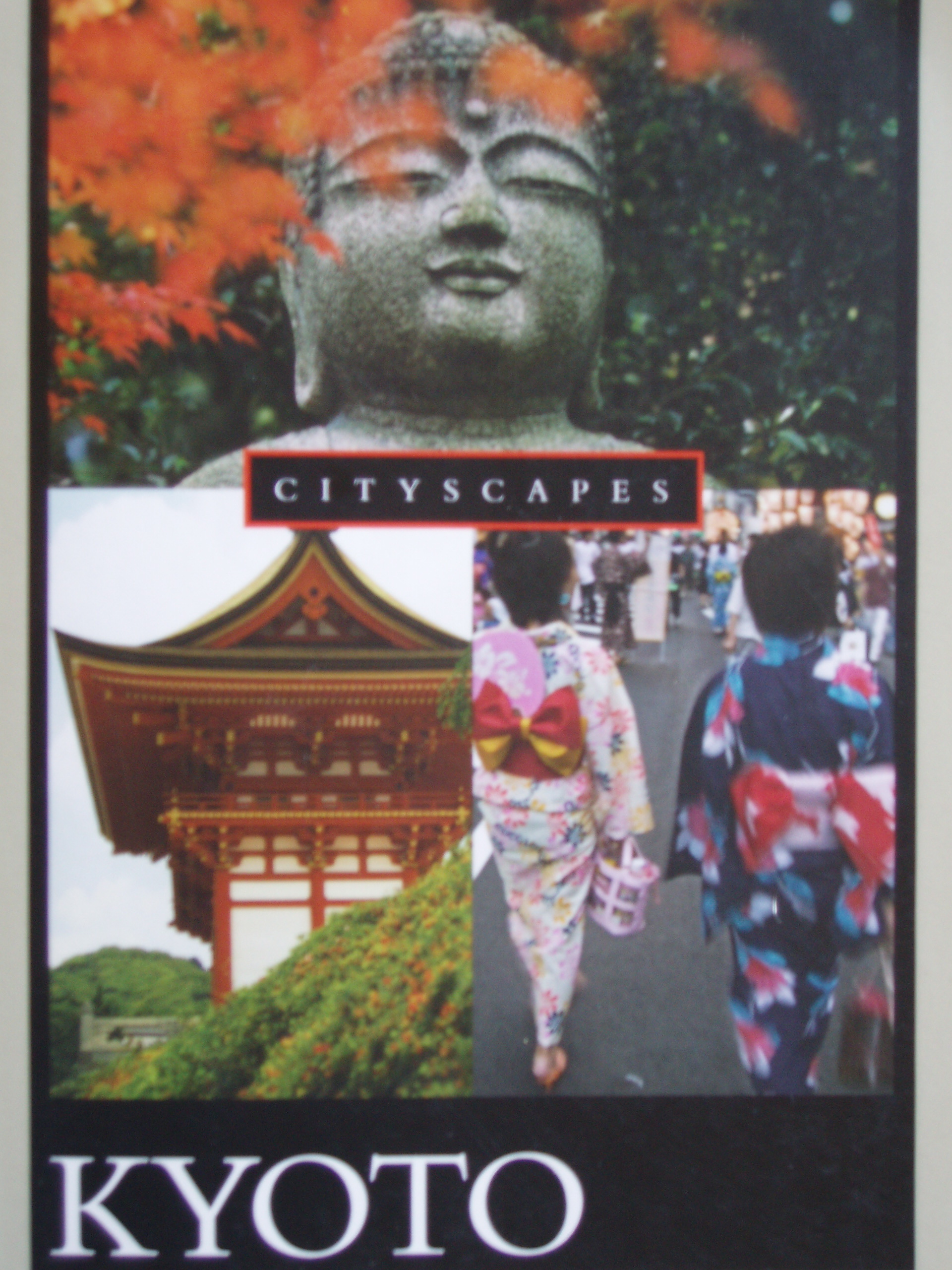
Kyoto: A Cultural History by John Dougill

What are you working on now?
I have two current projects. One concerns travelling around Japan by train, the other is a longterm project about Shinto and shamanism which centres on a journey from Siberia through Manchuria and Korea to Kyushu, where I pick up the Kojiki mythology of ancient times. I also run a blog, Green Shinto, which is in a way more satisfying than any of the books I’ve written because of the feedback. I never envisaged that it would lead me to befriend people from America and Australia. It allows you to control your own material and be creative too. Though Iʼm a computer dunce, I’ve found blogging to be greatly rewarding — even though there are no royalties!

Finally, what makes Kyoto so attractive to writers, do you think?
The history.  The culture.  The access to nature.  Above all, it’s a city of learning with perhaps the highest student to teacher ratio in Japan.  ‘Don’t give up the day job,’ runs the well-known advice to writers, and there are plenty of teaching jobs to provide a steady income while writing on the side.  Teachers have a high status in Japan; being a penniless author doesn’t have much status anywhere!!

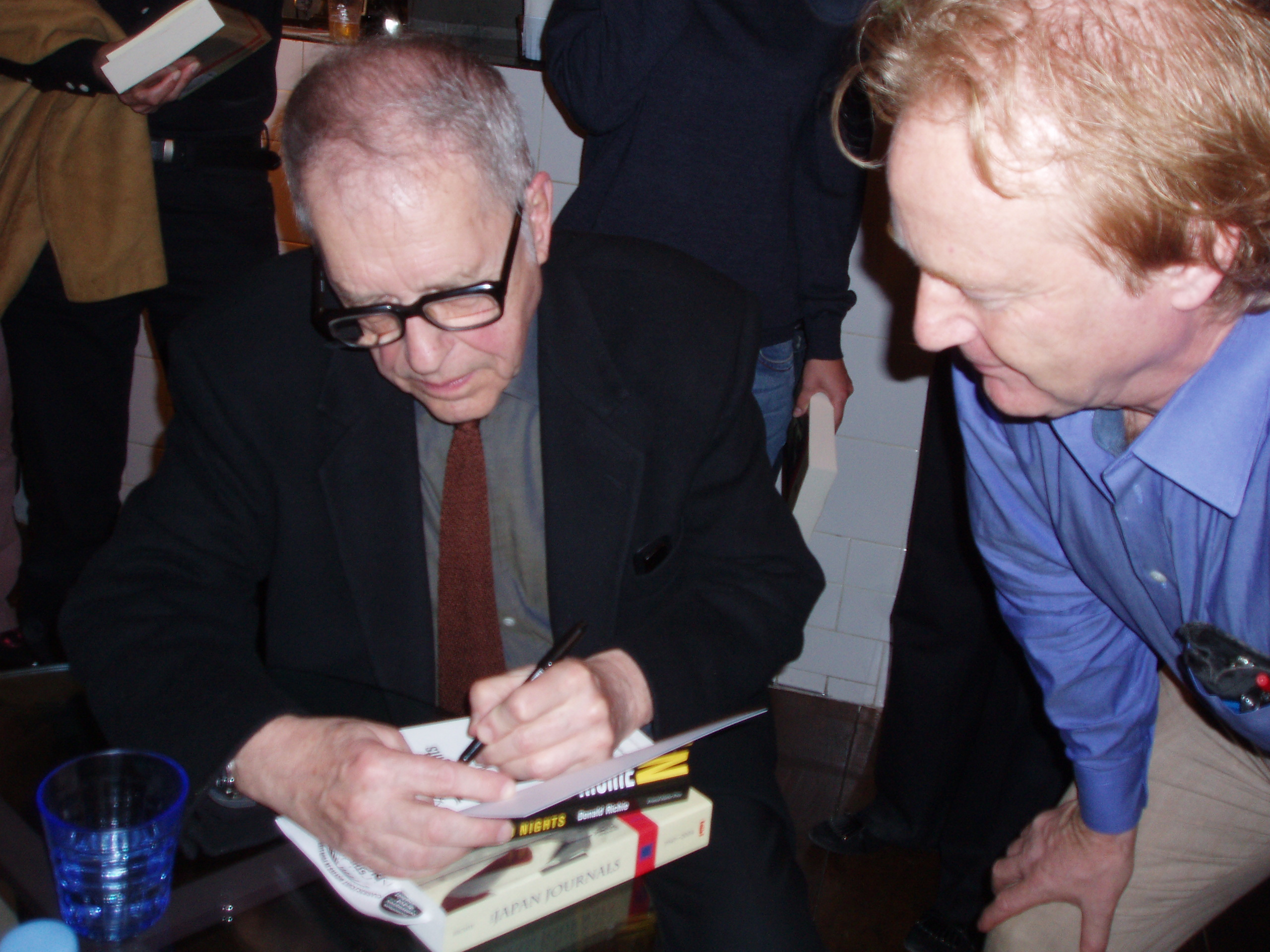
Donald Richie, who wrote the Foreword for Dougill’s book on Kyoto: A Cultural History, signs a copy of his self-published fiction.  No one was more selfless in promoting writers and writing than Richie.

Quotes on writing and reading

Haruki Murakami, when asked recently about what advice he would give to an aspiring writer had an interesting take on the matter.  “The act of writing is the same as sweet-talking a woman, in that you can get better, to an extent, with practice. Fundamentally, though, your abilities are determined by the talents you’ve been born with. Well, anyway, do your best.” (See the full article for more.)  

Featured writing

Excerpt: Pico Iyer’s ‘The Lady and the Monk: Four Seasons in Kyoto’

One evening, I wandered through the ancient geisha quarter of Kyoto as night began to fall over the houses, and life to stir within them.  The crooked, narrow streets were secret in the dusk, but still I could catch snatches from within: laughter from some inner passage, figures outlined in an upstairs window, the whitened face of an apprentice geisha slipping like a ghost into a waiting taxi.

By the time the street led out onto a busy road, it was dark, and I could just make out, in front of me, the entrance to a park.  Inside the giant torii gates, I found myself amidst a carnival of lights like nothing I had ever seen, or dreamed, before.  Families were gathered by the side of a pond, ringed by lanterns, and lamplit stalls were set along their paths.  

Continue reading

Featured writing

Excerpt: Yukio Mishima’s ‘The Temple of the Golden Pavilion’

When the first B-29s attacked Tokyo in November of 1944, it was expected that Kyoto would be raided at any time.  It became my secret dream that all Kyoto should be wrapped in flames.  This city was too anxious to preserve its old things just as they were; the multifarious shrines and temples were forgetting the memories of the red-hot ash that had been born from inside.  When I imagined how the Great Battle of Ojin had laid waste this city, I felt that Kyoto had lost part of its beauty from having too long forgotten the unrest of war fires.

Tomorrow the Golden Temple would surely burn down.  That form which had been filling the space would be lost.  Even the bird on top of the temple would be revived like the classical phoenix and soar away.  And the Golden Temple itself, which had until then been constrained by its form, would be freed from all rules and would drift lightly here and there, scattering a faint light on the lake and on the waters of the dark sea.

Newer posts »

© 2026 Writers In Kyoto

Based on a theme by Anders NorenUp ↑