Page 64 of 65

Featured writing

Gary Snyder on May

The Back Country (1968) by Gary Snyder is an autobiographical collection of poems, covering his youth when he worked as a logger and forest ranger, followed by poems written between 1956 and 1964 in Japan and India, then a section on his return to the USA where he considers the West through Asian eyes.  The title of the book refers on one level to the wilderness of which he writes, but also to so-called ‘backward’ countries and the ‘back country’ of the mind in which the unconscious resides.

The collection contains a series of poems covering a year in Japan, mostly Kyoto.  Here he writes of climbing Mt Hiei and looking over Biwako (Lute Lake)…

May

Sitting and resting on the crest, looking far
out over Yokkawa
to a corner of Ohara –
Sugi and fir and maple on the half-logged hill

A delicate little hawk floats up
hunting delicate little country mice to eat.   Lute
Lake; the noble Sugi – a tree as great as Redwood, Douglas
Fir, Sequoia, Red Cedar, Sugar Pine.

(To hell with all these cultures – history
after the Jurassic is a bore.   Sugi like Sequoia;
Hinoki like a cedar)

Light wind, warm May sun & old woman bundling
brush by the trail –
men planing beams in a cool tin-roof shed
for the new Shaka-do – fine double-edged saws
hand worn brush-hooks
battered jikatabi, funny breeches, cotton head-things
like the Navajo –
relit cigarette butts, sturdy walkers – hills and trails
of rocks and trees and people.

Quiet grey-wood copper-roofed old temple.    Down
and off into the Ogi village fields, and on along
steep ridges through bamboo brush to Ohara, Jakko-in.
Jizo there with his bug-scare clanker staff

(Night-ride America; thin-lipped waitress whores –)
Featured writing

Gary Snyder Kyoto Journals

The following extracts are taken from Kyoto Journal No. 24, ‘Of All the Wild Sakura’.  They comprise notes from Gary Snyder’s Kyoto journals between March and June 1959. (With thanks to Ken Rodgers.)  Click here for the full Gary Snyder article, which is much longer and has non-Kyoto entries too.

*************************

Monday Rinko-in

Preparing to leave Shokoku-ji and move to the Kitano river valley. The last few days cleaning the little house I’ll rent at Yase, “Eight Sandbars.” Yesterday Petersen and I were out there taking up all the tatami, peering under the floor, shoring up busted boards. Dust everywhere from the road. Yesterday it rained; smoking and sitting on the porch-edge; the white puffs of cloud on the hillsides almost too oriental. Dust and cobwebs, old sake bottles. Today I finished the job, beating the tatami in spots of sun between showers, reading an old Mainichi as I laid them out with bug powder.

Mrs. Ishiguro brought bancha for lunch. No dreams since I got here. The big old Rinko-in tom disappeared. & now a brindled male kitten roams about looking for food and warm spots. The temple family rise at 5:30, dust the shoji, cough and piss and talk — barefooted on chill floors, splashing cold water on the face. Camellia blooms / cherry begins / tombi sails over the hinoki tops slowly, twisting and angling his wide flat tail feathers. Continue reading

Writers in focus

Eric Johnston, on being a news reporter in today’s world

Eric Johnston is a well-known figure from his writings in The Japan Times and his involvement in a wide range of Kansai activities.  He’s used to interviewing people of course, but here WiK reverses the tables and asks him some questions for a change…

What do you write about?
As a full-time reporter based in Osaka, I write primarily about political and social news in the Kansai region, and on certain national news topics. I cover the adventures of Osaka mayor Toru Hashimoto, nuclear power, including the reactors in Fukui prefecture, renewable energy, the U.S. military presence on Okinawa and Okinawan politics, the U.S.-Japan relationship, and various subjects ranging from hate speech to the new state secrets law.

Do you write for other publications?
Very rarely. In the past, I’ve done the odd piece for The Guardian, The Observer, USA Today, Adbusters, the International Herald-Tribune, and any number of magazines in and out of Japan. That includes Kyoto Journal, where I had the honor of serving as chief editor for Fresh Currents, Continue reading

Featured writing

Kathmandu earthquake

The thoughts of Kyoto go out to the people of Kathmandu at this time of tragedy in a poem connecting the two cities by A.J. Dickinson…

here then gone

here
gliding low
over wild duck river

a grey imperial crane
lands stands looks
takes wing again Continue reading

Featured writing

The Flowers of Spring (Kawabata)

Chieko discovered the violets flowering on the trunk of the old maple tree. ‘Ah. They’ve bloomed again this year,’ she said as she encountered the gentleness of spring.

The maple was rather large for such a small garden in the city; the trunk was larger around than Chieko’s waist. But this old tree with its coarse moss-covered bark was not the sort of thing one should compare with a girl’s innocent body.

Continue reading

Writers in focus

David Duff, on women and cats

Could you tell us a few words about your background?
I’m a Scottish-Irish American from Virginia, now 23 years here in Kyoto.  Part-time English teacher, private teaching and at the SDF Air Force Academy in Nara.  Part-time writer and full-time drinker.  Ex-marine, hippy herb salesman and worked for 12 years with NASA on the space shuttle, space telescope and Galileo programs.

When did you start writing?
I began writing when I first arrived in Kyoto in 1992.  I studied East Asian Studies at university, and my ex-wife was from Kyoto.

Continue reading

Writers in focus

WiK launched!

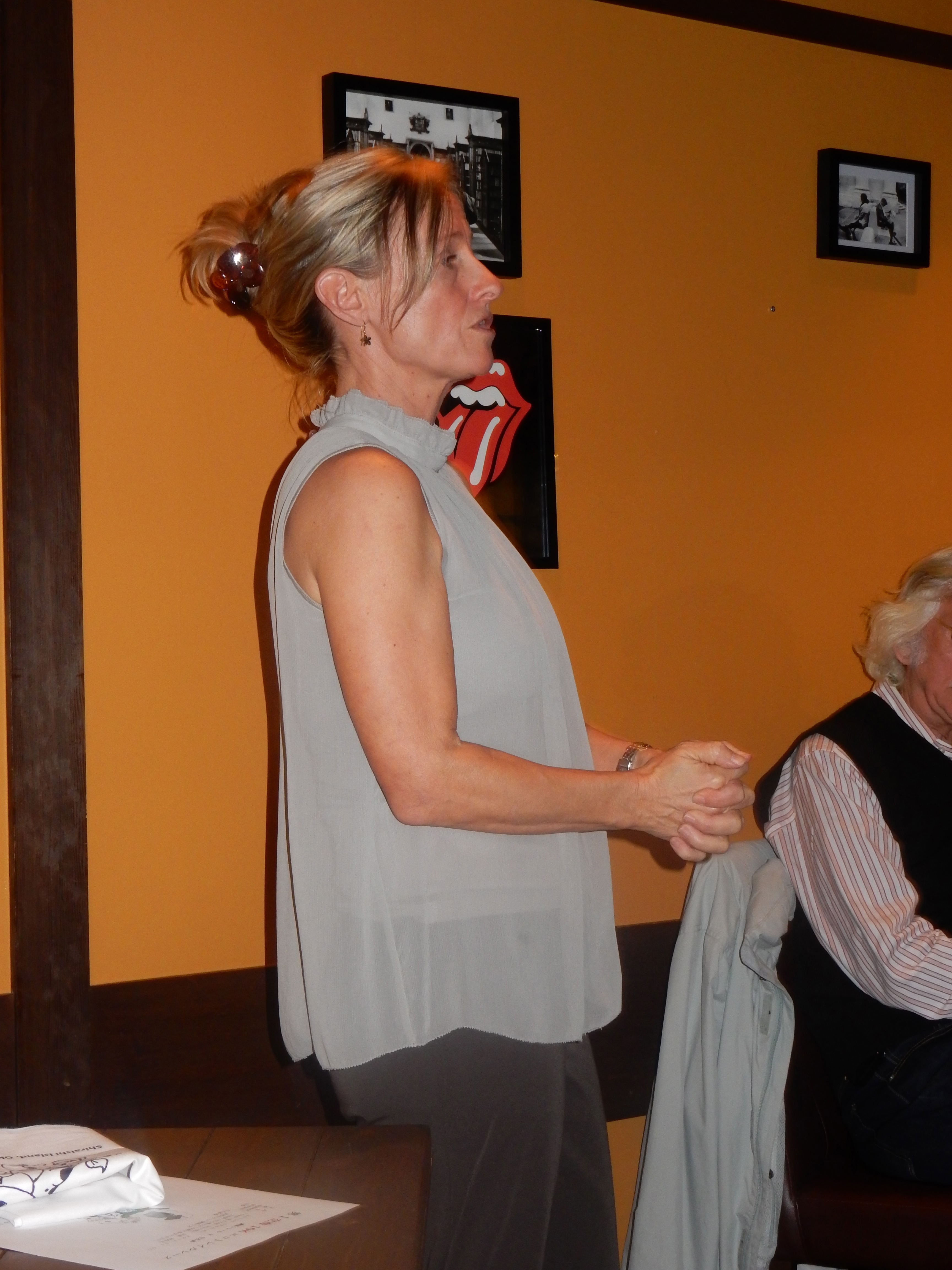
Amy Chavez speaking (for more images of the event, see Photos)
Amy Chavez speaking

WiK is now officially launched after a successful opening event, when about 30 people gathered for a talk by Amy Chavez of Japan Times and Rocket News fame.  She told us about her experiences trying to make a living from writing in Japan, which involved a lot of determination, persistence and sheer luck.  One important lesson was the value of personal contact and appealing to publisher’s particular tastes.  Afterwards there was time for socialising, and it was pleasing to see a lot of networking amongst people who had never met before but were working in related fields.  Writing can be an isolated activity, and one of the main purposes of the group is to bring people together to share information and experience.  We already have more members

Continue reading

Featured writing

Joseph Campbell on creative space

Joseph Campbell came to Kyoto in 1955 and stayed for a while near Nishi Honganji (where he bumped into Kyoto writer, Hal Gold).  His journal was later published as a memoir, Saké and Satori (2002).  Campbell famously said ‘follow your bliss’, and in the passage below he argues that this requires “sacred space” – a space for uninterrupted reflection and unrushed creative work.

Continue reading

Featured writing

Inspirational Kyoto

Australian writer Stephanie Dowrick offers occasional upmarket writing retreats in Kyoto.  What makes her fly halfway round the world to offer a writing workshop?  Here she explains why…

“Kyoto has been described by many as the world’s “most exquisite small city” and it is indeed a gem. Not only is it clean, safe, accessible and vastly rich in temples, shrines, glorious gardens (and quite wonderful, affordable authentic restaurants), it also has an exceptionally strong aesthetic. Everywhere you look there is natural and created beauty to be found, Continue reading

« Older posts Newer posts »

© 2026 Writers In Kyoto

Based on a theme by Anders NorenUp ↑